

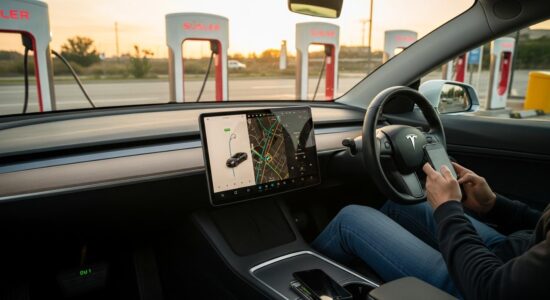
I still remember my first long-distance Tesla trip: heading to the South of France, 800 km ahead of me, and that little knot in my stomach. Would I find charging stations? How much time would I lose charging? Would I break down in the middle of nowhere?
Spoiler: everything went perfectly. Range anxiety is completely normal when you’re not used to it yet, but with the right preparation, a long-distance Tesla trip even becomes more enjoyable than with a combustion car.
In this guide, I’m going to share my proven method for planning your long-distance Tesla trip stress-free. After reading it, you’ll know exactly what to check, what tools to use, and how to optimize your stops to hit the road with peace of mind.
Assess your Tesla’s real-world range before departure
Understand the difference between displayed range and real-world range
The first thing to understand: your Tesla’s real-world range never exactly matches the advertised WLTP figures. On the highway at 130 km/h, you’ll always consume more than in a standardized cycle.
Besoin d'accessoires pour ta Tesla ?
Looking for accessories for your Tesla?
Several factors directly influence your energy consumption: speed, of course (it’s the number one factor), but also outside temperature, wind, your driving style, and even the terrain.
My golden advice: always count on 70-80% of the displayed range to be realistic. For example, if your Model 3 Long Range shows 600 km of range, plan for 420-480 real km in normal highway conditions.
Let’s take a concrete example: Paris-Lyon, about 460 km. With a Model 3 Standard Range Plus (displayed range 430 km), you’ll need a Supercharger stop. With a Long Range, you can technically get there without charging, but I still recommend an intermediate stop for more comfort.
Test your energy consumption on a test drive
Before your first big trip, I strongly recommend doing a short highway test drive. About fifty kilometers are enough to observe your real consumption.
On your Tesla’s screen, you can see your real-time energy consumption in Wh/km. Note this figure: it will serve as a reference for all your future calculations. Generally, on the highway, you’ll be between 160 and 220 Wh/km depending on conditions.
The huge advantage of knowing your own driving style is that you can refine your planning. If you drive rather gently, you’ll consume less. If you’re the pedal-to-the-metal type, you’ll need to allow for larger margins.
Mastering the trip planner integrated into your Tesla
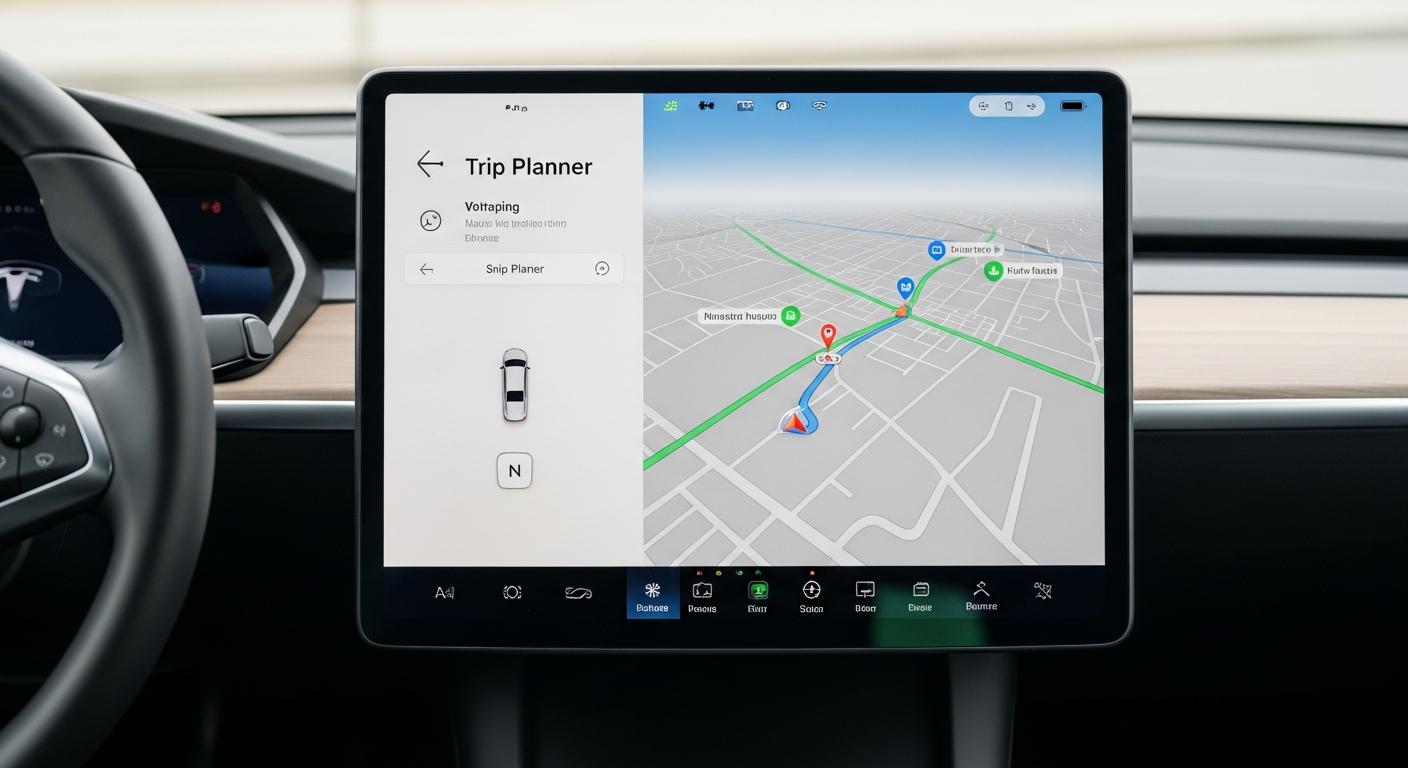
Your Tesla’s integrated trip planner is, without exaggeration, the best tool for preparing your trip. Forget third-party apps to start: the Tesla GPS is more than sufficient.
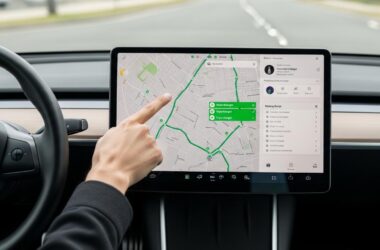
It’s super simple: you enter your final destination, and the car automatically calculates all necessary fast charging stops. For each Supercharger, you’ll see the battery percentage upon arrival, the recommended charging time, and even the estimated arrival time.
What’s great is that the system is much smarter than you think. It takes into account real-time traffic, weather, station occupancy, and even your battery’s temperature. Everything is optimized so you lose as little time as possible.
My personal tip: I always check the route the night before, then on the morning of departure to see if anything has changed. Sometimes, a station is under maintenance or particularly busy, and the trip planner will automatically suggest an alternative.
Advanced option for perfectionists: you can also manually adjust stops by clicking on the route. Handy for avoiding peak hours at certain busy stations, or to synchronize with your own constraints (e.g., lunch break at a specific location).
Optimize your charging stops to save time
The strategy of short and frequent charges
Here’s THE secret for efficient trips: prioritize several short charges (15-20 minutes) rather than a single long charge. It might seem counter-intuitive, but it’s mathematically faster.
Why? Because of the charging curve. From 10% to 80%, charging is ultra-fast (sometimes over 200 kW). But after 80%, it slows down considerably. Going from 80% to 100% can take almost as long as from 10% to 80%.
Besoin d'accessoires pour ta Tesla ?
Looking for accessories for your Tesla?
My typical example: I systematically charge up to a maximum of 60-70%, rarely beyond 80% unless absolutely necessary. A 15-20 minute stop is perfect for going to the restroom, grabbing a coffee, stretching your legs. You don’t lose any ‘extra’ time, and it also helps preserve your battery’s health in the long term.
The idea is to synchronize your natural breaks with charging stops. You would have taken a break anyway, so you might as well use it to recharge.
Choosing the right Superchargers on your route
Not all Superchargers are created equal. My first tip: prioritize stations with many charging points (8, 12, 16 or more). Less risk of waiting, and even if it’s busy, things move quickly.
The Tesla displays real-time availability directly on the navigation screen. You see how many charging points are free even before you arrive. If a station shows full or almost full, the system will automatically suggest an alternative.
Second important criterion: target Superchargers near amenities. Restaurant, service area with shops, shopping center… That makes the break much more pleasant than being stuck in the middle of nowhere.
Tip for busy weekends (holiday departures, long weekend returns…): leave very early in the morning (before 8 AM) or late in the evening (after 8 PM). You’ll avoid peak hours at Superchargers, and you’ll save a lot of time.
Essential apps and tools for the road
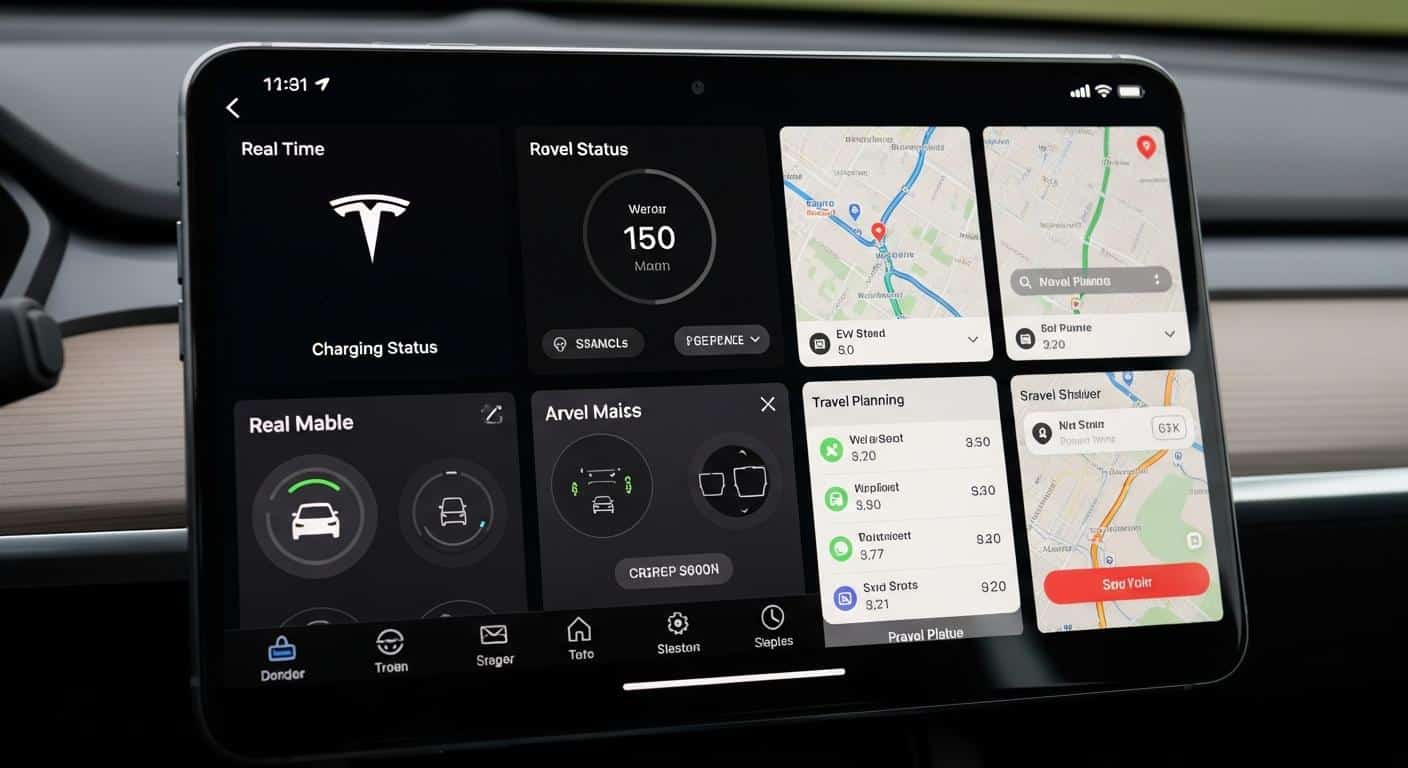
Even if the integrated GPS is excellent, some complementary apps can really help you, especially for your first Tesla road trip.
ABRP (A Better Route Planner) is the app I systematically use to simulate different scenarios before leaving. You can test several routes, play with speed and weather parameters, and see the impact on your energy consumption. It’s free and super comprehensive.
Chargemap is also useful for identifying alternative charging stations outside the Supercharger network. In case of emergency or if you want to go off the beaten path, it can help out. But honestly, for a first trip, stick to Superchargers.
The Tesla app on your phone is essential: it allows you to preheat the battery before arriving at the Supercharger. The car does this automatically when you navigate to a station, but you can also trigger it manually if needed.
Don’t forget to check the weather on your route. Headwinds, intense cold, or heavy rain directly impact range. If you know it will be -10°C, you’ll adjust your planning accordingly.
My personal setup: I really use ABRP and the weather. The rest is just a gadget for me. Chargemap remains installed ‘just in case’, but I’ve never really used it on my long trips.
Last tip: download offline maps to your phone as a backup. If you ever lose connection, you won’t be stuck. It almost never happens, but it’s better to be safe than sorry.
Prepare your Tesla and your equipment for the trip
Before leaving, a few basic checks are essential. Start by checking your tire pressure: it has a direct impact on energy consumption. Under-inflated tires can easily make you lose 5 to 10% of range.
Fill up your windshield washer fluid and check the condition of your wipers. On the highway, you’ll need them, and it’s silly to run out at a rest stop.
Even if you only plan to use Superchargers, I advise you to have a good Type 2 cable in the trunk. For public charging stations in case of emergency or if you want to charge at a hotel. It’s reassuring.
Regarding accessories, a few items really change everything: a good phone charger (you’ll be using Spotify, Waze maybe, ABRP…), a trunk organizer to prevent everything from rolling around, and blankets if you’re traveling in winter. To learn more, I invite you to consult our guide on choosing the right accessories for your long Tesla trips.
My personal checklist before each departure:
- Tire pressure checked
- Battery charged to 100% (for long-distance trips, it’s OK)
- Windshield washer fluid full
- Charging cables in the trunk
- Phone charged, apps updated
- Snacks and water in the car
This last point is important: pack snacks and water to avoid wasting time shopping. Charging breaks are short, no time for shopping.
After several long trips, planning becomes second nature. You don’t even think about it anymore, it’s become automatic. Range is no longer a source of anxiety but simply a variable to manage, like the fuel level in a combustion car (but better, because you recharge while taking a real break).
My advice for your first trip: go for it. Seriously. The first one is the most daunting, then everything becomes natural. The Tesla community is very active and supportive, never hesitate to ask your questions on forums or Facebook groups if you have any doubts.
One last personal tip I love: take advantage of stops to discover places you would never have seen otherwise. A nice village, a viewpoint, a small local restaurant… Charging breaks have made me discover hidden gems I would never have found by foolishly rushing down the highway.
To further your preparation, you can consult our complete guide to planning a Tesla road trip which goes into even more detail depending on seasons and destinations. You can also explore different routes and destinations suitable for electric vehicles for inspiration.
Have you already taken your first long-distance Tesla trip? Share your experience in the comments, it will surely help others who are still hesitant to get started!
Profitez d'avantages exclusifs en achetant votre Tesla
Vous envisagez d'acquérir une Tesla ? En utilisant mon code de parrainage lors de votre achat, vous pouvez bénéficier d'avantages exceptionnels !
Des kilomètres gratuits de recharge ou d'autres récompenses exclusives, mon code de parrainage est votre passeport pour des avantages supplémentaires : https://ts.la/antoine49352 🤩
Pas de pression, juste une opportunité à saisir pour enrichir votre expérience Tesla.
Découvrez ici le système du parrainage et comment utiliser le code.
Get exclusive perks when buying your Tesla
Thinking about getting a Tesla? If you use my referral code when you purchase, you may be eligible for extra perks.
Free Supercharging miles or other exclusive rewards - my referral code can unlock additional benefits: https://ts.la/antoine49352 🤩
No pressure - just a simple option if you want to enhance your Tesla experience.
Learn how the Tesla referral program works and how to use the code.