



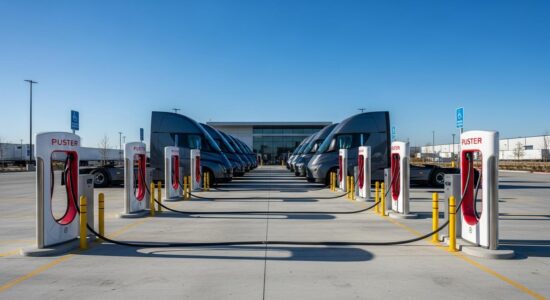
Tesla is no longer content with just selling electric cars. Elon Musk’s company is now structuring the infrastructure for trucks, and that changes everything. The announcement of a strategic partnership with Pilot Travel Centers, the largest network of travel centers in the United States, marks a major turning point. The goal? To deploy ultra-powerful chargers capable of powering the Tesla Semi and all other Class 8 electric heavy-duty trucks.
What fascinates me about this strategy is its scope: Tesla isn’t just building a network for its own vehicles, but laying the foundations for a national infrastructure open to all manufacturers. With charging stations delivering 1.2 megawatts and an opening planned for the summer of 2026, I’ll explain why this agreement could redefine American road logistics, and perhaps inspire Europe.
A game-changing partnership for electric road transport
Pilot Travel Centers is not just any player. We’re talking about the largest operator of travel centers in the United States, with a strategic presence on all major logistics corridors: Interstate 5 along the West Coast, I-10 crossing the country from east to west, and many other vital routes for freight transport.
The agreement initially covers 5 states starting in 2026: California, Georgia, Nevada, New Mexico, and Texas. These are not random choices. These states concentrate the densest logistics flows, where diesel trucks heavily circulate today. By positioning its chargers on these routes, Tesla is directly targeting the heart of the American transportation system.
Besoin d'accessoires pour ta Tesla ?
Looking for accessories for your Tesla?
The timeline is ambitious but realistic. The first sites will be operational by summer 2026, with between 4 and 8 chargers per station depending on local demand. This progressive approach allows for testing, optimizing installations, and then massive deployment once the model is validated.
What I find brilliant about this approach is that Tesla isn’t starting from scratch. By relying on an existing and proven infrastructure – with its restaurants, service stations, and rest areas for truckers – the company accelerates deployment and reassures transporters. No need to change their travel habits, just their refueling method. This premium user experience around charging, like the Tesla Lounge in Dietikon, now applies to the world of professional road transport.
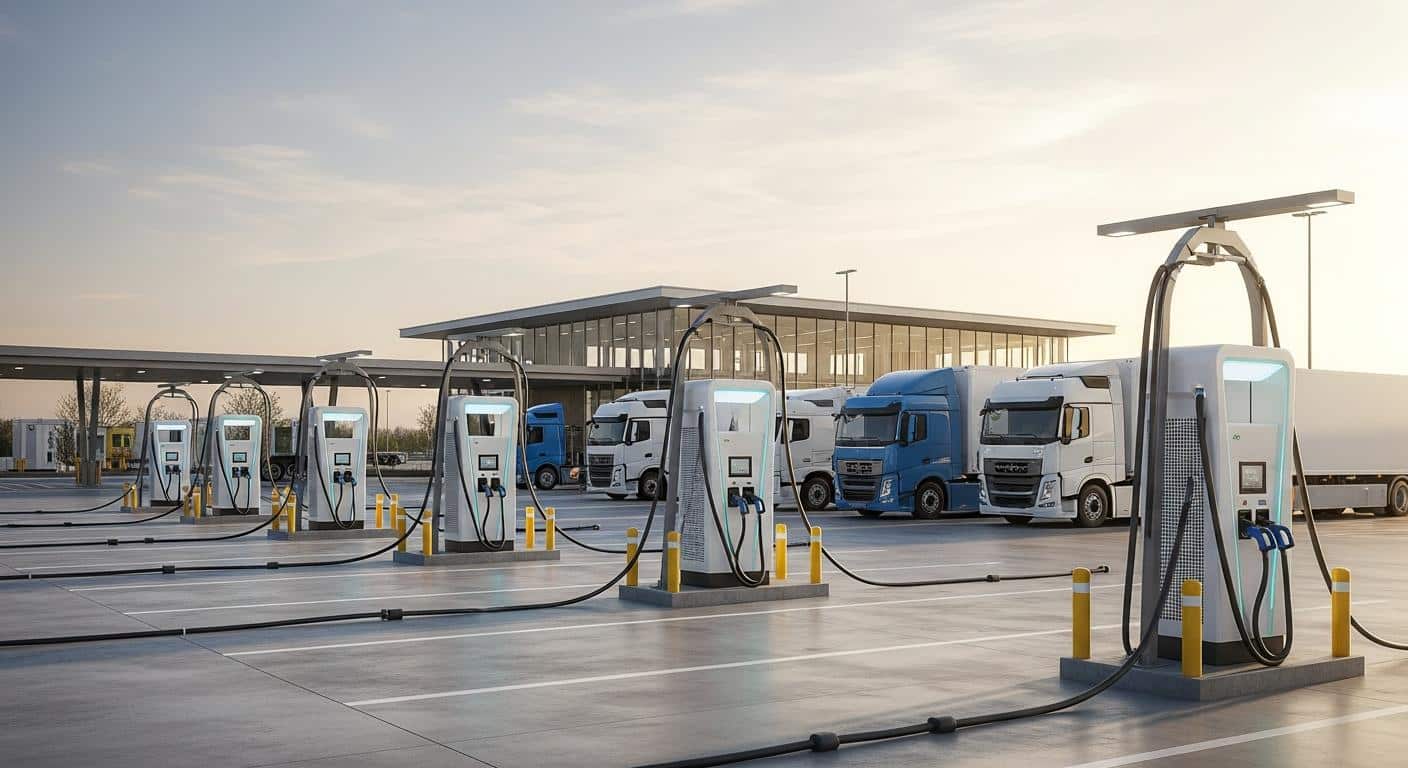
Ultra-powerful chargers open to all manufacturers
Unprecedented charging power for the sector
Let’s talk numbers. Each station will deliver up to 1.2 megawatts of power. To give you an idea of the scale, if I charge my Tesla Model 3 at a classic Supercharger, I get about 250 kW maximum. Here, we’re talking about nearly 5 times that power. It’s colossal, and it’s absolutely necessary.
Why such power? Because electric truck batteries easily exceed 500 kWh, which is 5 to 7 times the capacity of a Tesla Model 3 Long Range. With this infrastructure, a Tesla Semi can recharge sufficiently in less than 30 minutes – exactly the time of a mandatory regulatory break for truck drivers.
These chargers use the Megawatt Charging System (MCS) standard, currently undergoing international standardization. It’s the equivalent of CCS for light vehicles, but adapted to the specific needs of heavy-duty trucks. To optimize charging times through battery preconditioning, the same technological logic as for passenger vehicles applies to Semis, further amplifying efficiency.
An open strategy that surprises
Here’s what really changes the game: these chargers will not be reserved for Tesla Semi. They will be open to all manufacturers of Class 8 electric trucks. Freightliner, Nikola, Volvo Trucks, Daimler… all will be able to use this infrastructure.
This strategy marks a break from Tesla’s initial approach to Superchargers for light vehicles, which remained exclusive for a long time before their gradual opening. Here, Tesla clearly aims to become the reference infrastructure for the entire sector, not just a proprietary network for its own customers.
In Europe, similar standards for electric heavy-duty trucks are starting to emerge, but the infrastructure remains embryonic. Our French highways still have very few stations adapted for electric trucks. Tesla could well inspire European players like Engie, TotalEnergies, or Ionity to massively accelerate their investments. Moreover, as I explained in my guide on using Tesla Superchargers, the experience gained with passenger vehicles naturally translates to heavy-duty trucks, with the necessary power adaptations.
A rapidly expanding network to support the Semi’s ramp-up
This partnership with Pilot Travel Centers is no coincidence. Tesla already has 46 Semi Charger sites under development or planned across the United States. The agreement with Pilot Travel represents a major acceleration of this deployment pace, with much broader and faster geographical coverage.
This infrastructure meets an ambitious goal: Tesla aims to produce 50,000 units of Semi in the medium term. To make this volume commercially viable, a dense infrastructure covering the main logistics corridors is needed. It’s an implacable industrial logic: infrastructure must follow, or even precede, the ramp-up of production.
The feedback from early adopters validates this approach. PepsiCo already operates several dozen Tesla Semis, with millions of miles covered. DHL is also conducting logistics tests in real-world conditions. The data collected confirms sufficient driving range for most regional trips, solid operational reliability, and, above all, significantly lower operating costs than diesel.
What strikes me is that Tesla isn’t launching the Semi into a vacuum. This field feedback validates the concept before massive deployment. It’s a cautious approach, almost counter-intuitive for Tesla, but terribly effective. The company simultaneously builds demand (via pilot customers) and supply (via infrastructure), creating a complete ecosystem before scaling up.
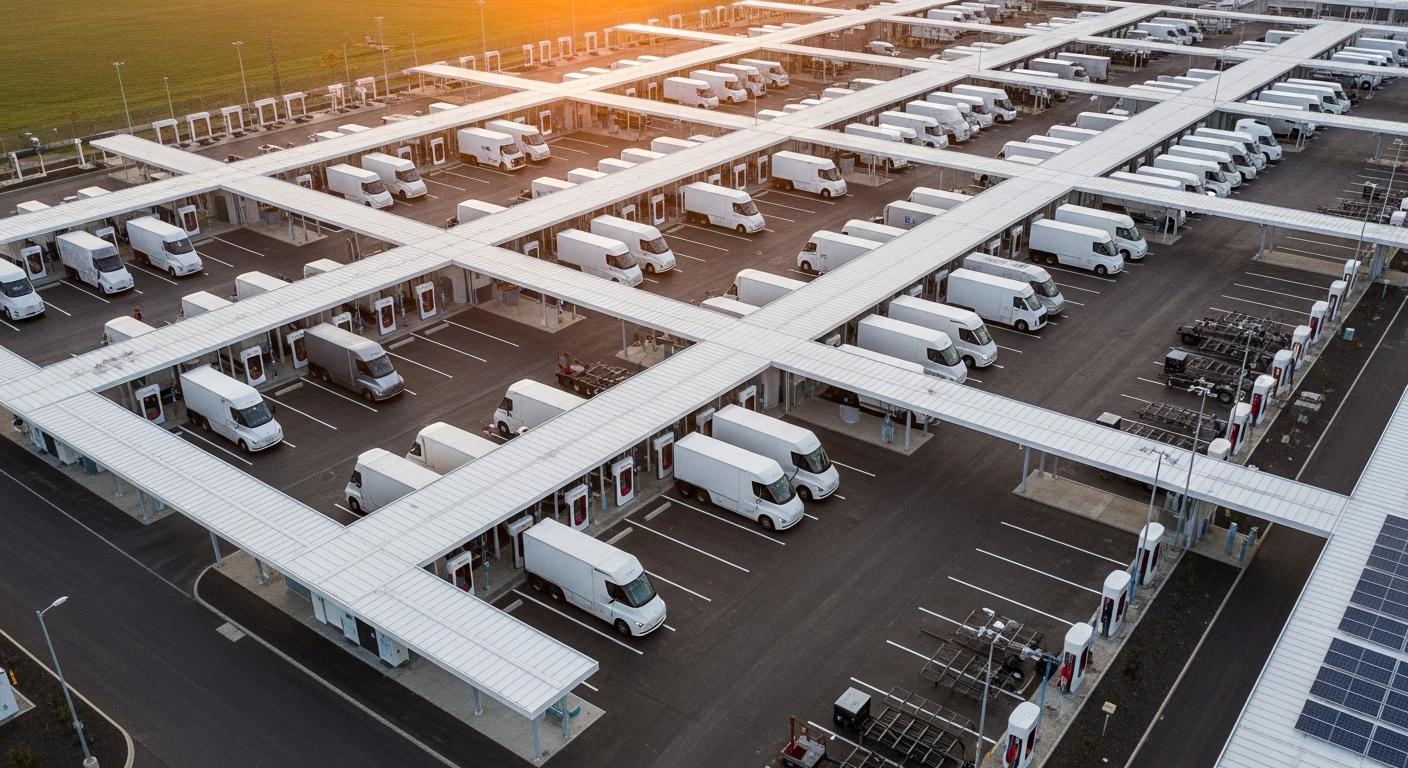
Tesla positioned as architect of electric heavy-duty infrastructure
Tesla’s ambition goes far beyond simply selling electric trucks. In 2025, the company announced a partnership with Uber to develop electric trucking in urban logistics. A global vision is emerging: vehicles + infrastructure + integrated logistics services.
Besoin d'accessoires pour ta Tesla ?
Looking for accessories for your Tesla?
Tesla no longer positions itself as a mere car manufacturer, but as a complete ecosystem provider. This strategy generates recurring revenue through charging, well beyond the one-time sale of vehicles. The Supercharger network for light vehicles, long considered a cost center, is now profitable. The same infrastructural business model applies to heavy-duty trucks, with potentially even larger margins.
In France and Europe, we are only just beginning to see pilot projects for electric trucks. The infrastructure on our highways is almost non-existent. According to specialized industry sources, the deployment of megawatt charging stations remains largely insufficient to meet the future needs of electric road transport. Tesla shows that we must think infrastructure first, adoption second. Our European players must accelerate massively if they do not want to be outpaced by the American lead.
This partnership with Pilot Travel Centers is not just another piece of news in Tesla’s current events. It’s a major strategic signal: Tesla is no longer just playing in the automotive manufacturers’ league. The company is becoming a leading energy player and infrastructure provider. It now controls the entire value chain: vehicle production, deployment of charging infrastructure, and even progressively the supply of energy via its solar and storage solutions.
And that, perhaps, is even more disruptive than the Semi itself. Tesla is building the electric highway of the future, while others are still discussing technical standards. This head start could permanently redefine the landscape of road transport, in the United States first, then in the rest of the world.
Profitez d'avantages exclusifs en achetant votre Tesla
Vous envisagez d'acquérir une Tesla ? En utilisant mon code de parrainage lors de votre achat, vous pouvez bénéficier d'avantages exceptionnels !
Des kilomètres gratuits de recharge ou d'autres récompenses exclusives, mon code de parrainage est votre passeport pour des avantages supplémentaires : https://ts.la/antoine49352 🤩
Pas de pression, juste une opportunité à saisir pour enrichir votre expérience Tesla.
Découvrez ici le système du parrainage et comment utiliser le code.
Get exclusive perks when buying your Tesla
Thinking about getting a Tesla? If you use my referral code when you purchase, you may be eligible for extra perks.
Free Supercharging miles or other exclusive rewards - my referral code can unlock additional benefits: https://ts.la/antoine49352 🤩
No pressure - just a simple option if you want to enhance your Tesla experience.
Learn how the Tesla referral program works and how to use the code.