


I’ll always remember that road trip in Normandy where I waited almost 50 minutes at a Supercharger for a charge that should have taken 20 minutes. Frustrating, right? Yet, I quickly understood that most charging slowdowns are avoidable. After dozens of sessions and a lot of experimentation, I’ve identified the most common errors that waste your time at the Supercharger. Good news: they’re all easy to fix! In this article, I’ll share with you the pitfalls to avoid and my concrete solutions for optimizing your Supercharger charging time at each stop.
Arriving with a cold (or too hot) battery: the temperature error
Why battery temperature impacts charging speed
This is the number one error, and probably the one that made me lose the most time before I understood the mechanism. Lithium-ion batteries need an optimal temperature to accept fast charging, generally between 28 and 32°C.
When your battery is cold, its internal resistance increases considerably. The BMS (Battery Management System) then limits the power to protect the cells. Conversely, a battery that is too hot triggers thermal protections which also slow down charging.
The concrete impact? I’ve measured differences of 20 to 30 minutes on a full session depending on whether my battery was at temperature or not. That’s huge when you’re in a hurry!
Besoin d'accessoires pour ta Tesla ?
Looking for accessories for your Tesla?
The solution: automatic pre-conditioning
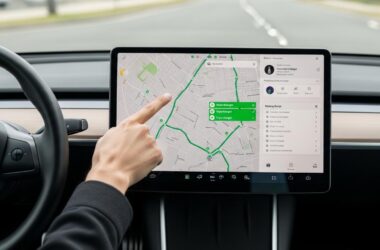
The good news is that Tesla has thought of everything. You just need to activate navigation to the Supercharger in your GPS, even if you know the way perfectly. The system will automatically heat or cool your battery during the trip so that it arrives at the ideal temperature.
I’ve measured a time saving of up to 25% faster simply by activating automatic battery pre-conditioning. My advice: plan your route at least 20 to 30 minutes before arriving at the Supercharger so the system has time to act effectively.
Charging beyond 80%: the “systematic full charge” error
How many times have I seen owners patiently wait for their Tesla to reach 100%… while they were wasting so much time! The charging curve is not linear, and it’s crucial to understand that.
Here’s what I regularly observe on my Model Y:
- From 10 to 50%: approximately 150 kW of power, ultra-fast charging
- From 50 to 80%: power gradually decreases between 100 and 70 kW
- From 80 to 100%: sharp drop between 50 and 25 kW
The math is undeniable: the last 20 percent take as much time as the first 60. You can check typical charging times to see the concrete impact.
My golden rule: I systematically stop at 80% unless my next Supercharger is really far away. Not only do I save time, but with the per-minute pricing at some stations, I also save money. Prioritize several short stops rather than one long one; that’s the winning strategy for efficient Tesla fast charging.
Ignoring power sharing between adjacent stalls
How power sharing works
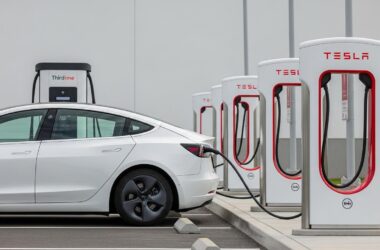
Here’s a subtlety many owners ignore. To understand how Superchargers work, you need to know that the stalls operate in pairs: each electrical cabinet powers two stalls (1A/1B, 2A/2B, etc.).
Concretely, if you plug into stall 3A and a Tesla arrives at 3B right after, you will share the available power. On older V2 Superchargers, the impact is systematic: your theoretical 250 kW becomes a real 125 kW.
V3 and V4 are less impacted thanks to improved architecture, but power sharing still exists to a lesser extent.
The tip for choosing the right stall
Since I started applying this method, I’ve noticed a real difference in my battery charging speed. Here’s my process:
- I look at my Tesla’s screen, which shows me the recommended stall number
- I visually check for available adjacent stalls before parking
- I absolutely avoid parking next to a car that has just arrived
- I prefer isolated stalls, even if I have to walk a little further
The potential gain can reach 100% more power! It’s really worth taking 30 seconds to choose intelligently.
Neglecting initial charge state and weather
The “I arrive at 5%” error is more common than one might think. Arriving with a nearly empty battery stresses the cells and reduces the accepted charging speed. The optimal arrival zone is between 10 and 20% to fully benefit from the fast charging curve.
Weather also plays a major role, even with pre-conditioning activated. In the middle of winter, I always make sure to drive at least 20 minutes before charging: the natural warming of the battery during driving helps enormously.
Besoin d'accessoires pour ta Tesla ?
Looking for accessories for your Tesla?
In summer during heatwaves, I’ve developed a different strategy: I look for shaded Superchargers or charge early in the morning/late in the evening when temperatures are milder. Adapting your planning according to the seasons is part of Supercharger optimization.
My advice: always plan for a safety buffer driving range. Arriving with 15% rather than 3% changes almost nothing to your total driving range, but makes a real difference to your initial Supercharger power.
Small practical errors that cost time
Beyond the big errors, I’ve identified many small details that, when combined, eat away at your precious time.
A poorly inserted cable is a classic: you think you’re charging at full power, but the connection isn’t optimal. I always push it firmly until I feel the click and see the confirmation on the screen.
Leaving the air conditioning on full blast during charging might seem harmless, but it draws from the available power. I systematically reduce it to eco mode during my sessions.
Sentry Mode is another silent thief: its parasitic consumption can make you lose a few precious percent. I always deactivate it at Superchargers where I feel safe.
My favorite technique? Using the Tesla app to monitor charging remotely while I stretch my legs, grab a coffee, or go to the restroom. Time passes much faster when you’re productive instead of sitting in your car staring at the screen!
My personal protocol for optimal charging every time
After hundreds of sessions, I’ve developed a routine that saves me between 15 and 20 minutes with each charge. Here’s my checklist that I systematically apply:
- Before departure: I plan my route with active navigation to the Supercharger
- 10 km before arrival: I check the battery temperature and site occupancy
- Upon arrival: I choose an isolated stall and insert the cable correctly
- During charging: 80% target, monitoring via the app, non-essential equipment turned off
These actions have become automatic for me, and according to industry experts, these good practices also preserve your battery’s longevity in the long term.
Do you already apply some of these tips? Do you have others to share? Feel free to tell me about your experience in the comments, I love discussing our optimization techniques!
Profitez d'avantages exclusifs en achetant votre Tesla
Vous envisagez d'acquérir une Tesla ? En utilisant mon code de parrainage lors de votre achat, vous pouvez bénéficier d'avantages exceptionnels !
Des kilomètres gratuits de recharge ou d'autres récompenses exclusives, mon code de parrainage est votre passeport pour des avantages supplémentaires : https://ts.la/antoine49352 🤩
Pas de pression, juste une opportunité à saisir pour enrichir votre expérience Tesla.
Découvrez ici le système du parrainage et comment utiliser le code.
Get exclusive perks when buying your Tesla
Thinking about getting a Tesla? If you use my referral code when you purchase, you may be eligible for extra perks.
Free Supercharging miles or other exclusive rewards - my referral code can unlock additional benefits: https://ts.la/antoine49352 🤩
No pressure - just a simple option if you want to enhance your Tesla experience.
Learn how the Tesla referral program works and how to use the code.