





When Elon Musk posted his announcement on X, I had to reread it three times to make sure I understood. SpaceX, the company that has made us dream of Martian colonies for years, has just redefined its priorities: a self-sufficient lunar city is now at the top of the list, with a crazy goal of less than 10 years. Mars? Still in the plans, but pushed back to more than 20 years. This radical change is not an abandonment of the Martian dream, far from it. It’s a pragmatic decision that could well save humanity faster than expected. What if the Moon was ultimately our best life insurance? I’m going to explain why this strategic pivot might be the best decision Elon Musk has ever made.
The strategic pivot announced by Elon Musk
The announcement came via X, the social network that allows Musk to communicate directly and unfiltered with millions of people. And what he said is quite surprising: SpaceX is now focusing on establishing a self-sufficient lunar city in less than 10 years. Mars is not forgotten, but the timeline is radically changing: more than 20 years before we see a functional colony there.
What struck me when reading this announcement is that the fundamental mission remains unchanged: to extend human consciousness into space and ensure the protection of humanity. This is not a billionaire’s whim, changing his mind on a dime. It’s a strategic recalibration based on concrete data.
When I first saw this announcement, I thought it was typical Musk provocation. But by digging into the reasons behind this change in priority, everything becomes clear. To understand Musk’s global vision for SpaceX and the future of space exploration, you have to look beyond the headlines.
Besoin d'accessoires pour ta Tesla ?
Looking for accessories for your Tesla?
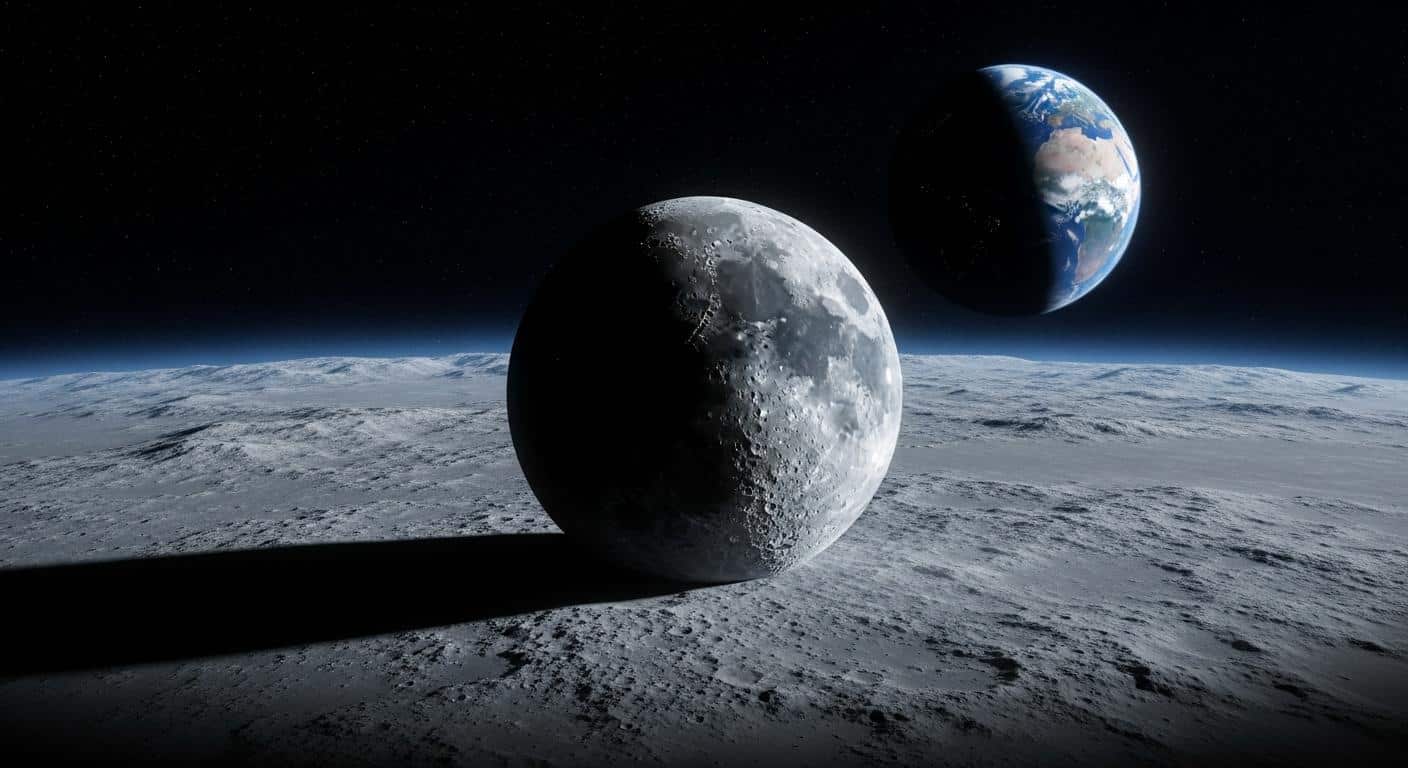
Why the Moon is becoming the top priority
Timelines twice as short
The comparison is stark but illuminating: 10 years to establish a permanent presence on the Moon versus 20+ years for Mars. Faced with the existential risks threatening our planet, this timeline difference changes everything.
Musk perceives a growing urgency to establish an anchor point off Earth. Climate change, geopolitical tensions, asteroid impact risks: there’s no shortage of threats. Being able to secure a functional lunar colony in a decade rather than two potentially doubles our chances of survival as a species.
The decisive logistical advantage
Here’s where it gets really interesting. Launch windows to the Moon open approximately every 10 days. For Mars? Only every 26 months, when the planets align correctly.
The transit time also changes completely: 2 days to reach the Moon versus 6 months for Mars. It’s like learning to drive in a parking lot before venturing onto the highway.
Concretely, this proximity allows for rapid iteration on all critical technologies. You can test a new habitat system, identify a problem, correct it on Earth, and send an improved version a few weeks later. With Mars, an error costs you a minimum of 2 years of waiting.
This accelerated learning capability is a major strategic advantage. Each lunar mission can integrate lessons from the previous one, creating a cycle of continuous development and improvement impossible to replicate with Mars.
The technical constraints that change the game
Martian launch windows depend on the orbital alignment between Earth and Mars, which only occurs every 26 months. This constraint is non-negotiable: it’s pure physics, not a matter of technology or budget.
The consequences are massive. An error, a delay, a major technical problem, and it’s a 2-year wait before the next opportunity. Imagine the financial and human cost of such latency.
With the Moon, this operational flexibility completely changes the game. A launch opportunity every 10 days means you can adjust, correct, and improve in near real-time. Each lunar mission can integrate feedback from the previous one.
For habitat construction, life-support systems, local resource extraction: all these critical technologies can be tested and perfected at a sustained pace. SpaceX’s philosophy of fail fast, learn faster only truly works with the Moon. Mars’s orbital constraints make this model much less efficient.
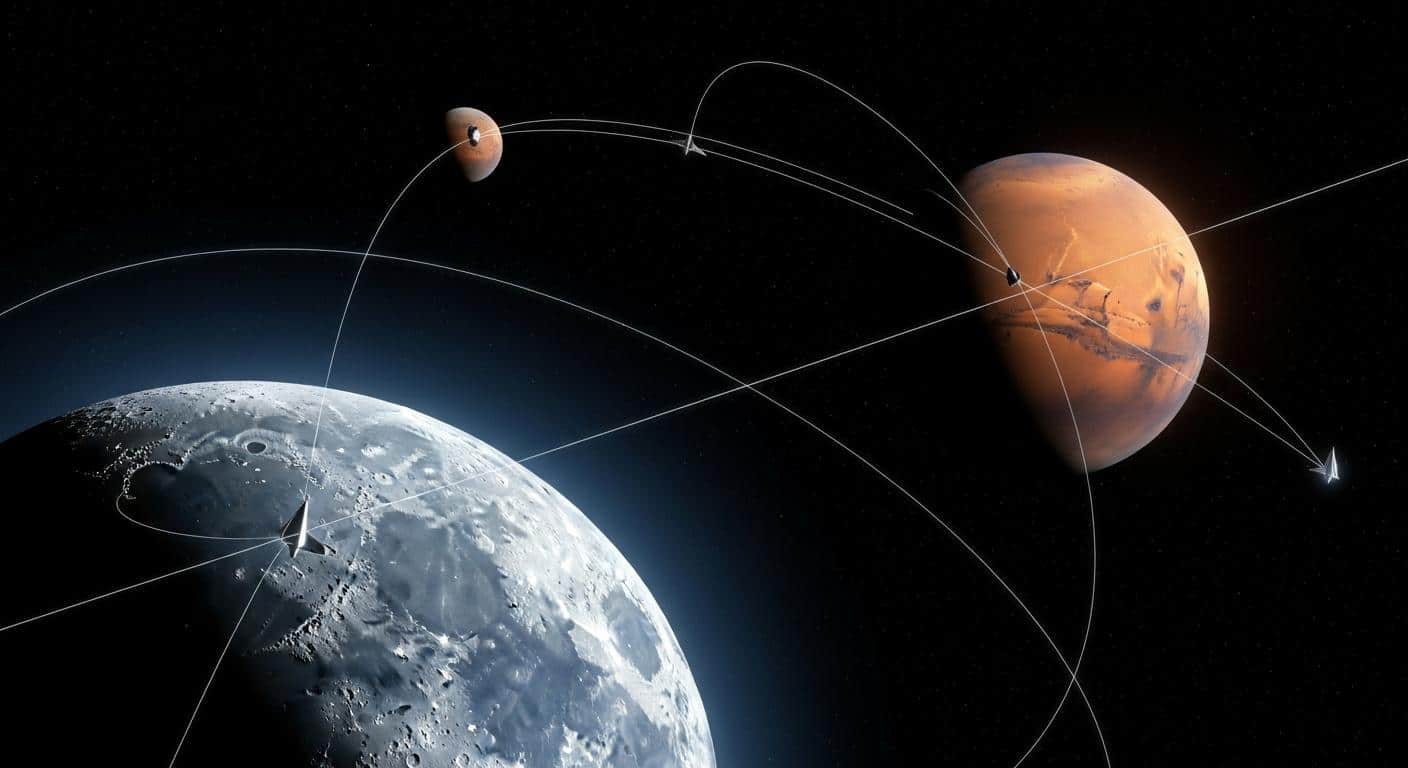
Mars is not abandoned: the parallel strategy
Let’s be clear: this change in priority does not mean Mars is disappearing from the radar. On the contrary, SpaceX is maintaining simultaneous development on both fronts. The Martian timeline remains active with Martian missions planned to begin in 5 to 7 years.
An important technical point: direct Earth-Mars trajectories are confirmed. Contrary to what one might imagine, the Moon will not serve as a space gas station for ships en route to Mars. Why? Because fuel is scarce on the Moon and it would be economically unviable to make a stopover.
This parallel approach is brilliant: the Moon to address the urgency of securing humanity quickly, Mars to realize the long-term vision of a multi-planetary civilization. I find this strategy remarkable: why choose when you can do both?
Besoin d'accessoires pour ta Tesla ?
Looking for accessories for your Tesla?
All technologies developed for lunar colonization – life systems in hostile environments, in-situ resource extraction, pressurized habitats – will directly benefit future Martian colonies. To better understand the evolution of the Martian program, I recommend following future Starship v3 missions to Mars, which are still very much on the agenda.
The Moon as life insurance for humanity
The concept of a self-sufficient lunar city is fascinating. We’re talking about a colony capable of producing its own energy, extracting water from lunar ice, and potentially growing its own food. A true backup for human civilization, activatable in less than a decade.
This lunar colony would protect us against terrestrial existential risks: major natural disasters, nuclear conflicts, asteroid impacts, global pandemics. It’s quick-to-activate insurance rather than a perfect but distant plan.
The stakes go far beyond technology. It’s about the survival of humanity and the geographical diversification of our species. No longer having all our eggs in the same planetary basket. According to aerospace industry experts, establishing a permanent human presence on the Moon represents a crucial step for space exploration.
Once the self-sufficient lunar city is secured and operational, Mars naturally becomes the next logical step. But with a major difference: we will have already proven that humanity can survive and thrive elsewhere than on Earth. The investment in the financial and technological ecosystem that Musk is building demonstrates that the resources needed to carry out these two ambitious projects in parallel are very real.
It’s pragmatic, audacious, and ultimately, it’s exactly what we expect from SpaceX. The Moon first, Mars next. Both objectives remain alive, but the order of priority has just adapted to the reality on the ground and the urgency of our time.
Profitez d'avantages exclusifs en achetant votre Tesla
Vous envisagez d'acquérir une Tesla ? En utilisant mon code de parrainage lors de votre achat, vous pouvez bénéficier d'avantages exceptionnels !
Des kilomètres gratuits de recharge ou d'autres récompenses exclusives, mon code de parrainage est votre passeport pour des avantages supplémentaires : https://ts.la/antoine49352 🤩
Pas de pression, juste une opportunité à saisir pour enrichir votre expérience Tesla.
Découvrez ici le système du parrainage et comment utiliser le code.
Get exclusive perks when buying your Tesla
Thinking about getting a Tesla? If you use my referral code when you purchase, you may be eligible for extra perks.
Free Supercharging miles or other exclusive rewards - my referral code can unlock additional benefits: https://ts.la/antoine49352 🤩
No pressure - just a simple option if you want to enhance your Tesla experience.
Learn how the Tesla referral program works and how to use the code.