





Today, I’m talking to you about a milestone I’ve been anticipating since the 2023 announcement: Tesla has officially commissioned its lithium refinery in Corpus Christi, Texas. Since January 2026, the facility has been producing battery-grade lithium hydroxide, marking a major turning point in the company’s vertical integration strategy.
What makes this refinery truly special isn’t just its size or location. It’s primarily the innovative process it uses and what it represents for American independence from Chinese dominance in lithium refining.
Specifically, what does this change for Tesla, for the automotive industry, and for us, electric mobility enthusiasts? I’ve delved into the available data to decipher the real stakes behind this facility.
A technological first in North America
What strikes me about this refinery is, first and foremost, its innovative process. Tesla uses a method of direct spodumene processing, the raw lithium ore, to directly produce lithium hydroxide.
Besoin d'accessoires pour ta Tesla ?
Looking for accessories for your Tesla?
Why is this important? Because traditionally, refineries first convert spodumene into lithium carbonate, then transform that carbonate into hydroxide. Tesla bypasses this intermediate step.
The process breaks down as follows:
- Heating spodumene in high-temperature kilns
- Controlled cooling of the material
- Alkaline leaching to extract lithium
- Purification of impurities
- Final crystallization into battery-grade lithium hydroxide
The competitive advantage? A significant reduction in production costs, considerable time savings, and fewer material manipulations. It’s a first in North America, even if similar technologies exist elsewhere in the world.
Let’s be honest: Tesla didn’t invent lithium refining. But the company has simplified and optimized a complex process, applying its usual engineering philosophy.
A record development timeline
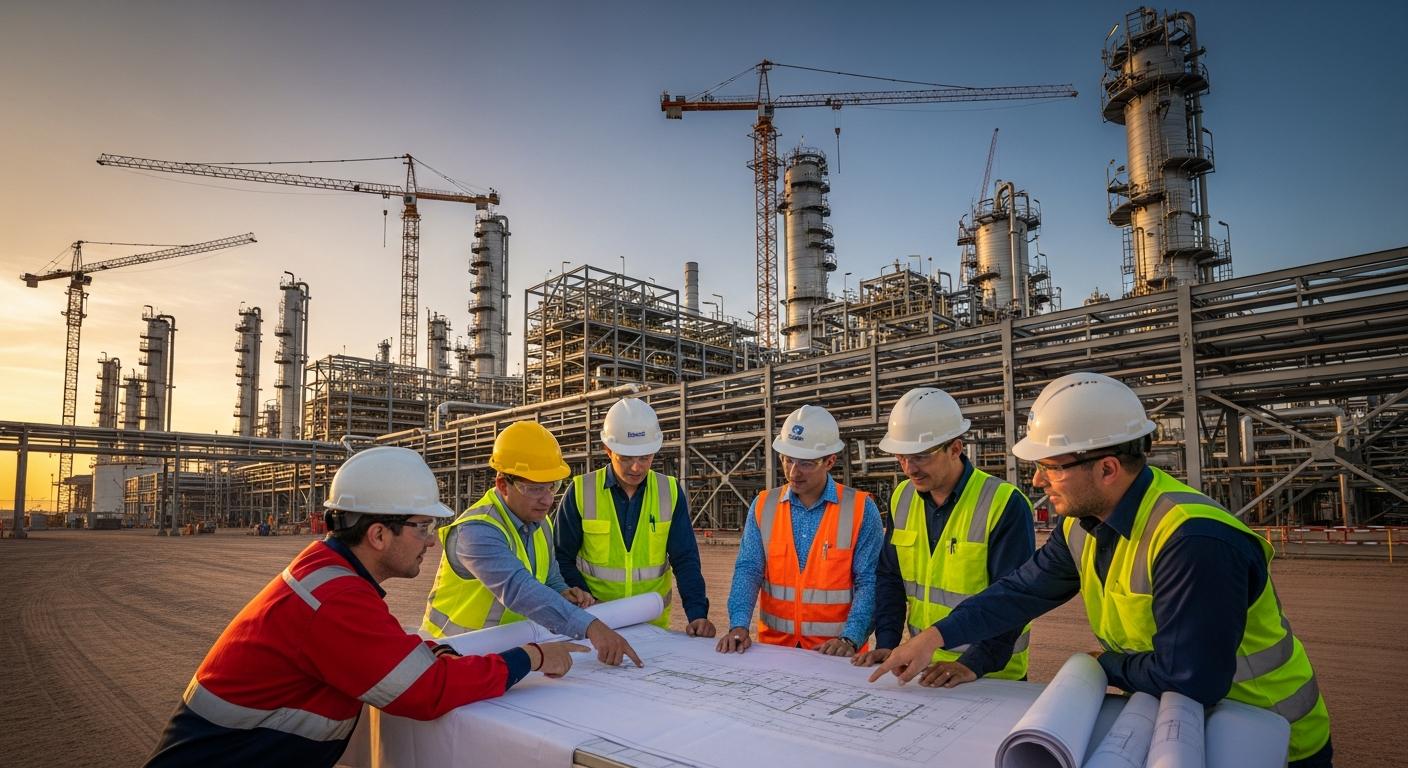
In three years, from the first groundbreaking to effective production. For the heavy industrial sector, this is unprecedented. Here is the exact timeline:
- 2023: Construction begins in Corpus Christi
- 2025: Gradual commissioning of facilities
- January 2026: Refinery fully operational
In the traditional mining and chemical industry, a project of this magnitude usually requires between 4 and 7 years. How did Tesla do it?
The answer lies in its parallel methodology: the company simultaneously conducted studies, design, and construction. Instead of waiting for each phase to end before starting the next, Tesla overlapped the stages, accepting a higher level of risk.
This is Tesla’s iterative approach applied to the heavy industrial sector. An important nuance, however: “operational” does not necessarily mean “at full capacity”. The gradual ramp-up will likely take several months.
A truly “clean” process? A closer look
When Musk talks about a “very clean” refinery, I wanted to dig into what that really means. The main argument rests on the valuable byproduct generated by the process.
Anhydrite, a valuable byproduct
Unlike traditional refineries that generate hazardous waste requiring costly treatment, the Tesla refinery primarily produces anhydrite. This calcium sulfate can be directly used in:
- Concrete mixes
- Construction materials
- The plaster industry
The environmental impact is therefore theoretically reduced: instead of storing toxic waste, Tesla generates a marketable material. This is undeniable progress.
The limits of the “clean” argument
Now, let’s contextualize. “Clean” compared to what exactly? The clean process still requires:
- Very high-temperature kilns (high energy consumption)
- Electricity from the Texan energy mix (still largely fossil-fuel based)
- Chemicals for alkaline leaching
Tesla provides little information on the total energy consumption of the site or the precise origin of its electricity. The improvement compared to conventional refineries is real, but calling the process “very clean” in absolute terms remains debatable.
Besoin d'accessoires pour ta Tesla ?
Looking for accessories for your Tesla?
It’s “cleaner”, certainly. “Very clean”? The data is still insufficient to confirm it unreservedly.
Towards American Strategic Independence
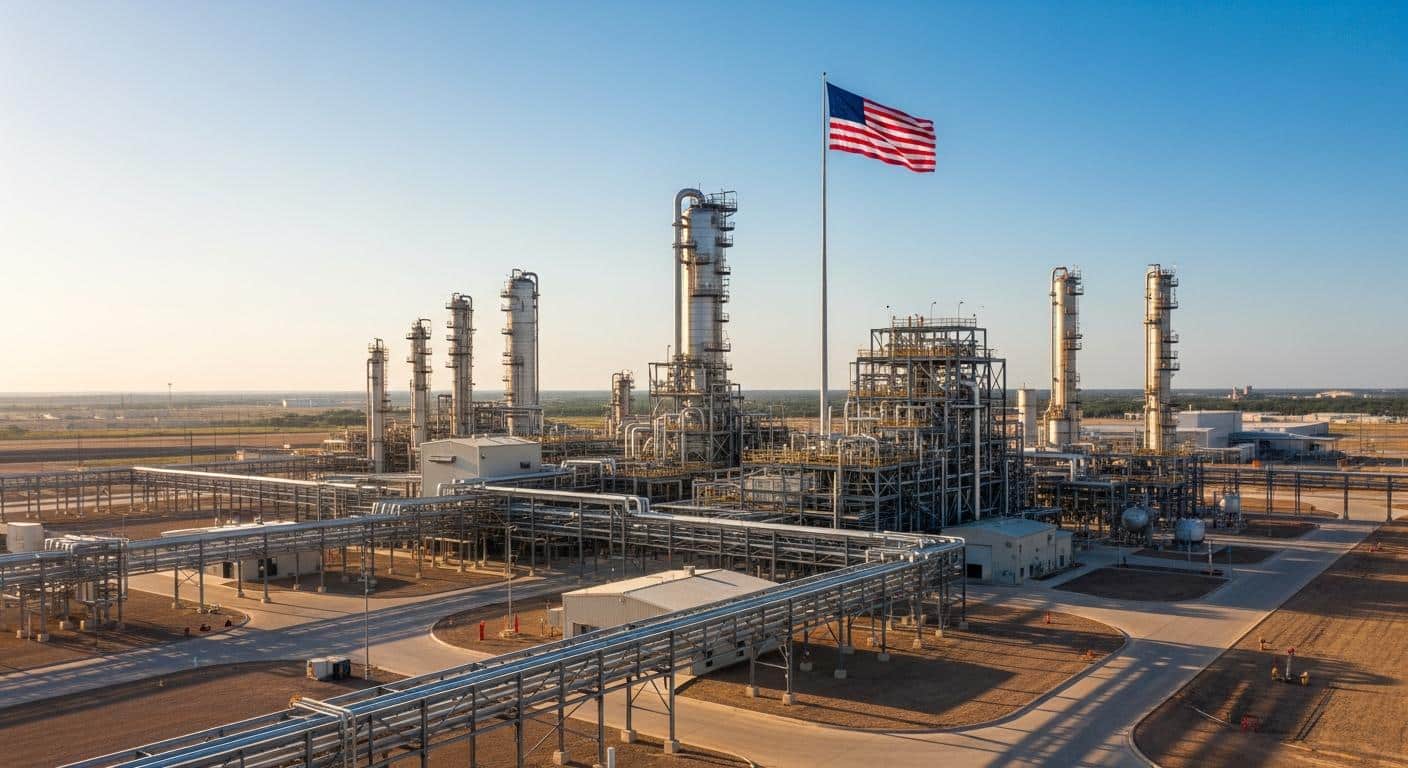
Beyond the technical achievement, this refinery addresses a major strategic issue: the energy and industrial independence of the United States.
Today, China controls about 60% of global lithium refining. For American electric vehicle batteries, this dependence poses an obvious geopolitical problem.
With its Texan refinery, Tesla secures a crucial part of its supply chain. The lithium hydroxide produced in Corpus Christi will directly supply Gigafactory Texas, located a few hundred kilometers away in Austin.
Specifically, this means that Cybertruck production at Gigafactory Texas can rely on locally refined lithium. The same logic applies to the future batteries of restyled Model Ys assembled on-site.
Tesla’s vertical integration reaches a new milestone here: from ore to finished vehicle, controlling an increasing share of the process. Reduction of logistical risks, lead times, and theoretically, costs.
For vehicles requiring massive quantities of lithium, such as the massive batteries of the Tesla Semi (approximately 900 kWh per truck), having a stable local supply source becomes a decisive competitive advantage.
What the numbers say (and don’t say)
Elon Musk never does things by halves. According to his statements, this facility would be “the largest lithium refinery in North America” and “the most technologically advanced refinery in the world”.
Verifiable? Partially. Regarding size, the claim seems to hold true: no other lithium refinery of this capacity currently exists in North America. Regarding the “most advanced in the world” aspect, it’s more subjective and depends on the criteria used.
What is sorely missing from official communication:
- Annual production capacity in tons of lithium hydroxide
- Total investment in the project
- Number of jobs created
- Exact origin of the processed spodumene
- Site energy consumption
Without this verifiable data, it’s difficult to compare precisely with established players like Albemarle or SQM. The crystallization and purification processes used are based on methods documented by specialized industrial sources, but Tesla keeps some of its optimizations secret.
The truly innovative aspect here is the speed of execution and integration into the Tesla ecosystem. From a purely technological standpoint, it’s a smart evolution rather than a revolution.
This refinery marks an important step in Tesla’s autonomy and in the reshoring of critical material production in the United States. It remains to be seen if the announced capacities will materialize at full scale in the coming months.
And you, do you think this vertical integration will give Tesla a lasting advantage over the competition? Or will other manufacturers quickly catch up on supply chain control? Tell me in the comments!
Profitez d'avantages exclusifs en achetant votre Tesla
Vous envisagez d'acquérir une Tesla ? En utilisant mon code de parrainage lors de votre achat, vous pouvez bénéficier d'avantages exceptionnels !
Des kilomètres gratuits de recharge ou d'autres récompenses exclusives, mon code de parrainage est votre passeport pour des avantages supplémentaires : https://ts.la/antoine49352 🤩
Pas de pression, juste une opportunité à saisir pour enrichir votre expérience Tesla.
Découvrez ici le système du parrainage et comment utiliser le code.
Get exclusive perks when buying your Tesla
Thinking about getting a Tesla? If you use my referral code when you purchase, you may be eligible for extra perks.
Free Supercharging miles or other exclusive rewards - my referral code can unlock additional benefits: https://ts.la/antoine49352 🤩
No pressure - just a simple option if you want to enhance your Tesla experience.
Learn how the Tesla referral program works and how to use the code.