




On February 8, 2026, between two spectacular Super Bowl plays, SpaceX marked a strategic turning point for Starlink. For the first time in its history, Elon Musk’s company aired a commercial spot during a major public event of this scale. This is a complete break from the organic growth strategy that has driven the success of its projects until now.
Why this marketing shift now? With 9 million subscribers worldwide already, is Starlink looking to accelerate its profitability? Or does this advertising offensive hide difficulties in penetrating certain markets?
As a fan of the Elon Musk ecosystem, I find this move fascinating… but also intriguing. Let’s analyze this commercial offensive together, decipher the figures, and explore the implications for the European market.
SpaceX Makes a Big Splash: Starlink Appears at the Super Bowl
The cost of a 30-second advertising slot during the Super Bowl ranges between $7 and $8 million. A colossal investment that SpaceX decided to make to propel Starlink to the American public.
Besoin d'accessoires pour ta Tesla ?
Looking for accessories for your Tesla?
The ad’s message is simple and impactful: a promise of registration in under 2 minutes, a dedicated number (1-888-GO-STARLINK), and highlighting global coverage. The commercial positioning leaves no doubt: fast internet, low latency, affordable, available “almost anywhere on Earth.”
What’s striking is the strategic shift. SpaceX has never done traditional TV advertising, preferring word-of-mouth, social media, and Elon Musk’s direct communication on X. Tesla also made its first foray into traditional advertising with the Model Y and the Cybertruck, a sign of a global evolution in the Musk ecosystem’s marketing strategy.
But here’s the question that bothers me: why invest so much in a mainstream ad with 9 million subscribers already? Is this a sign of difficulty penetrating the urban residential market? I wonder if this shift towards mass advertising doesn’t hide increased pressure on growth.
9 Million Subscribers and Rapid Expansion
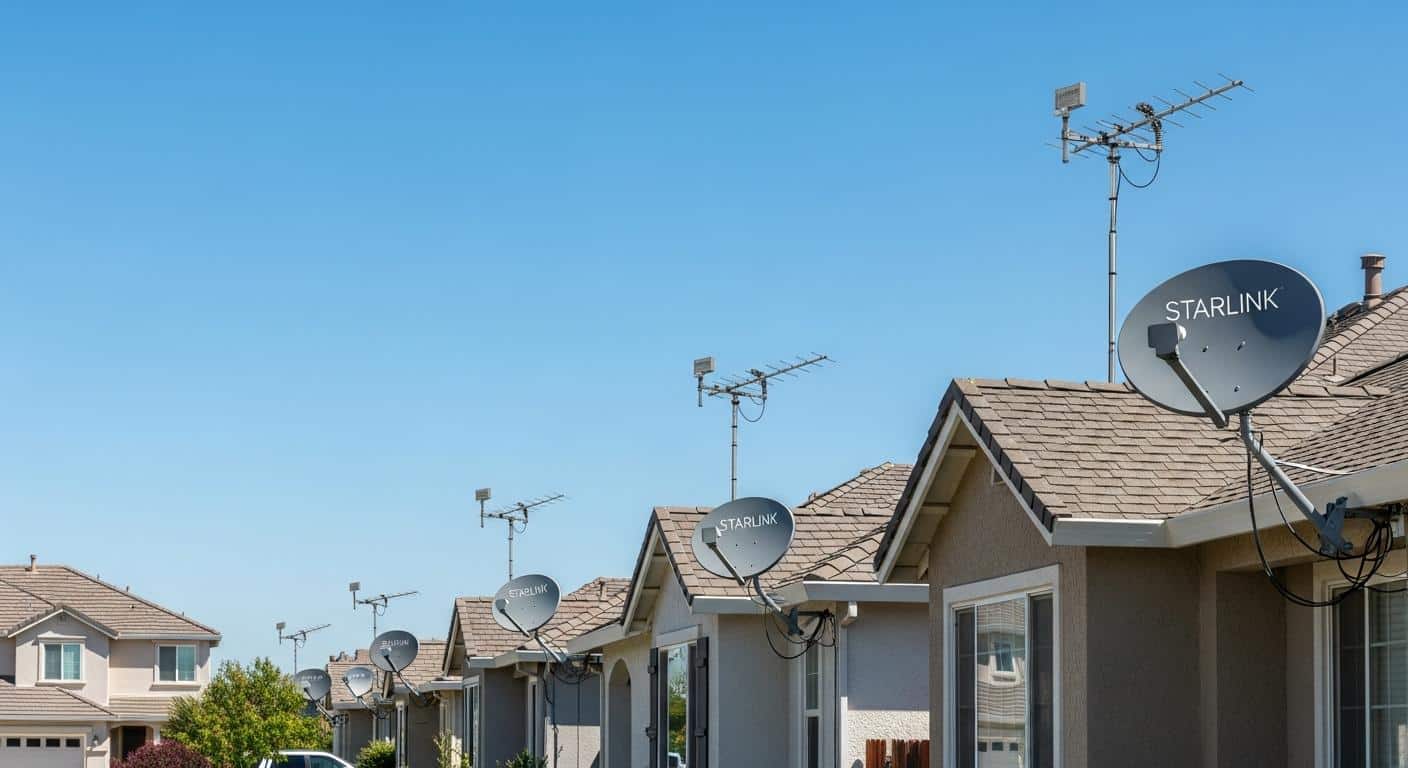
The 2025 figures are impressive: Starlink now has over 9 million users worldwide. An official confirmation that testifies to the service’s rapid expansion since its commercial launch.
Brazil particularly illustrates this dynamic: with over 1 million subscribers, it has become one of the most dynamic markets for SpaceX. At the same time, dozens of new markets were activated in 2024-2025, driven by a constellation of several thousand low-orbit satellites.
Let’s put these figures into perspective: 9 million subscribers is huge for such a young service. But compared to traditional ISPs like Orange (40 million customers and more), the base is still modest.
The question of profitability concerns me. Is it enough to amortize the colossal investments in satellite launches, R&D, and ground infrastructure? The service is available in France and Europe, but these figures are impressive without fully reassuring me about the business model.
An All-Out Commercial Offensive
Free Hardware and Aggressive Promotions
Beyond TV advertising, SpaceX is multiplying aggressive promotions. In some regions, the Starlink kit is offered free or heavily discounted. Installation fees have been waived in several countries, and the Starlink Mini is even offered for free in certain targeted markets.
Monthly rates have also decreased in several geographical areas, with significant reductions to attract new subscribers.
AI for Simplified Registration
The integration of artificial intelligence tools to facilitate subscription is another major focus. The marketing promise of registration in under 2 minutes relies on the complete automation of the process: address verification, compatibility, installation configuration.
These massive promotions remind me of the welcome offers from traditional operators… An acquisition strategy at any cost? These reductions are reminiscent of classic market penetration strategies, but raise a question: is SpaceX compensating for slower-than-expected growth in certain areas?

Beyond Residential: Aviation and Mobile Connectivity
Starlink Aviation is already operational on several airlines. Pricing is premium, but the value proposition is clear: in-flight connectivity that transforms the passenger experience.
Even more promising: direct-to-cellular in development. The partnership with T-Mobile in the United States aims to connect smartphones directly to satellites, without ground infrastructure. A potential revolution for uncovered areas.
Besoin d'accessoires pour ta Tesla ?
Looking for accessories for your Tesla?
This diversification of the business model seems strategically essential to me. No longer relying solely on residential allows for exploring potentially more profitable B2B and premium segments. This approach is reminiscent of the Tesla ecosystem: diversification between vehicles, energy, and Superchargers.
Personally, this diversification seems more economically promising than mass residential.
Starlink vs. Traditional ISPs: Has the Match Really Begun?
The shift in positioning is clear: Starlink no longer presents itself as a last-resort solution for unserved areas, but as a direct competitor to traditional ISPs. The marketing discourse evolves from “Internet everywhere” to “fast internet AND affordable.”
This marketing offensive is reminiscent of how traditional manufacturers intensified their communication against Tesla, when the American brand began to seriously eat into market share.
But what is the reality of the French and European market?
- Unserved areas: Starlink offers a real value proposition, with no credible competition
- Urban areas: difficult to compete with fiber optics on price, speed, and latency
- Rural areas: direct competition with 4G/5G boxes from traditional operators
The Super Bowl ad primarily targets the American market, with its immense rural areas. Is this strategy transferable to Europe, where urban density and coverage by historical operators are much higher?
European regulatory implications (net neutrality, data protection) add a layer of complexity. And then, with current promotions, what is the real business model? According to industry analysts, the profitability of satellite constellations remains a major long-term challenge.
As an observer of the Musk ecosystem, I acknowledge the absolutely remarkable technical achievement. But I remain skeptical about short-term profitability, especially given the well-established terrestrial infrastructures in Europe.
Profitez d'avantages exclusifs en achetant votre Tesla
Vous envisagez d'acquérir une Tesla ? En utilisant mon code de parrainage lors de votre achat, vous pouvez bénéficier d'avantages exceptionnels !
Des kilomètres gratuits de recharge ou d'autres récompenses exclusives, mon code de parrainage est votre passeport pour des avantages supplémentaires : https://ts.la/antoine49352 🤩
Pas de pression, juste une opportunité à saisir pour enrichir votre expérience Tesla.
Découvrez ici le système du parrainage et comment utiliser le code.
Get exclusive perks when buying your Tesla
Thinking about getting a Tesla? If you use my referral code when you purchase, you may be eligible for extra perks.
Free Supercharging miles or other exclusive rewards - my referral code can unlock additional benefits: https://ts.la/antoine49352 🤩
No pressure - just a simple option if you want to enhance your Tesla experience.
Learn how the Tesla referral program works and how to use the code.