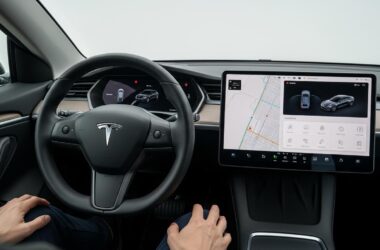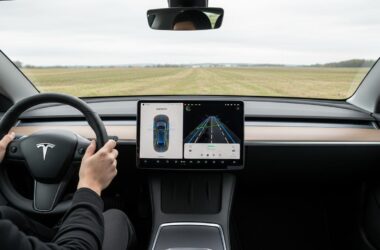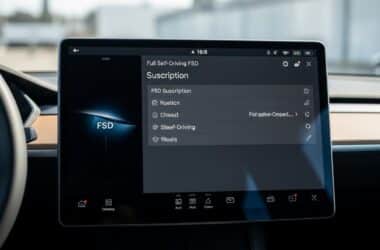


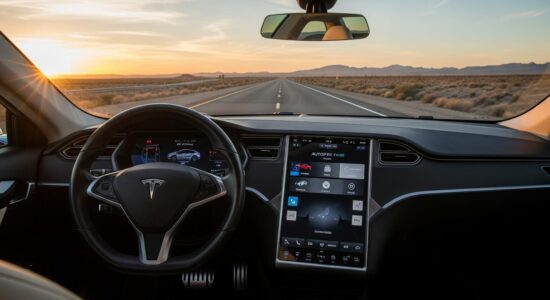
In January 2026, Alex Roy achieved a historic milestone for autonomous driving. This former automotive journalist and record holder accomplished the unthinkable: crossing the United States from Los Angeles to New York, a distance of 3,081 miles (4,957 km), without any human intervention. For 58h22, his 2024 Tesla Model S equipped with the AI4 chip and Full Self-Driving v14.2.2.3 managed the entire journey alone, facing snow, ice, and heavy rain.
This feat redefines the possibilities of FSD and raises a troubling question: has the human become the least reliable element in the equation? A look back at this technical event that marks a turning point for Tesla and autonomous driving.
A historic feat for Tesla autonomous driving
The Cannonball Run is much more than just a race: it’s an American automotive myth. This mythical coast-to-coast journey symbolizes ultimate performance, and Alex Roy knows every kilometer of it. But this time, he wasn’t at the wheel.
For the first time in automotive history, a vehicle traveled 3,081 miles without any driver intervention. Not a single turn of the wheel, no braking, no manual acceleration. The context makes this feat even more remarkable: Alex had attempted the experience twice before.
Besoin d'accessoires pour ta Tesla ?
Looking for accessories for your Tesla?
- December 2024: first attempt with several necessary interventions
- February 2025: second attempt, still with human corrections
- January 2026: zero intervention, total success
This progression illustrates the rapid maturation of Full Self-Driving. It transitions from “supervised assisted driving” to near-total autonomy. For Tesla and the autonomous driving industry, this is a major milestone that proves the technology can handle thousands of kilometers in real-world conditions.
The extreme winter conditions of the test
Hostile weather and road challenges
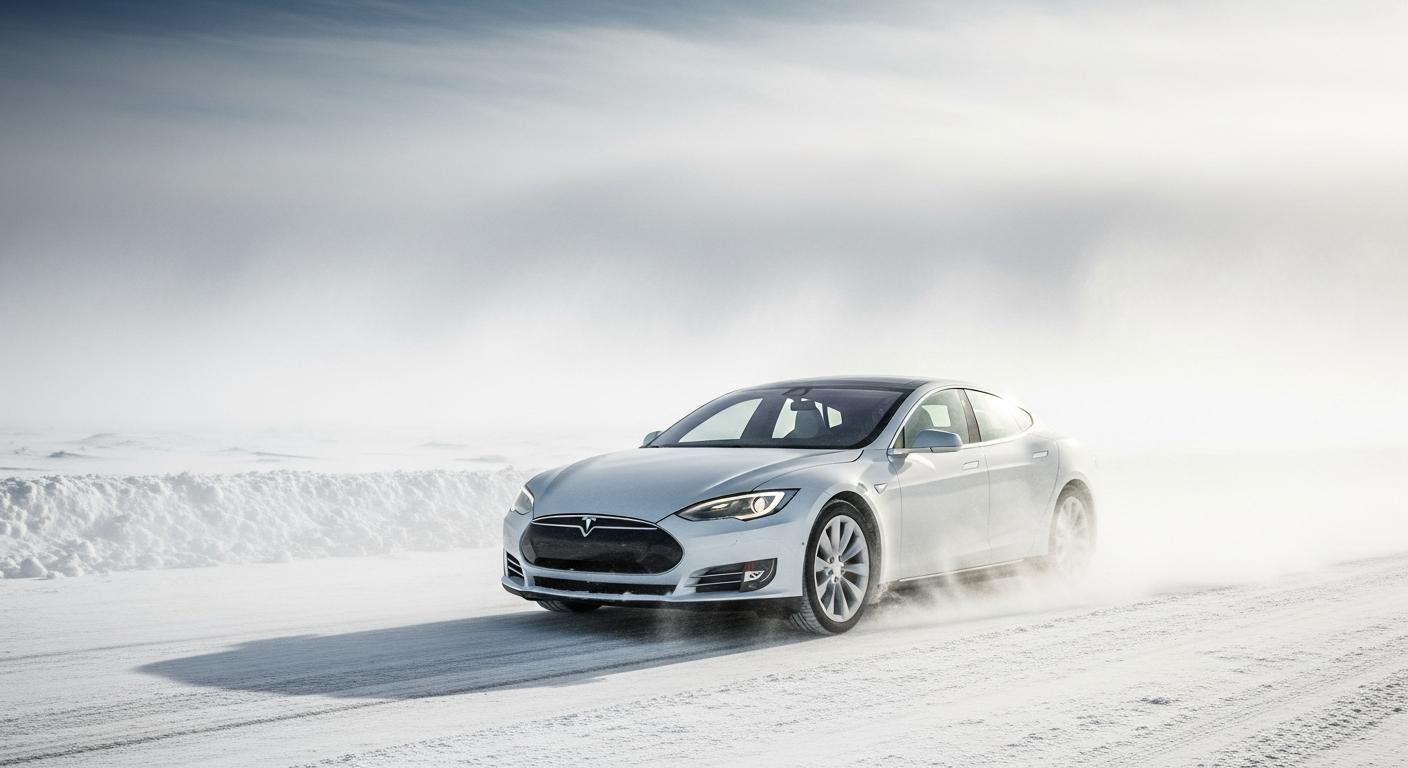
January is not the ideal month to cross the United States. Alex Roy and his team deliberately chose this period to subject the system to extreme conditions: heavy snow, icy roads, treacherous black ice, heavy rain, and intense cold.
These conditions severely tested the 8 cameras of the Tesla Model S and the perception artificial intelligence. The system had to manage critical situations in full autonomy that even experienced drivers dread.
- Aquaplaning on wet pavement
- Snowy roads with invisible markings
- Dense traffic approaching New York
- Reduced visibility due to bad weather
Essential preventive maintenance
While the journey occurred without human intervention in driving, there was one essential action: cleaning the cameras during charging stops. With approximately 10 cumulative hours of charging, the team systematically checked and cleaned the sensors.
This is currently the system’s limitation: the cameras cannot self-clean. In winter conditions, salt, snow, and mud accumulate quickly, compromising the vehicle’s vision. This minimal human action remains necessary to ensure safety.
Technical performance and driving range of the Tesla Model S
Impressive figures
The data from this autonomous Cannonball Run speaks for itself:
- Total duration: 58h22 minutes
- Distance: 4,957 km (3,081 miles)
- Average speed: 64 mph (103 km/h)
- Charging time: approximately 10 cumulative hours
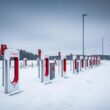
The driving/charging ratio is particularly favorable for such a long journey. Optimizing stops, with battery pre-conditioning before each Supercharger, helped minimize downtime. For a complete crossing of the United States in winter conditions, this is a remarkable performance.
The winning duo: AI4 and FSD v14.2.2.3
The success of this feat relies on the perfect combination of hardware and software. The AI4 chip represents the new generation of Tesla processor, with significantly higher computing power than AI3. It processes the streams from the 8 cameras in real-time with unprecedented precision.
On the software side, FSD v14.2.2.3 is a major version with significantly improved neural learning. The system anticipates, predicts the behavior of other vehicles, and manages obstacles with almost human fluidity. This optimal hardware/software combination made possible what seemed impossible just a year ago.
Alex Roy’s analysis: “The human becomes the error”
Alex Roy’s statement after this journey is as troubling as it is revealing. According to him, the rare errors during the trip were not technical, but human. This paradigm shift deserves attention.
During previous attempts, human interventions sometimes degraded the system’s performance rather than improving it. Alex cites several concrete examples:
- Suboptimal route choices due to excessive caution
- Hesitations during stops that extended the total time
- Unnecessary interventions triggered by reflex, even though FSD was handling the situation perfectly
His conclusion is unequivocal: “The human becomes the error”. Full Self-Driving has reached a system maturity such that it now surpasses human reliability over long distances. This statement raises philosophical questions about the driver’s role in the years to come.
Implications for FSD deployment in France and Europe
While this feat is inspiring, the European reality is quite different. European regulations impose a strict framework that limits autonomy to Level 2. Unlike the United States where “Supervised” FSD is permitted, Europe maintains significant restrictions.
Besoin d'accessoires pour ta Tesla ?
Looking for accessories for your Tesla?
The technological gap between Tesla USA and Tesla Europe is widening. For us, French owners, here is the situation:
- Basic FSD available but with limited features
- Automatic lane changes unavailable
- Advanced urban navigation absent
- Growing frustration within the French-speaking community
The prospects for approval remain uncertain. Tesla is in discussions with European authorities, but the timeline remains unclear (2026-2027 at best). The system will need to adapt to European specificities: different signage, country-specific road codes, varied road infrastructure.
In the meantime, I recommend mastering the use of Superchargers on long journeys to optimize your travels with the currently available features.
Alex Roy’s feat undeniably demonstrates the technical maturity of Full Self-Driving. But between the permissive American context and the regulated European reality, there’s a world of difference. For us, French drivers, this promising technology remains out of reach for now.
I continue to follow regulatory developments closely and hope for a gradual deployment in Europe. According to independent analyses, the transition to higher levels of autonomy will still require time and education for authorities.
In the meantime, I’ve created a delivery checklist to verify the proper functioning of the cameras upon receiving your Tesla. These sensors are essential for Autopilot and the future European FSD, so it’s best to ensure they work perfectly from the start.
And you, how far have you tested your Autopilot? Share your experiences in the comments!
Profitez d'avantages exclusifs en achetant votre Tesla
Vous envisagez d'acquérir une Tesla ? En utilisant mon code de parrainage lors de votre achat, vous pouvez bénéficier d'avantages exceptionnels !
Des kilomètres gratuits de recharge ou d'autres récompenses exclusives, mon code de parrainage est votre passeport pour des avantages supplémentaires : https://ts.la/antoine49352 🤩
Pas de pression, juste une opportunité à saisir pour enrichir votre expérience Tesla.
Découvrez ici le système du parrainage et comment utiliser le code.
Get exclusive perks when buying your Tesla
Thinking about getting a Tesla? If you use my referral code when you purchase, you may be eligible for extra perks.
Free Supercharging miles or other exclusive rewards - my referral code can unlock additional benefits: https://ts.la/antoine49352 🤩
No pressure - just a simple option if you want to enhance your Tesla experience.
Learn how the Tesla referral program works and how to use the code.