

Tesla has just reached a decisive milestone for its autonomous robotaxi project. On February 19, 2026, the Federal Communications Commission (FCC) granted Tesla a crucial waiver to use Ultra-Wideband technology outdoors. This regulatory approval allows the manufacturer to move forward with wireless charging for the Cybercab, an essential element for a fully autonomous vehicle unable to plug in a cable itself.
Specifically, this authorization removes a major obstacle: until now, UWB was reserved for indoor use in the United States. Let me explain what this actually changes for the future of the Cybercab and the Tesla charging network.
The FCC Gives Its Approval for Outdoor Ultra-Wideband
The Federal Communications Commission is the authority that regulates radio communications in the United States. Its green light is not just a simple administrative formality: it technically validates that Tesla’s system will not interfere with other surrounding wireless equipment.
Tesla obtained what is called an outdoor use waiver. Normally, Ultra-Wideband technology was limited to indoor applications such as tracking objects in warehouses or digital car keys. Using it outdoors required proving the system’s complete harmlessness.
Besoin d'accessoires pour ta Tesla ?
Looking for accessories for your Tesla?
This approval comes at a symbolic moment: February 2026, a few months before the planned launch of the Cybercab. For French readers, note that this approval is specific to U.S. territory. Europe will have its own certifications through ETSI and ARCEP.
How the Cybercab’s Wireless Charging Actually Works
The Three-Step Technological Ballet
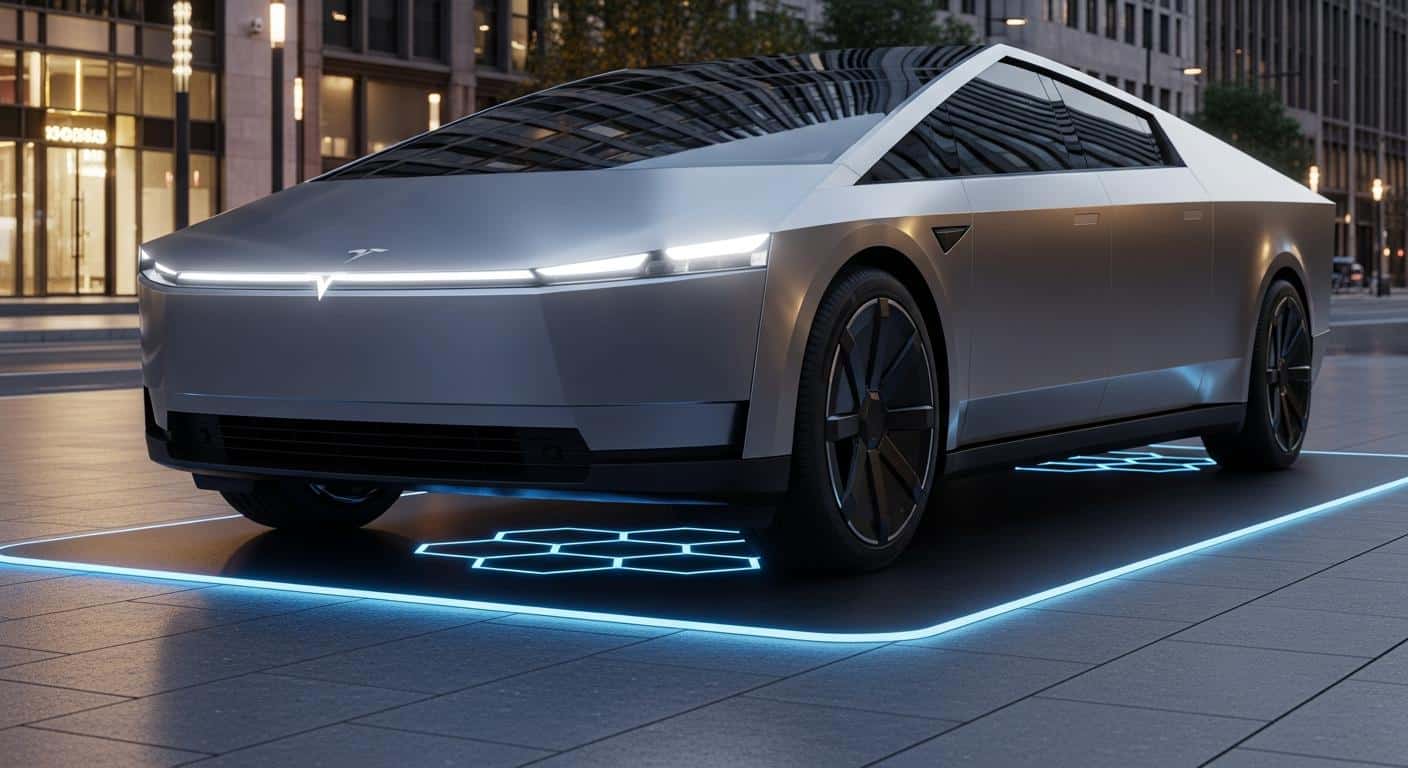
Tesla has been working on wireless charging for its electric vehicles for several years. The Cybercab system relies on a precise three-step technological choreography.
First step: Bluetooth detection. When the Cybercab approaches a wireless charging station, it first detects the station via low-energy Bluetooth. This technology allows rough localization, sufficient to know that a station is nearby.
Second step: Precise positioning via UWB. This is where Ultra-Wideband comes in. For just a few seconds, the UWB system activates to enable centimeter-precise positioning. This precision is essential to perfectly align the vehicle’s charging plate with the one on the ground.
Third step: Activation of inductive charging. Once the vehicle is perfectly positioned, charging begins. The UWB immediately shuts off: it is no longer needed during the hours of charging that follow.
Reassuring System Characteristics
If you’re concerned about radio waves, several elements should reassure you. The UWB signal used is very low power, much lower than that of a smartphone. It only activates for a few seconds, unlike your router’s WiFi which transmits continuously.
Additionally, the vehicle’s metal body naturally attenuates emissions. The range remains limited to a few meters maximum. It’s a bit like the NFC on your bank card, but for positioning a car: brief activation, short range, minimal power.
The Arguments That Convinced the FCC
Tesla did not obtain this waiver by magic. The manufacturer provided comprehensive technical data demonstrating the absence of interference with other communication systems, surrounding vehicles, and even potential medical equipment.
The key argument relies on minimal exposure duration. Unlike the continuous waves of WiFi or 4G, the Cybercab’s UWB only operates for a few seconds per charging session. The rest of the time, during the actual charging hours, no UWB emission occurs.
Natural attenuation by the metal chassis also worked in Tesla’s favor. Engineers demonstrated that emissions detectable outside the vehicle remained well below regulatory thresholds, even at the moment of activation.
A Pragmatic Approach: The Cybercab Maintains Wired Compatibility
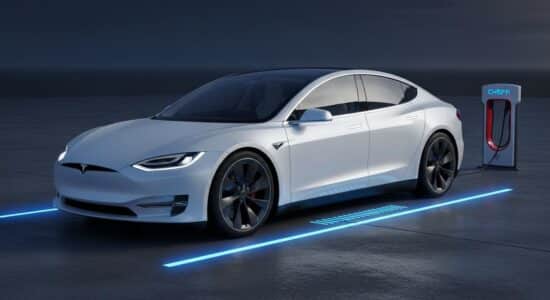
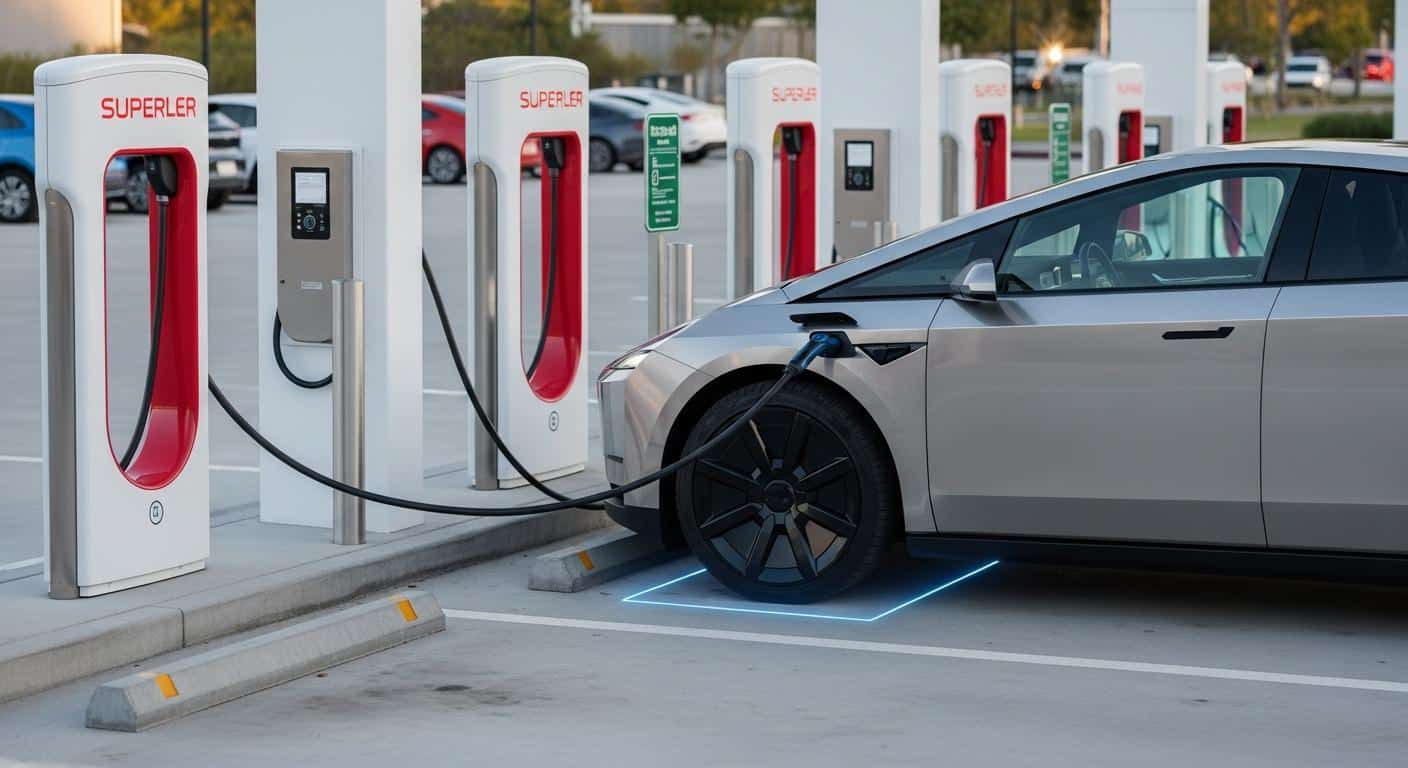
Tesla is not putting all its eggs in the wireless basket. Cybercab prototypes already use the standard Superchargers of the existing network. This maintained compatibility ensures that the robotaxi launch will not be delayed if wireless station deployment takes longer than expected.
The gradual deployment strategy seems logical: the first batches of Cybercab will likely operate with conventional wired charging, while being equipped for wireless. Tesla will then add wireless stations zone by zone, based on profitability and usage density.
This dual infrastructure during the transition leverages Tesla’s major competitive advantage: its existing Supercharger network. By the way, could the NACS charging standard adopted by other manufacturers also evolve toward wireless? The question remains open.
Besoin d'accessoires pour ta Tesla ?
Looking for accessories for your Tesla?
On the competition side, other manufacturers like Rivian or Mercedes are also testing inductive charging systems. As with the Cybertruck’s charging innovations, Tesla tests these technologies on its most recent vehicles. But the major difference lies in the objective: Tesla is targeting robotaxi use without human intervention, not just driver comfort.
What This Changes for the Tesla Network and the Future of the Robotaxi
For a 100% autonomous vehicle, wireless charging becomes essential for complete autonomy. A driverless robotaxi obviously cannot plug in a cable. Wireless eliminates this last human dependency and enables optimal vehicle rotation: as soon as a Cybercab needs charging, it automatically positions itself on an available platform.
For Tesla’s infrastructure, the installation cost of wireless platforms remains to be evaluated. These stations will likely be deployed first in dense urban areas where robotaxi fleets will operate. One question remains open: will Tesla eventually open this technology to the Model 3, Y, S, and X?
On the timeline, the Cybercab launch is scheduled for mid-2026 according to Tesla’s official announcements. The first wireless stations should appear in test phase between 2026 and 2027. Massive deployment seems more realistic around 2028-2030.
For the European market, patience will be required. The FCC approval is only valid for the United States. We will have to wait for equivalent certifications from the relevant authorities in Europe such as ETSI or ARCEP for France. The typical delay between the United States and Europe for this type of technology is generally around 12 to 24 months.
Profitez d'avantages exclusifs en achetant votre Tesla
Vous envisagez d'acquérir une Tesla ? En utilisant mon code de parrainage lors de votre achat, vous pouvez bénéficier d'avantages exceptionnels !
Des kilomètres gratuits de recharge ou d'autres récompenses exclusives, mon code de parrainage est votre passeport pour des avantages supplémentaires : https://ts.la/antoine49352 🤩
Pas de pression, juste une opportunité à saisir pour enrichir votre expérience Tesla.
Découvrez ici le système du parrainage et comment utiliser le code.
Get exclusive perks when buying your Tesla
Thinking about getting a Tesla? If you use my referral code when you purchase, you may be eligible for extra perks.
Free Supercharging miles or other exclusive rewards - my referral code can unlock additional benefits: https://ts.la/antoine49352 🤩
No pressure - just a simple option if you want to enhance your Tesla experience.
Learn how the Tesla referral program works and how to use the code.