




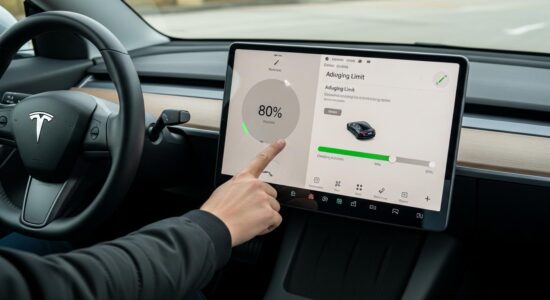
Since I got my Tesla, the question that comes up most often in discussions among owners is this one: what daily charge limit should you really choose? We all face this universal dilemma: prioritize maximum driving range or preserve the longevity of our lithium-ion battery in the long term. Our charging habits have a direct and measurable impact on battery health. Today, I’m going to break down with you the famous 80%, 90%, or 100% recommendations, based on your real-world usage. Don’t worry: there’s no single answer, but smart principles to adapt to your daily life.
Why does Tesla recommend limiting the charge to 80%?
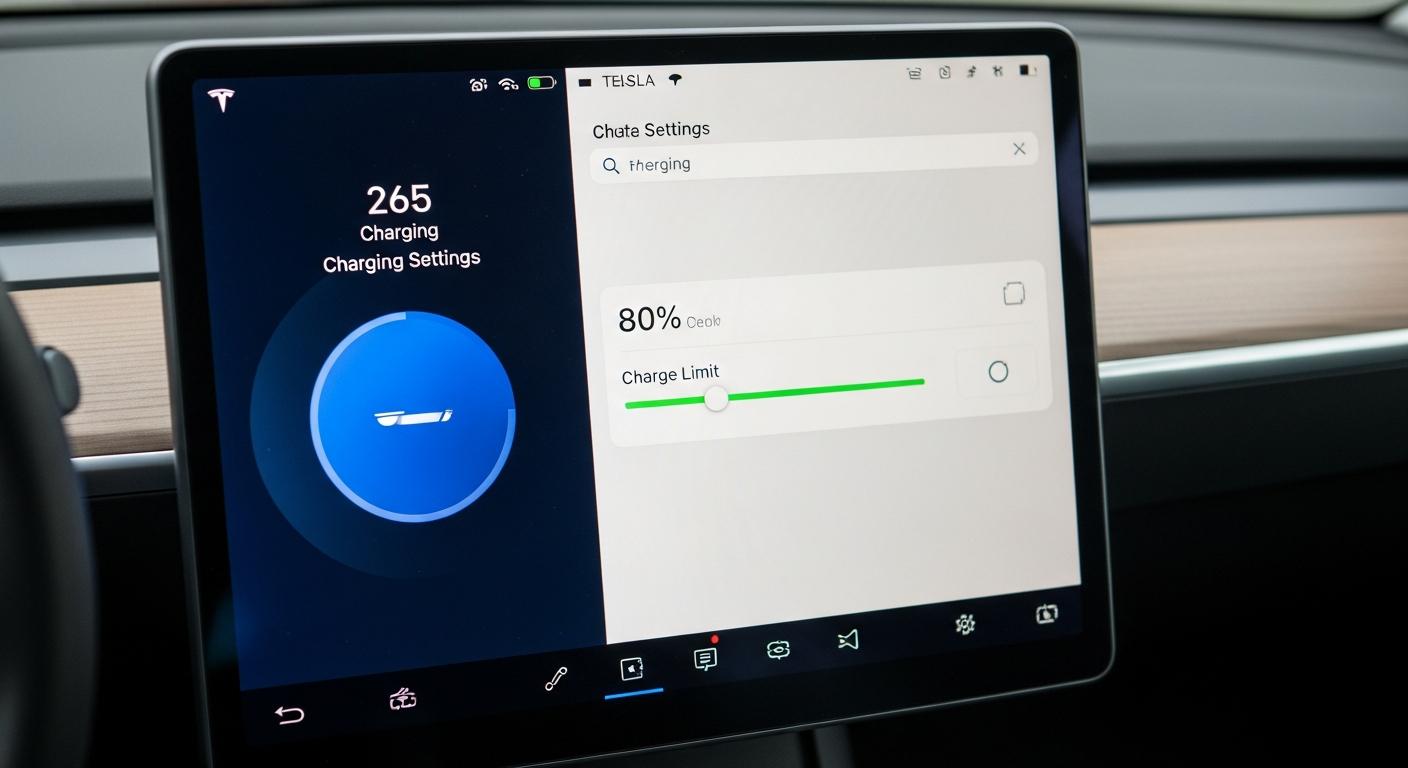
When you receive your Tesla, the interface defaults to an 80% daily charge limit. This is no coincidence. Lithium-ion batteries experience significant chemical stress when maintained at very high charge levels. By staying within this 80% zone, you place your battery in its optimal comfort zone to maximize its longevity.
Think of it like a backpack: you can fill it to the brim every day, but the seams and fabric will wear out much faster than if you fill it three-quarters full. It’s the exact same principle with your battery.
A crucial point to understand: not all Tesla batteries are created equal. LFP cells (Lithium Iron Phosphate), found particularly in some Model 3 Rear-Wheel Drive models, have different characteristics than NMC cells (Nickel Manganese Cobalt). LFP batteries handle full charges much better, whereas NMC batteries truly benefit from this 80% limitation.
Besoin d'accessoires pour ta Tesla ?
Looking for accessories for your Tesla?
In practice, respecting this limit slows down your battery’s annual degradation. Instead of losing 2 to 3% driving range per year, you can keep this loss around 1 to 1.5%. Over ten years, the difference becomes significant.
In which cases should you switch to 90% daily charge?
I won’t lie to you: during my first few months with my Tesla, I religiously imposed the 80% limit on myself. Then winter arrived, and with it, the reality of longer daily commutes and real-world range melting away like snow in the sun.
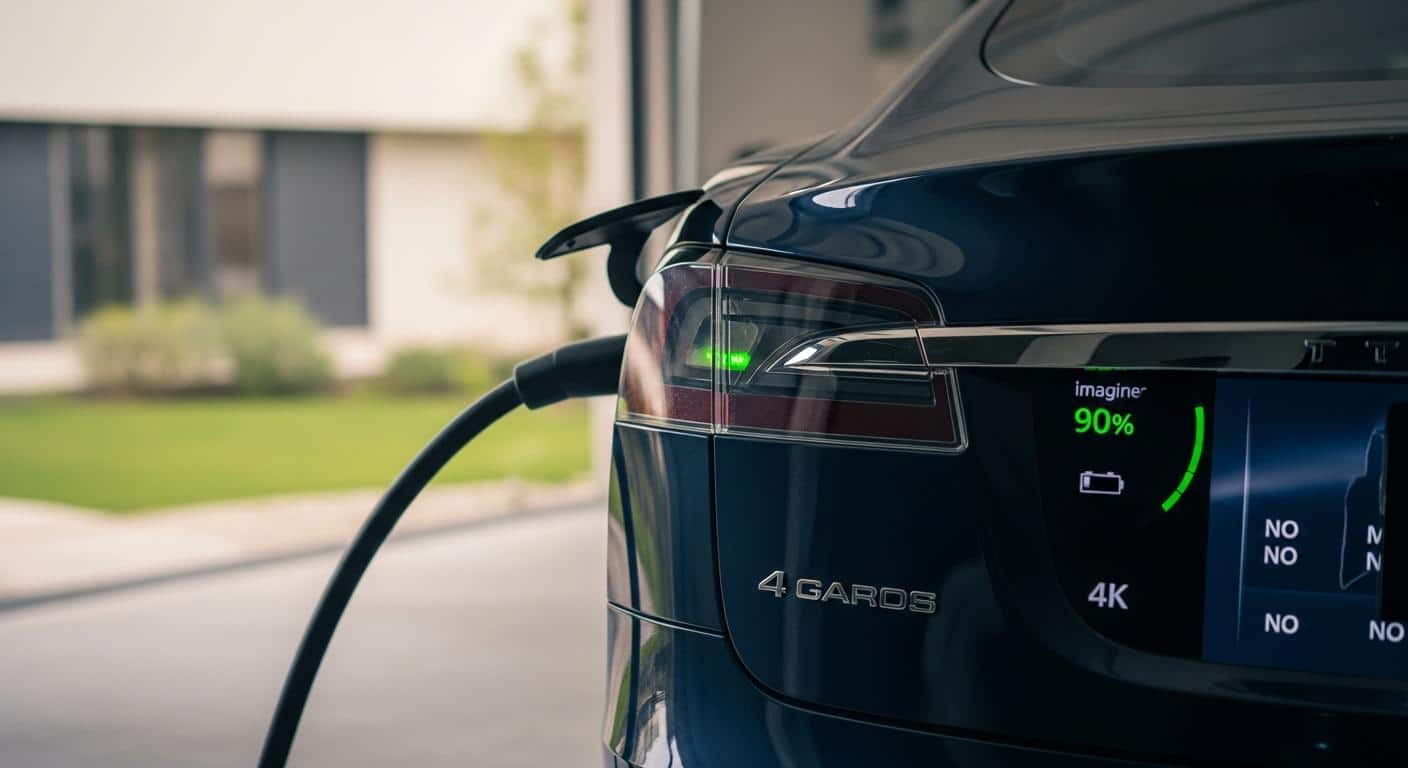
Switching to 90% charge becomes relevant in several concrete situations. If you regularly drive 60 to 80 kilometers per day, especially without an accessible charging station at your destination, these extra 10% offer you real peace of mind. In winter conditions, this is even more true: the driving range loss can reach 30 to 40% in very cold weather.
Personally, I switched from 80 to 90% when I started feeling that famous “range anxiety” every Friday, after a week of varied commutes. It’s a reasonable compromise: yes, there’s a slight impact on battery lifespan, but it remains marginal compared to the gain in daily use comfort.
Signs that 80% is no longer enough
Pay attention to these indicators in your usage:
- You regularly feel stressed at the end of the week about your charge level
- You frequently make detours to urgently recharge
- You constantly calculate if you’ll “make it” before your next unplanned trip
- You charge more than 3 times a week to maintain your driving range
If you check several of these boxes, increasing your limit to 90% will significantly improve your experience without sacrificing your battery’s health.
Charging to 100%: when is it really necessary?
Let’s be clear: charging to 100% should remain exceptional, reserved almost exclusively for long trips. This is the golden rule I impose on myself and that Tesla explicitly recommends for NMC batteries.
Timing is crucial here. When I prepare for a road trip, I always schedule my charge to reach 100% just before I leave, ideally within the hour before. Leaving your battery at 100% for several days or even a full night unnecessarily accelerates its degradation.
My personal protocol for holiday departures: I use the “Scheduled Departure” feature in the Tesla app. I set the departure time, and the car intelligently manages the charge to reach 100% right on time. It even preheats the battery if necessary. It’s truly the perfect tool to optimize these occasional full charges.
The specific case of LFP batteries (especially Model 3 RWD)
If you own a recent Model 3 Rear-Wheel Drive or certain versions imported from China, you probably have an LFP battery. Good news: the rules change completely for you.
Tesla even recommends charging to 100% at least once a week with these batteries. LFP chemistry requires this regular calibration to maintain the accuracy of the driving range estimate. You can identify if you have an LFP battery by looking in your car’s settings: the displayed driving range will be in percentage only, without a mileage estimate at certain levels.
With an LFP battery, you can truly forget the stress of a full charge. It’s one of the great advantages of this technology, even if it generally offers slightly lower energy density. To learn more about global best practices, I invite you to consult my complete guide on extending your battery’s lifespan.
How to adjust my limit according to my real-world usage?
Let’s move on to the truly practical part now: how to determine YOUR ideal limit, the one that matches your unique daily life.
Besoin d'accessoires pour ta Tesla ?
Looking for accessories for your Tesla?
Start by calculating your average weekly mileage. Open the Tesla app, check your energy consumption history for the last 30 days, and calculate an average. Then, apply this simple formula: take your Tesla’s displayed driving range, multiply by 0.8 to get the real-world range under normal conditions (0.6 in harsh winter).
Always keep a 15-20% safety margin. It’s non-negotiable. Unexpected things happen: last-minute detours, dropping temperatures, wanting to turn up the heating. This margin transforms the Tesla experience from anxious to serene.
An often-overlooked point: adjust by season. I personally increase my limit by 5 to 10% in winter, then I lower it in spring. In summer, with optimal energy consumption, I can even allow myself to go down to 75% some weeks. To understand all the secrets to optimizing your Tesla battery, I’ve compiled my best tips in a dedicated article.
My tip: test a limit for two full weeks before adjusting. This way, you’ll have a realistic view of your actual needs, not just your initial impressions.
Here’s a mental chart that can help you get started:
- Daily urban use (less than 50 km/day) → 70-80%
- Mixed use with average commutes (50-100 km/day) → 80-90%
- Regular long distance (more than 100 km/day) → 90% or more
My personal recommendations after several years of use
After three years and over 80,000 kilometers driving my Tesla, here’s what really works for me: I maintain 85% in winter (November to March) and 80% the rest of the year. It’s my sweet spot, the perfect compromise between comfortable driving range and battery preservation.
But most importantly, I’ve learned not to stress anymore. Your Tesla battery is designed to last. It benefits from a Tesla warranty that covers excessive degradation, and the thermal management systems are truly sophisticated. It’s better to enjoy your car fully than to over-optimize every detail to the point of spoiling the experience.
The loss of driving range in winter really justifies these seasonal adjustments. If you want to understand this phenomenon in detail, I’ve written a complete article on winter range degradation which will explain all the mechanisms involved.
My last tip: check your battery’s health once a year. You can do this via third-party apps or simply by observing your displayed maximum driving range after an occasional full charge. This will give you an objective perspective on the effectiveness of your charging habits.
Ultimately, the best charge limit is the one that allows you to drive serenely every day, without range anxiety and without unnecessarily sacrificing your battery. Adapt these tips to your personal context, test, adjust, and most importantly: savor every electric kilometer. To deepen your technical understanding, don’t hesitate to consult the official recommendations on optimal lithium-ion battery management.
Profitez d'avantages exclusifs en achetant votre Tesla
Vous envisagez d'acquérir une Tesla ? En utilisant mon code de parrainage lors de votre achat, vous pouvez bénéficier d'avantages exceptionnels !
Des kilomètres gratuits de recharge ou d'autres récompenses exclusives, mon code de parrainage est votre passeport pour des avantages supplémentaires : https://ts.la/antoine49352 🤩
Pas de pression, juste une opportunité à saisir pour enrichir votre expérience Tesla.
Découvrez ici le système du parrainage et comment utiliser le code.
Get exclusive perks when buying your Tesla
Thinking about getting a Tesla? If you use my referral code when you purchase, you may be eligible for extra perks.
Free Supercharging miles or other exclusive rewards - my referral code can unlock additional benefits: https://ts.la/antoine49352 🤩
No pressure - just a simple option if you want to enhance your Tesla experience.
Learn how the Tesla referral program works and how to use the code.