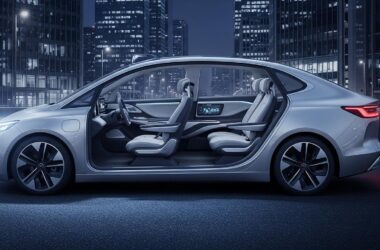




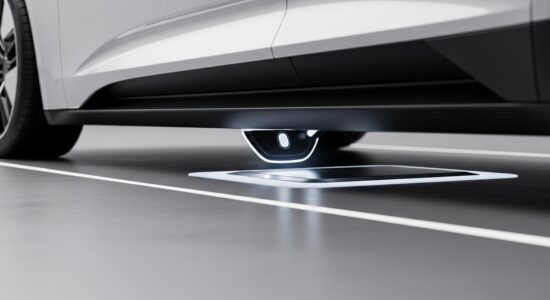
A surprising detail has just caught the attention of the most observant: the Cybercab prototypes currently circulating in the United States reportedly feature a mysterious panel at the rear, precisely where Tesla usually installs its charging ports. However, during the official presentation in October 2024, Elon Musk only spoke of wireless charging for this autonomous robotaxi.
So, a simple technical access panel or a real NACS port in preparation? This observation raises a fascinating question: Is Tesla finally preparing a dual charging solution for its Cybercab?
I suggest we analyze together what this seemingly insignificant detail reveals about Tesla’s actual industrial strategy.
A Mysterious Panel Puzzles the Tesla Community
It was Owen Sparks who ignited the discussion by spotting this intriguing detail in a video by Josh West shared on X. The Cybercab prototypes filmed in circulation feature a panel at the rear whose dimensions exactly match those of a standard NACS charging port.
Besoin d'accessoires pour ta Tesla ?
Looking for accessories for your Tesla?
The placement is no coincidence: it is located precisely in the area where Tesla traditionally installs its charging ports on all its other vehicles. It’s impossible not to see a troubling similarity.
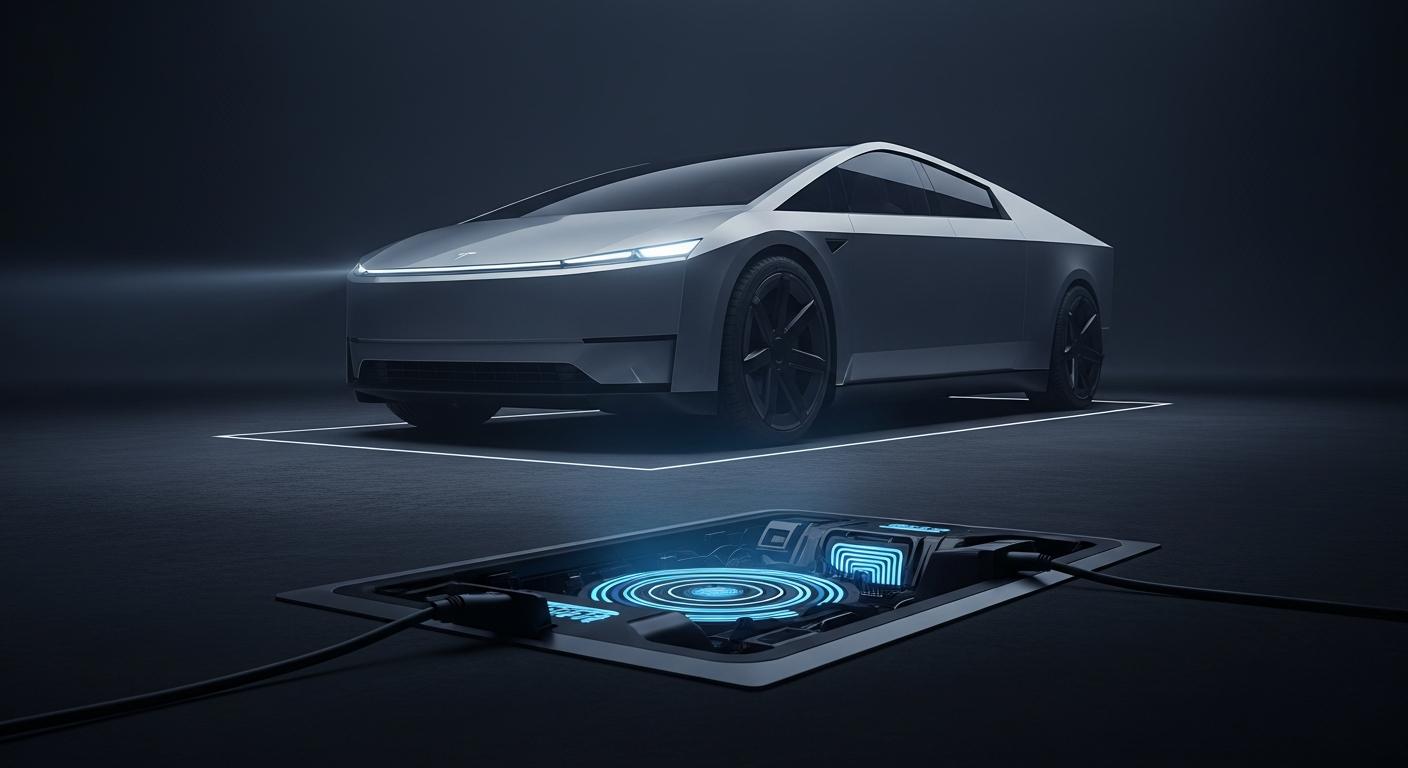
The contrast with official announcements is striking. During the Cybercab presentation in October 2024, Tesla only highlighted inductive wireless charging, presented as THE solution for this futuristic robotaxi. No mention of a physical port.
On forums and social media, the Tesla community was abuzz. Some see it as a simple technical access hatch, others a pragmatic Plan B in the face of wireless challenges.
My analysis? This type of field observation is rarely a coincidence. When Tesla discreetly modifies its prototypes between announcement and production, it usually reveals very real industrial adjustments.
Wireless Charging: A Promise Yet to Be Deployed
Let’s recall the facts: at the end of 2024, Tesla presented the Cybercab with an inductive charging system as the sole charging option. The vision was appealing: a robotaxi automatically positioning itself on a charging platform, without any human intervention.
The concept perfectly aligns with the DNA of the autonomous vehicle. No driver, no physical handling, everything is automated.
The thing is: several months after the announcement, no Tesla wireless charging infrastructure is visible anywhere. No photos of inductive stations under construction, no communications about the deployment of this network.
Yet the announced production schedule speaks of “a few months” according to Elon Musk’s latest communications. How can a robotaxi service be launched without operational charging infrastructure?
The reality is that deploying a network of inductive charging stations requires colossal time and investment. Stations need to be designed, tested, mass-produced, installed, and certified…
The gap between marketing announcements and industrial reality raises entirely legitimate questions about Tesla’s actual strategy.
The NACS Port as a Pragmatic Transitional Solution
Immediate Access to the Existing Supercharger Network
Integrating a physical port would completely change the game. The Cybercab would have a major advantage: instant compatibility with the thousands of Tesla Superchargers already operational worldwide.
This strategy would allow for the deployment of the autonomous robotaxi service without waiting for the construction of parallel infrastructure. The first Cybercabs could begin operating immediately in areas already covered by the Supercharger network.
The Cybercab could thus immediately benefit from the existing network and all its advantages – if you want to know more about how Tesla Superchargers work, I detailed their use in another article.
Besoin d'accessoires pour ta Tesla ?
Looking for accessories for your Tesla?
From an economic standpoint, the calculation is undeniable: using existing infrastructure rather than building an entirely new network represents substantial savings and a significantly reduced time-to-market.
Intelligent Redundancy for Autonomous Driving
But there’s another strategic advantage: the dual compatibility offers safety redundancy. If the wireless system encounters a technical problem, the physical port automatically takes over.
For an autonomous robotaxi in continuous service, this operational reliability is absolutely critical. A vehicle that generates revenue 24/7 simply cannot afford to run out of charge.
And with an autonomous system, the Cybercab could even automatically manage functions like battery pre-conditioning to optimize fast charging, thereby maximizing its operating time.
This approach also reflects Tesla’s engineering philosophy: systematically prioritizing redundancy for critical systems. Innovation, yes, but never at the expense of reliability.
Other Reliability-Oriented Design Clues
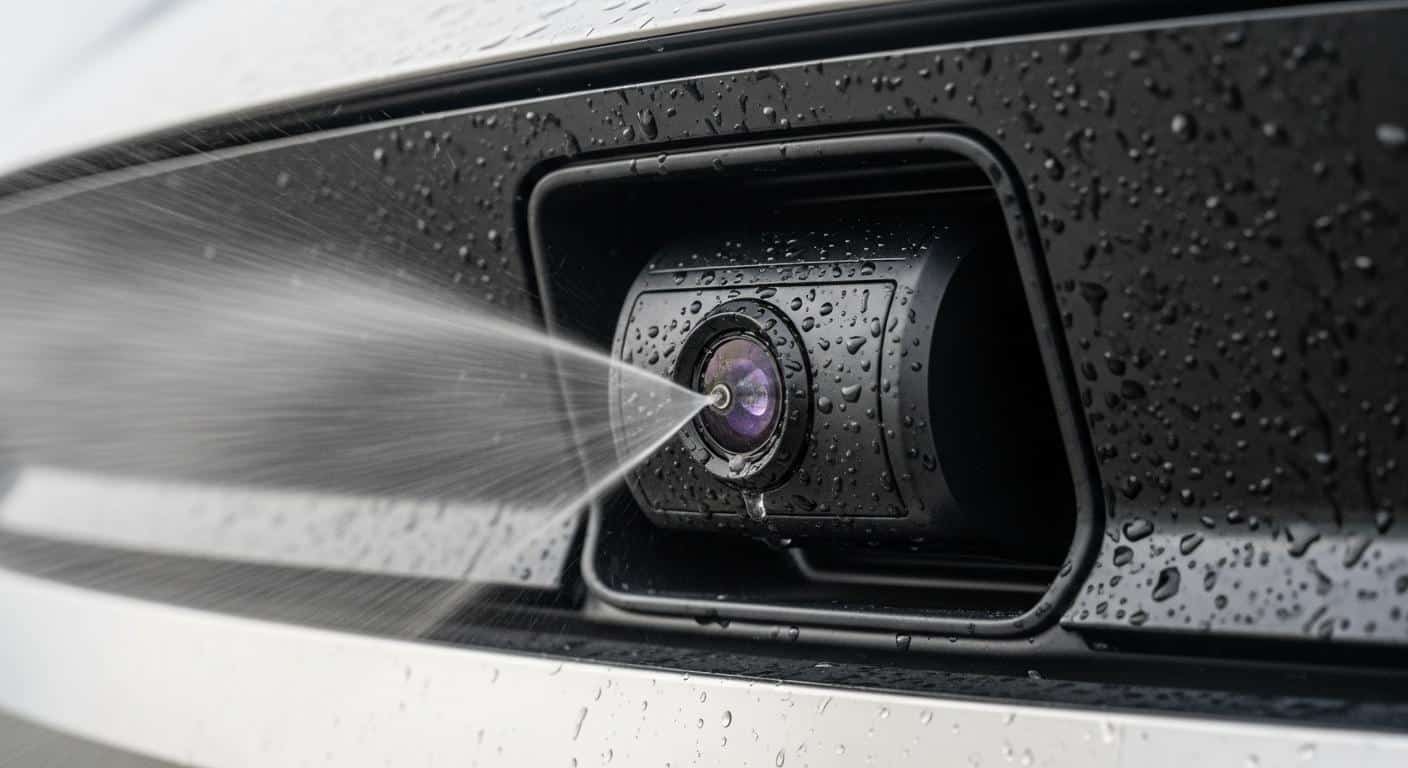
The charging port is not the only practical detail spotted on the prototypes in circulation. Observers have also confirmed the presence of a rear camera washing system on Cybercabs seen in Chicago.
This detail may seem insignificant, but it reveals a lot. For autonomous driving, clean cameras are an absolute prerequisite. A dirty sensor means a blind system.
The continuous operation of a robotaxi implies driving in all weather conditions: rain, snow, mud, various splashes. Without an automatic cleaning system, it’s impossible to guarantee reliable 24/7 service.
We find exactly the same logic as for the physical port: prioritizing operational robustness over minimalist design. Tesla seems to be refining all practical details before commercial launch, a sign of a more mature approach.
This is the fundamental difference between a presentation prototype designed to impress and a production vehicle designed to operate in the real world.
Between Innovation and Industrial Realism
What this charging port story ultimately reveals is the delicate balance Tesla must maintain between futuristic vision and operational constraints. Selling a revolutionary concept while preparing a truly viable product.
If we look at Tesla’s history, this approach is nothing new. The deployment of the Model 3, the evolution of FSD, the Cybertruck… each time, significant adjustments between initial announcements and final production.
This pragmatic approach is part of Tesla’s product strategy which aims to democratize its technologies while maintaining industrial viability.
The probable strategy? A progressive deployment: Phase 1 with NACS charging on the existing Supercharger network, allowing for a rapid service launch. Then Phase 2 with wireless infrastructure once it is truly operational and tested at scale.
For future robotaxi service users, this dual approach concretely means a service available more quickly, with better geographical coverage from the outset.
Wireless probably remains the ultimate goal – the ideal solution for a fully autonomous vehicle. But the physical port represents a smart bridge to this future, as confirmed by industry experts’ analyses on the technical challenges of inductive charging.
My personal opinion? This approach shows a more mature Tesla, one that learns from its past experiences. Prioritizing operational reliability over the spectacular is exactly what’s needed to transform a fascinating concept into a truly functional service.
Profitez d'avantages exclusifs en achetant votre Tesla
Vous envisagez d'acquérir une Tesla ? En utilisant mon code de parrainage lors de votre achat, vous pouvez bénéficier d'avantages exceptionnels !
Des kilomètres gratuits de recharge ou d'autres récompenses exclusives, mon code de parrainage est votre passeport pour des avantages supplémentaires : https://ts.la/antoine49352 🤩
Pas de pression, juste une opportunité à saisir pour enrichir votre expérience Tesla.
Découvrez ici le système du parrainage et comment utiliser le code.
Get exclusive perks when buying your Tesla
Thinking about getting a Tesla? If you use my referral code when you purchase, you may be eligible for extra perks.
Free Supercharging miles or other exclusive rewards - my referral code can unlock additional benefits: https://ts.la/antoine49352 🤩
No pressure - just a simple option if you want to enhance your Tesla experience.
Learn how the Tesla referral program works and how to use the code.