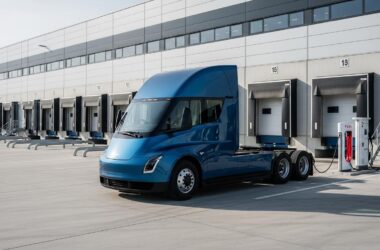





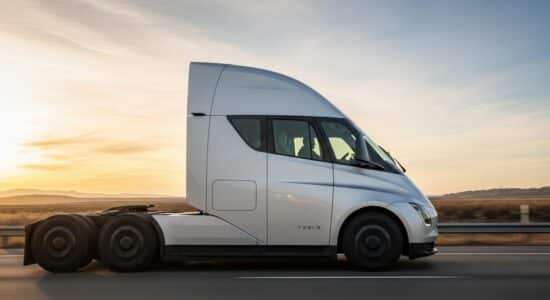
After years of waiting and speculation, Tesla finally lifts the veil on the true specifications of the Tesla Semi. Announced with great fanfare in 2017, this electric truck has experienced numerous delays, but it is now entering its final phase before mass production.
Today, I can finally share concrete figures with you: two confirmed versions, precise driving ranges, record charging power, and an impressive motor architecture. Let’s break down these technical specifications together, which are set to transform electric road transport.
Two Versions to Meet Different Logistics Needs
Tesla now offers two distinct Semi configurations, each adapted for specific uses. The Standard Range version offers a driving range of 523 km at maximum load (82,000 lbs, or approximately 37 tons). The Long Range version, meanwhile, reaches 805 km with the same gross vehicle weight.
The difference between these two versions is not limited to the battery. The Standard Range Semi weighs less than 20,000 lbs unladen, while the Long Range version reaches 23,000 lbs. This weight difference of 3,000 lbs (approximately 1.4 tons) has a direct impact on the transportable payload.
Besoin d'accessoires pour ta Tesla ?
Looking for accessories for your Tesla?
Fewer batteries mean more goods on board. The strategic positioning is clear: the Standard version is perfectly suited for short urban and regional trips, while the Long Range targets more extended routes. Interesting point: despite the difference in battery capacity, both versions show the same energy consumption of 1.7 kWh per mile.
Ultra-Fast Charging Thanks to the MCS 3.2 Standard
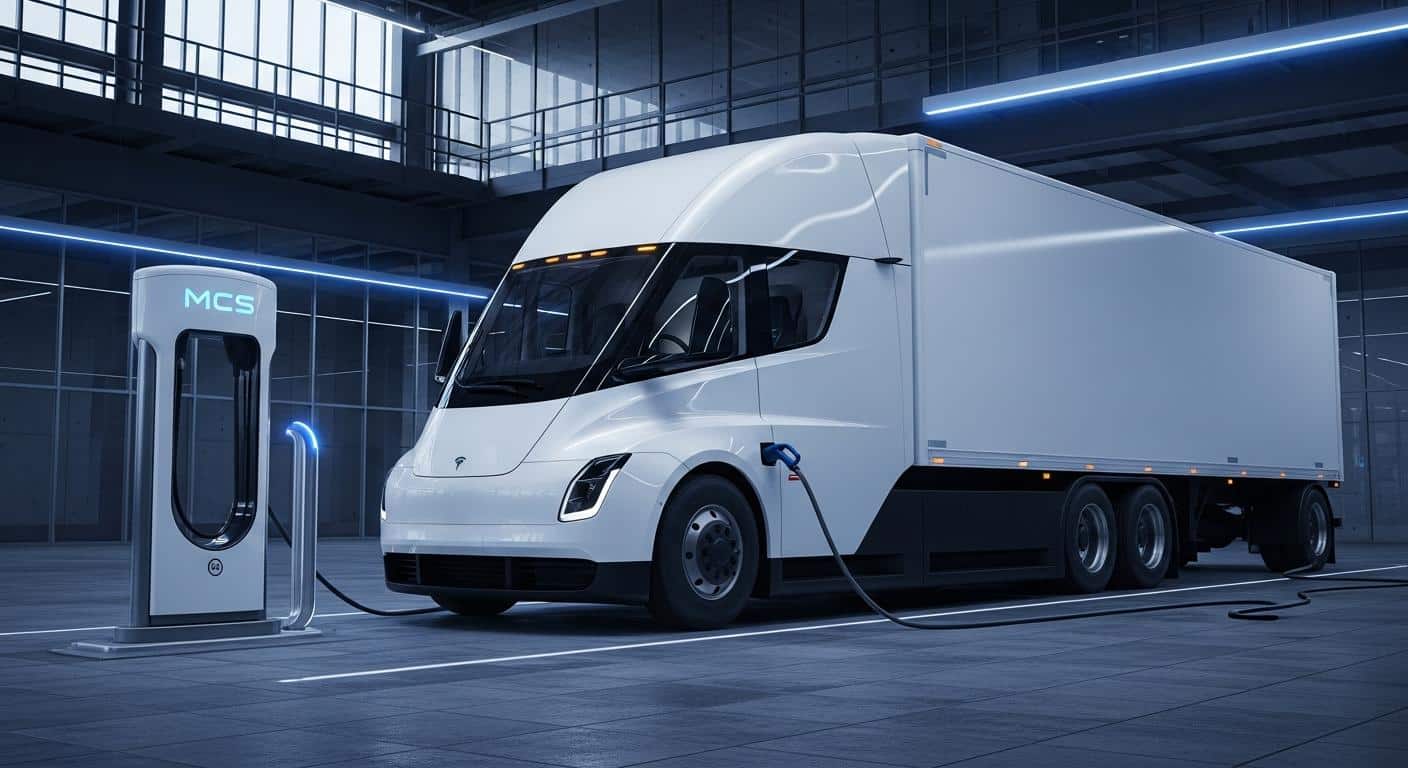
This is probably the most impressive innovation of the Tesla Semi: its charging capability. The truck uses the Megawatt Charging System 3.2 (MCS 3.2), a new standard specifically developed for electric heavy-duty vehicles.
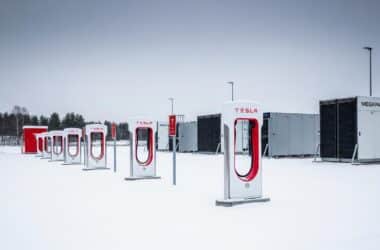
The Long Range version can reach a maximum power of 1.2 MW, or 1,200 kW. To give you an idea of what that represents, it’s six times more powerful than a classic Supercharger V3 (250 kW). If you want to better understand how Tesla Superchargers work, this comparison makes perfect sense.
Specifically, this power allows for 60% charge recovery in 30 minutes. This corresponds to approximately 480 km of driving range recovered during a mandatory break. Of course, there is still a gap with the 5 to 10 minutes needed to refuel a diesel truck, but this time becomes quite acceptable for daily operations.
As with Tesla passenger vehicles, battery preconditioning before charging plays a crucial role in optimizing these performances. Be aware, however: this technology requires dedicated MCS stations, which are currently being deployed.
Motor Architecture: 3 Independent Units and 800 kW of Power
The Tesla Semi relies on a particularly sophisticated motor configuration that explains its exceptional performance.
Motor Configuration on the Rear Axles
Tesla has opted for 3 independent electric motors mounted on the rear axles. The total drive power reaches up to 800 kW, or approximately 1,073 horsepower.
This architecture offers several major advantages: redundancy ensures increased safety, optimal torque management improves performance, and energy efficiency is maximized through intelligent power distribution based on load and road conditions.
ePTO System for Auxiliary Equipment
The Semi also integrates an ePTO (Electric Power Take-Off) system capable of delivering up to 25 kW. This power take-off supplies refrigeration systems, liftgates, and other auxiliary equipment.
The advantage over diesel is considerable: no more need for an auxiliary engine running continuously. The result: better energy efficiency and a significant reduction in noise pollution, particularly valuable during nighttime urban deliveries.
Mass Production Confirmed for 2026 After Years of Waiting
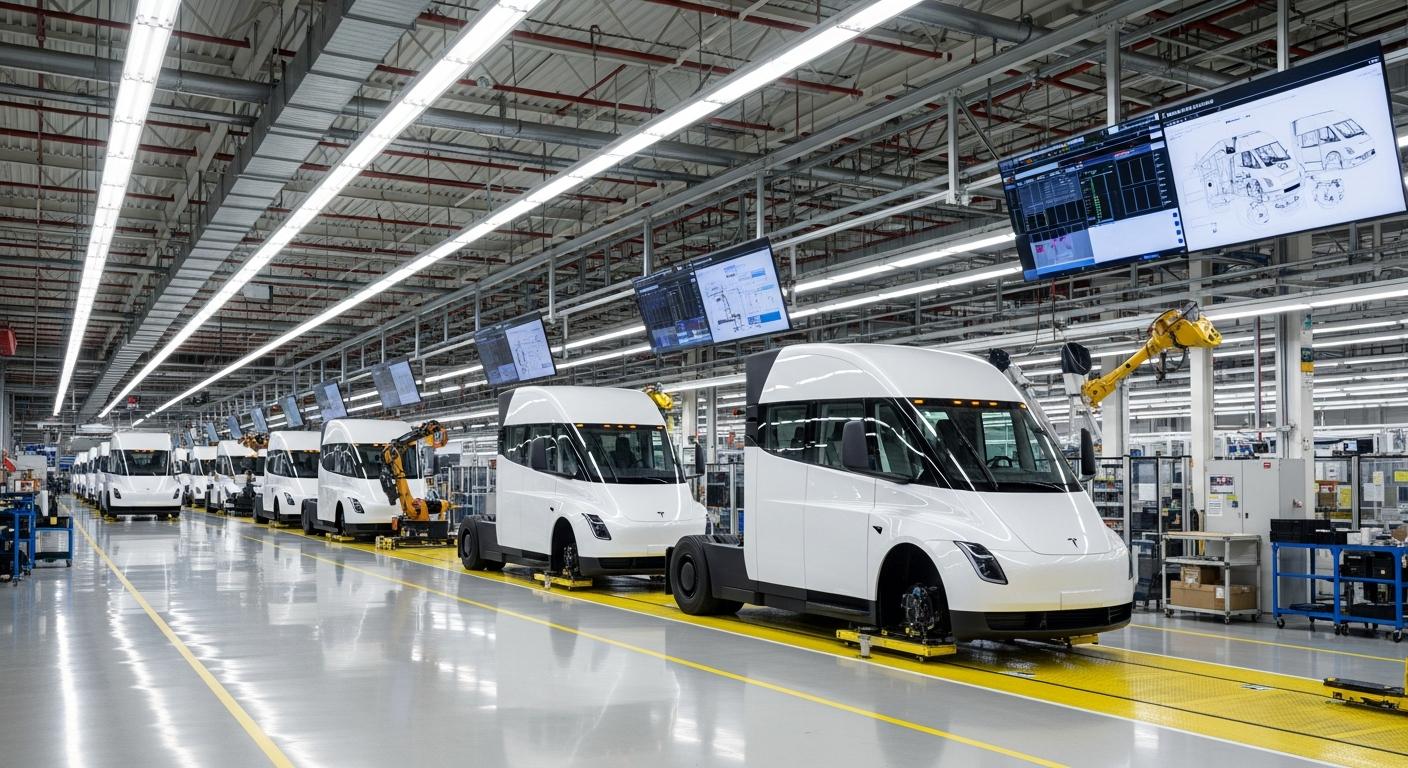
Let’s be honest: the Tesla Semi’s journey has been chaotic. Announced in 2017 with production initially planned for 2019, the project has been postponed several times. Elon Musk recently confirmed that mass production will begin in 2026.
A dedicated factory in Sparks, Nevada is now ready for deployment. Currently, Tesla maintains limited production for select pilot customers. Pepsi Co. and Frito-Lay have been using several Semis for a few years for real-world conditions tests.
Feedback has been positive despite the delays. These postponements are explained by major technical adjustments: battery optimization, charging system refinement, reliability improvement. Tesla clearly preferred to delay the launch rather than market an immature product.
Besoin d'accessoires pour ta Tesla ?
Looking for accessories for your Tesla?
This approach is part of Tesla’s complete electrification strategy, which now covers all segments, from compact vehicles to heavy-duty trucks.
Current Positioning Limited to Regional Routes
Let’s be clear about the current limitations of the Tesla Semi. The main constraint lies in the absence of a sleeper cabin for long-haul trips. This limitation naturally directs the truck towards regional deliveries with daily return to base.
The use cases of Pepsi and Frito-Lay perfectly illustrate this positioning: predefined routes, controlled distances, simplified planning. The advantage of this approach is the possibility of recharging overnight at the depot, without relying on a still-emerging public infrastructure.
A long-haul version with a sleeper cabin is under development to tackle the intercontinental transport segment, currently dominated by diesel. Tesla is adopting a pragmatic strategy: first conquer the segments where the Semi excels before tackling more complex uses.
To delve deeper into the regulatory and technical aspects of heavy-duty vehicle electrification, you can consult official technical information on the subject.
Tesla is finally delivering concrete figures after years of mystery. The Semi’s true strengths are undeniable: ultra-fast 1.2 MW charging, a viable driving range of over 500 miles, and a powerful 800 kW motorization. The limitations are acknowledged: no sleeper cabin yet and an MCS infrastructure to develop. 2026 will mark the real test with mass production. The Semi is finally moving from prototype status to an industrial product. Electric road transport is moving from promise to measurable reality.
Profitez d'avantages exclusifs en achetant votre Tesla
Vous envisagez d'acquérir une Tesla ? En utilisant mon code de parrainage lors de votre achat, vous pouvez bénéficier d'avantages exceptionnels !
Des kilomètres gratuits de recharge ou d'autres récompenses exclusives, mon code de parrainage est votre passeport pour des avantages supplémentaires : https://ts.la/antoine49352 🤩
Pas de pression, juste une opportunité à saisir pour enrichir votre expérience Tesla.
Découvrez ici le système du parrainage et comment utiliser le code.
Get exclusive perks when buying your Tesla
Thinking about getting a Tesla? If you use my referral code when you purchase, you may be eligible for extra perks.
Free Supercharging miles or other exclusive rewards - my referral code can unlock additional benefits: https://ts.la/antoine49352 🤩
No pressure - just a simple option if you want to enhance your Tesla experience.
Learn how the Tesla referral program works and how to use the code.