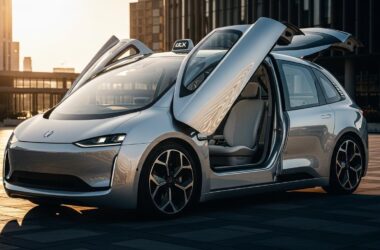

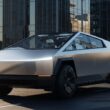


When the first videos of the public Tesla Cybercab tests started circulating on social media, a detail immediately caught my attention: a clearly visible manual charging port at the rear of the vehicle. My first reaction? The same as many observers: why on earth would a 100% autonomous robotaxi, without a steering wheel or pedals, need human intervention to charge?
Tesla had, however, grandly announced wireless induction charging as the main solution for its autonomous fleet. This apparent paradox deserves our attention, because behind what looks like a compromise lies a perfectly rational industrial logic. Let’s explore together the pragmatic reasons behind this technical decision.
A classic charging port discovered on the prototypes
It was during public demonstrations in the United States that the most attentive observers spotted this famous port. Videos and photos shared on Twitter and YouTube clearly show a manual flap at the rear of the vehicle, equipped with an accessible lock.
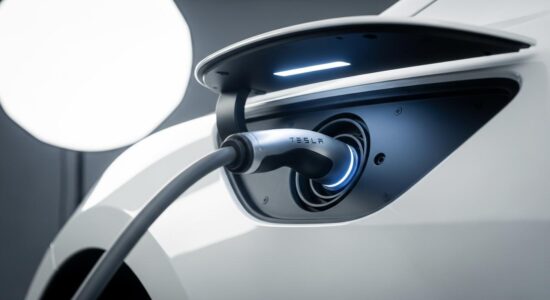
The location is strategic: positioned at the rear, this flap provides access to a perfectly classic manual charging port. The connection type? A standard physical connection, perfectly compatible with the Tesla Supercharger network already deployed worldwide.
Besoin d'accessoires pour ta Tesla ?
Looking for accessories for your Tesla?
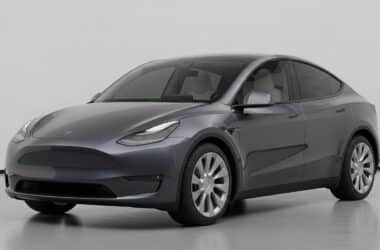
Reactions from the Tesla community were mixed. Some saw it as a disappointment compared to promises of full autonomy, while others praised the pragmatism of this approach. What personally struck me was the simplicity of the installation – exactly like on a current Model 3 or Model Y.
It’s important to remember that we are observing prototypes in the testing phase here. Large-scale production is only planned for April 2026, which still leaves time for adjustments. The Cybercab relies entirely on the Full Self-Driving system as its sole means of control, without any manual backup controls.
The Dual Strategy: Induction AND Cable
Induction Charging for Robotaxi Operation
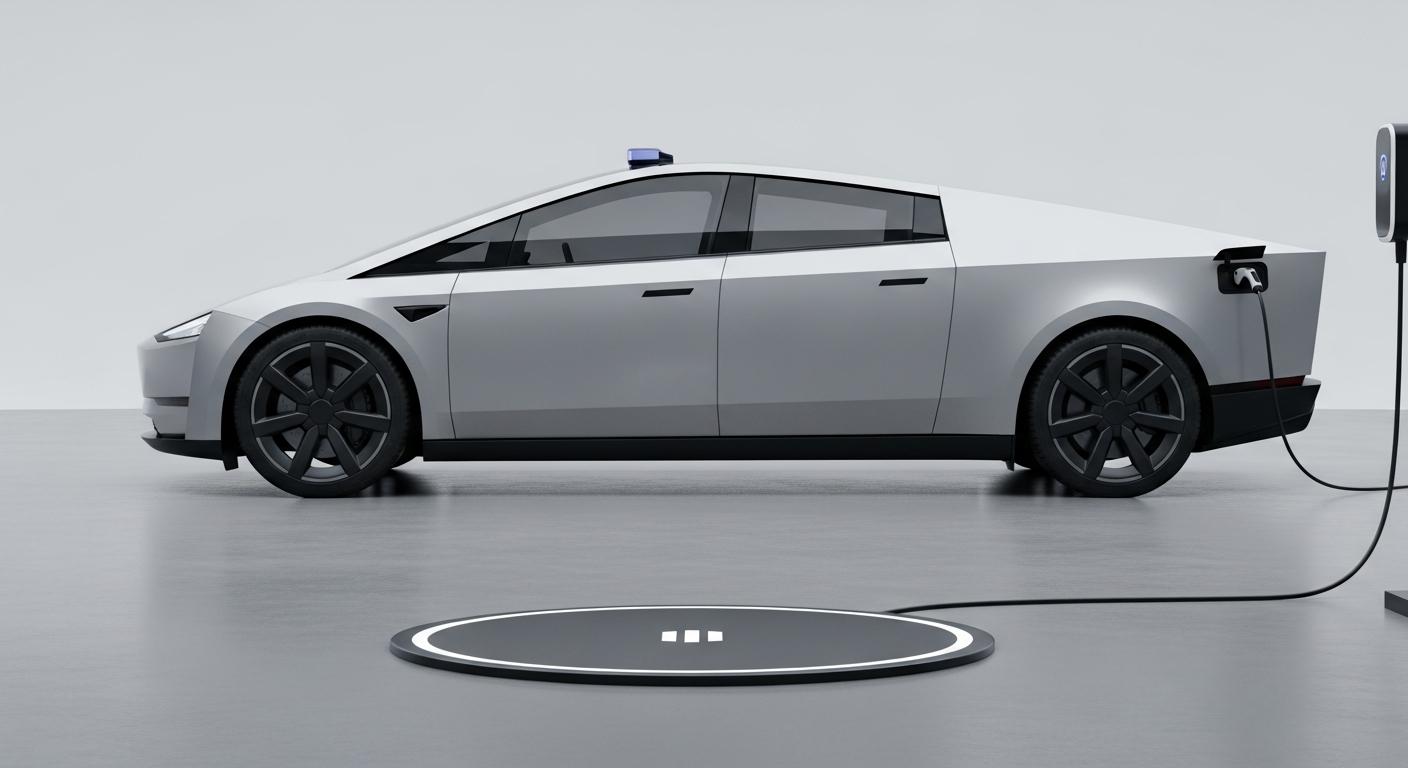
Tesla has not abandoned its ambition for induction charging. The wireless system remains planned for the daily operations of the robotaxi fleet. The principle is appealing: the vehicle automatically positions itself on an induction platform, without any human intervention.
The operational advantage is obvious. For quick rotations between rides, with short and frequent charges (15 to 20% battery), induction allows maximizing in-service time. It’s like a smartphone on its wireless charger, but on the scale of an autonomous car capable of generating revenue 24/7.
Wired Charging for Maintenance and Full Charges
The wired charging port addresses a different need: full charges during periods of maintenance or low demand. The technical advantage is undeniable – charging power is higher and energy efficiency is maximized.
I’m thinking of times when the vehicle is not in use: night, scheduled maintenance, software updates. That’s exactly what I do with my own Tesla – fast charging during the day when needed, full charge at home overnight. The reality is that the Supercharger infrastructure is already deployed and ultra-reliable.
This complementarity is not a flaw, it’s a strength: two systems for two distinct and complementary needs.
The Technical Challenges of High-Power Induction
Let’s talk frankly about the physical constraints. The major problem with induction charging is energy losses due to thermal transfer. According to current technologies, we’re talking about 20 to 30% of energy lost as heat.
Let’s compare concretely: a wired charge achieves about 95% efficiency, while induction charging tops out between 70 and 80% in the best-case scenario. Tesla has already experimented with induction using its wireless charging pads for smartphones integrated into current vehicles.
User feedback? Rather mixed. Recurring complaints about slowness, excessive heating, imprecise phone positioning. My iPhone often heats up on my Model Y’s charger, and it only charges at a maximum of 15W – far from optimal.
The scale challenge is colossal: going from 15W for a smartphone to 50-100 kW for an electric vehicle represents exponential complexity. The perfect alignment between the transmitting coil and the receiver becomes critical. The slightest deviation of a few centimeters can drastically reduce efficiency.
Not to mention the cost: installing high-power induction stations is much more expensive than deploying conventional charging stations. The technology exists, certainly, but it is not mature enough for mass deployment by 2026.
A Realistic Choice Given the Production Schedule
The deadline is tight: April 2026, less than two years to go from prototype to 2026 series production. Developing reliable and efficient induction technology requires several years of research and development.
Besoin d'accessoires pour ta Tesla ?
Looking for accessories for your Tesla?
Tesla has always favored an iterative approach: launching with a proven solution, then gradually improving. Look at the history: Autopilot, Full Self-Driving, 4680 batteries – all these systems have been deployed in successive phases.
My personal conviction? Tesla has always preferred to deliver a functional product rather than waiting for hypothetical perfection. The strategic advantage is enormous: leveraging the existing Supercharger network with over 45,000 charging stations deployed worldwide.
The transition plan seems clear to me: manual port for the 2026 launch, then gradual deployment of induction in subsequent years. For an initial robotaxi fleet of a few thousand vehicles, periodic human intervention remains perfectly acceptable operationally.
The competitive context also plays a role: Tesla wants to outpace Waymo and Cruise in the European and Asian markets. In this affordable autonomous vehicle strategy, every month counts. This is not a technological setback, it’s a smart step towards full autonomy.
Furthermore, to better understand how to optimize charging efficiency on Supercharger, Tesla has developed preconditioning features that will be essential to maximize the Cybercab’s operational time.
Ultimately, this manual charging port is absolutely not a failure, but a rational industrial choice. The dual system – induction for daily operation, wired for full charges – offers maximum flexibility.
As a Tesla owner, I perfectly understand this logic: a solution that works today is better than a futuristic promise postponed for three years. Automotive innovation happens through successive iterations, not instant revolutions. To delve deeper into these technological and regulatory issues, I recommend consulting in-depth sectoral analyses that shed light on the challenges of full autonomy.
What about you, do you prefer them to launch quickly with a manual port, or wait 2-3 more years for perfect induction?
Profitez d'avantages exclusifs en achetant votre Tesla
Vous envisagez d'acquérir une Tesla ? En utilisant mon code de parrainage lors de votre achat, vous pouvez bénéficier d'avantages exceptionnels !
Des kilomètres gratuits de recharge ou d'autres récompenses exclusives, mon code de parrainage est votre passeport pour des avantages supplémentaires : https://ts.la/antoine49352 🤩
Pas de pression, juste une opportunité à saisir pour enrichir votre expérience Tesla.
Découvrez ici le système du parrainage et comment utiliser le code.
Get exclusive perks when buying your Tesla
Thinking about getting a Tesla? If you use my referral code when you purchase, you may be eligible for extra perks.
Free Supercharging miles or other exclusive rewards - my referral code can unlock additional benefits: https://ts.la/antoine49352 🤩
No pressure - just a simple option if you want to enhance your Tesla experience.
Learn how the Tesla referral program works and how to use the code.