


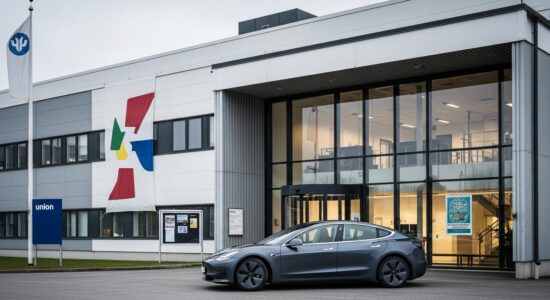
The labor dispute between Tesla and the Swedish union IF Metall, ongoing since late 2023, has just reached a symbolic milestone. In February 2025, the powerful American automotive union, UAW (United Auto Workers), officially lent its support to Swedish workers in their fight to obtain a collective bargaining agreement.
This internationalization of the conflict perfectly illustrates the clash between two visions of the world of work: on one side, the Nordic social model based on social dialogue and collective agreements; on the other, Tesla’s approach prioritizing direct relations with its employees.
But the union movement doesn’t stop at declarations of support. In Stockholm, a new tactic is emerging: activists are placing yellow flyers on the windshields of parked Teslas, deceptively resembling parking tickets. A guerrilla communication strategy that directly targets the Californian manufacturer’s brand image.
In this article, I’ll explain how this Swedish conflict is becoming a real test for Tesla in the European market, and why the UAW’s entry into the battle could mark a turning point in Elon Musk’s company’s labor relations.
Besoin d'accessoires pour ta Tesla ?
Looking for accessories for your Tesla?
The Swedish conflict: a strike that has been dragging on since late 2023
It all began in late 2023 when Tesla refused to sign a collective bargaining agreement with IF Metall, the main Swedish metalworkers’ union. In Sweden, collective bargaining agreements are not just a mere formality: they form the very foundation of the Nordic social model.
Unlike France or other European countries, Sweden does not have a legal minimum wage. Everything is handled through collective bargaining between employers and unions. Refusing to sign a collective bargaining agreement therefore calls into question an entire system based on social dialogue.
Faced with Tesla’s refusal, IF Metall triggered a solidarity strike movement that paralyzed many of the company’s activities in Sweden:
- Blocking of ports preventing vehicle delivery
- Post office refusal to distribute license plates
- Cessation of cleaning services at Tesla facilities
- Logistical disruptions throughout the supply chain
Tesla maintains its position: the company complies with all Swedish labor laws, offers competitive wages, and good working conditions. For the manufacturer, signing a collective bargaining agreement would create a precedent incompatible with its global human resources management model.
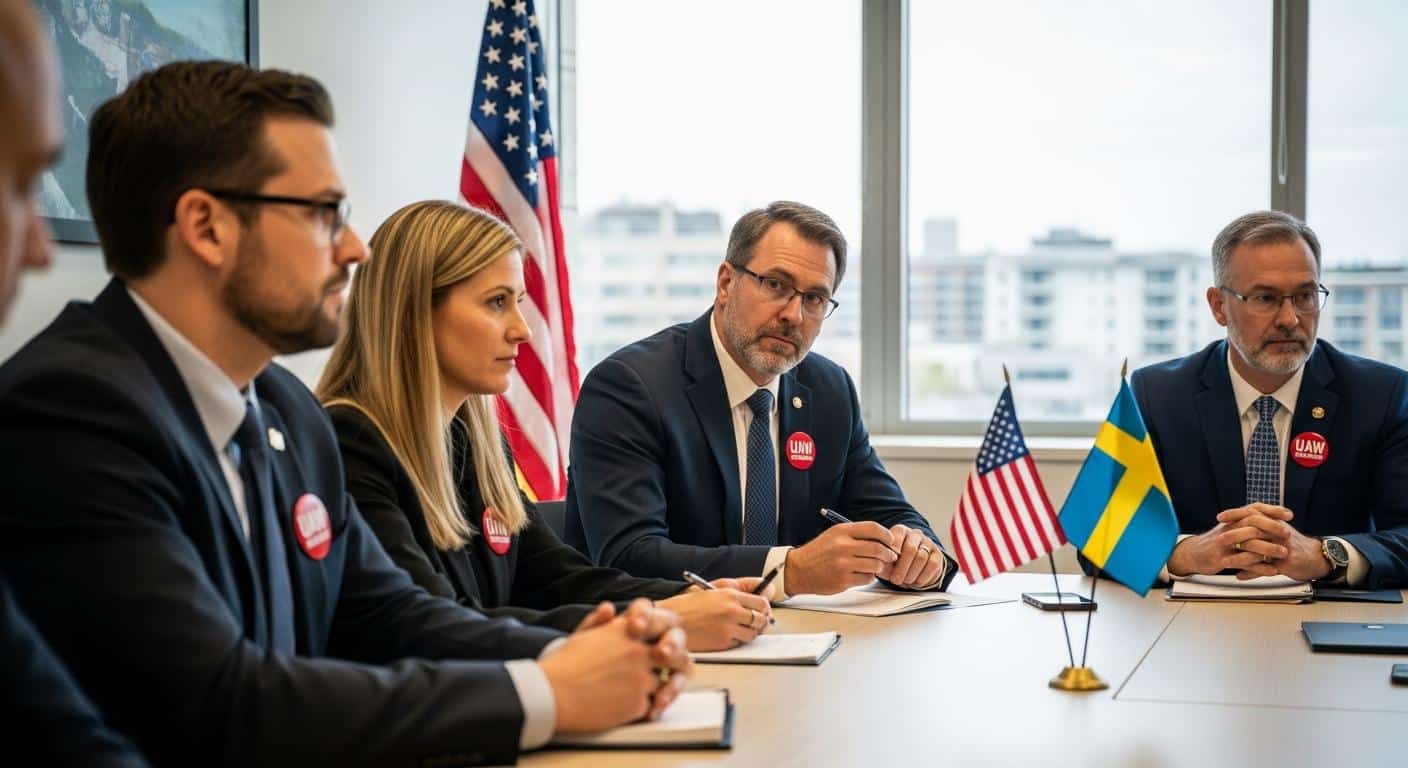
The American UAW officially enters the fray
In February 2025, Tim Smith, director of UAW Region 8, publicly expressed his support for Swedish workers. This statement marks the internationalization of the conflict and shows that automotive unions are now coordinating their actions globally.
To understand this initiative, it’s important to remember that the UAW has been trying for years to unionize Tesla factories in the United States, without success. Elon Musk’s company remains one of the few major American automakers without a union agreement.
Recently, the UAW has won symbolic victories by successfully unionizing some foreign manufacturers’ plants in the United States, notably Mercedes and Volkswagen. Support for the Swedish movement is part of this strategy of transatlantic solidarity.
Concretely, does this support really change the situation on the ground in Sweden? Probably not in the short term. It is primarily a symbolic gesture aimed at showing that unions can organize internationally against a global company like Tesla. But this coordination could have longer-term repercussions on the manufacturer’s brand image.
New tactic: directly targeting Tesla owners
Yellow flyers on windshields in Stockholm
The Swedish newspaper Dagens Arbete has revealed a new form of activist action: yellow flyers placed on the windshields of Teslas parked on the streets of Stockholm. These flyers, which visually resemble parking tickets, inform owners about the ongoing labor dispute.
This guerrilla communication tactic aims to impact Tesla’s brand image directly with its customers. The idea is simple: if Tesla owners become aware of the conflict, they could pressure the company or, at the very least, the information will circulate more widely in public opinion.
A controversial strategy and its limits
However, this approach carries significant risks. Imagine discovering what looks like a fine on your car, only to realize it’s a union flyer. The confusion could annoy Tesla owners rather than raise their awareness of the cause.
From an ethical standpoint, directly involving customers in a labor dispute between employer and unions is a questionable approach. Tesla vehicle owners have no real influence over the group’s HR policy.
In the history of labor disputes in the automotive industry, this approach has rarely been seen. Indirect pressure via customers remains a marginal strategy, whose effectiveness is yet to be proven.
Besoin d'accessoires pour ta Tesla ?
Looking for accessories for your Tesla?
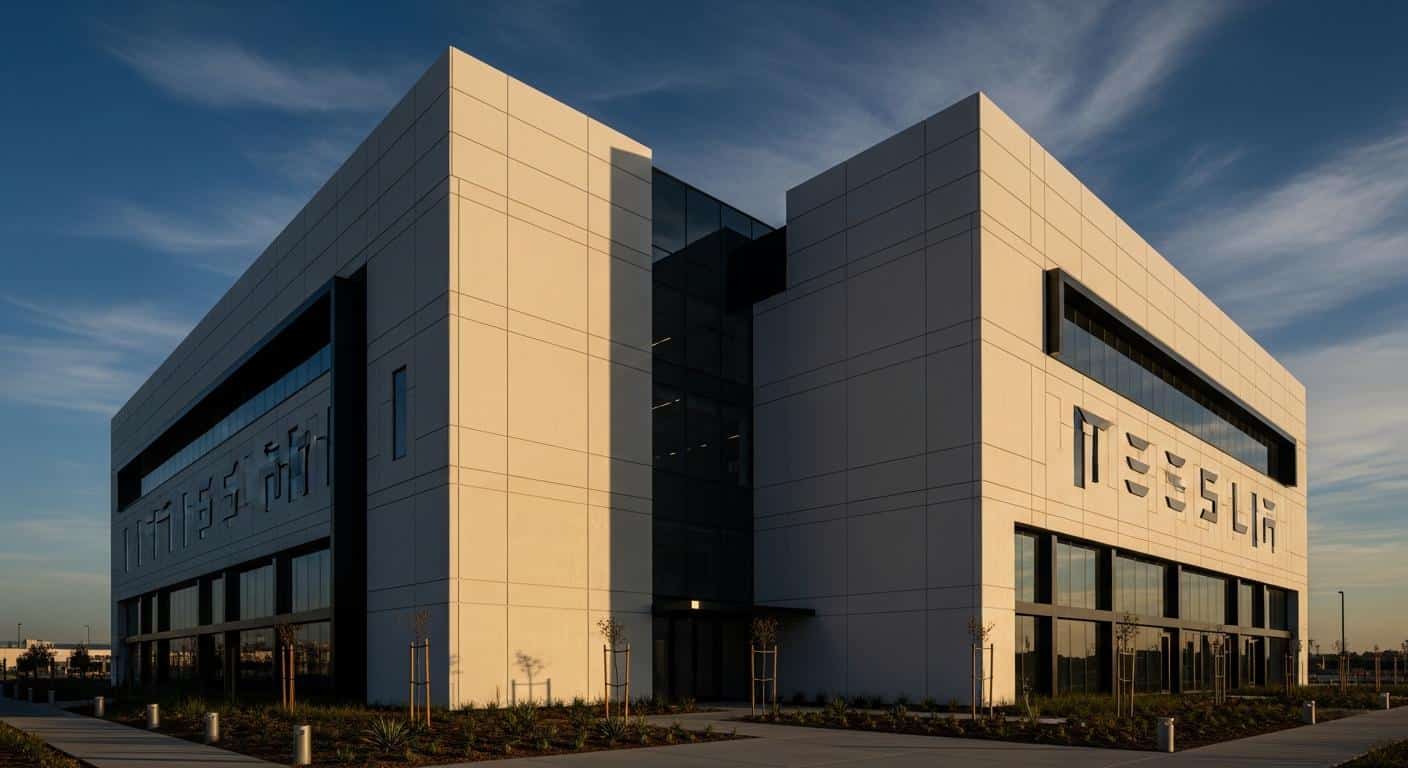
Tesla maintains its stance against unions
Faced with this escalation, Tesla maintains its official position: the company scrupulously adheres to Swedish labor laws, pays competitive wages, and offers excellent working conditions. No public comment has been made regarding the UAW’s support.
This strategic silence is consistent with Elon Musk’s general philosophy, which favors a direct relationship between the company and its employees, without union intermediaries. For Tesla, traditional union structures represent unnecessary bureaucracy that slows innovation.
Interestingly: in 2020, Tesla sued Rivian for aggressive talent poaching. However, the company took no action against Apple despite massive attempts to recruit Tesla engineers to develop its autonomous car project (since abandoned).
This difference in treatment illustrates that Tesla carefully chooses its battles. The company fights fiercely against its direct competitors in the electric vehicle market but adopts a different stance towards tech giants or unions.
The Musk model is based on the idea that talented employees should be rewarded directly by the company, particularly through stock options, without collective bargaining.
What are the stakes for Tesla in the European market?
The Nordic social model has important specificities. Unlike most European countries, Sweden does not impose a minimum wage by law. Everything relies on collective bargaining agreements negotiated sector by sector. Refusing this system means attacking the very heart of the Swedish social contract.
The risk of contagion is real. Denmark, Norway, and Finland share similar social models and could follow suit if the situation in Sweden worsens. A regional escalation would put Tesla in a delicate position across the entire Scandinavian market.
For the European market as a whole, this conflict poses an image problem. Tesla risks being perceived as an American company that refuses to respect the “European social contract,” which could affect its reputation among customers sensitive to social and environmental issues.
In terms of commercial impact, it will be necessary to monitor the evolution of Tesla’s sales in Sweden in the coming quarters. If the informal boycott gains momentum, it could result in a measurable drop in registrations.
Let’s compare with the competition: Volkswagen, Stellantis, Renault, and all other European manufacturers have collective agreements in their European factories. Tesla is an exception, and this particularity is becoming increasingly difficult to justify. Moreover, Teslas manufactured in China and their commercial implications show that the company must adapt to the specificities of each major market.
The strategic question is: Can Tesla maintain its long-term position without compromising its growth in Europe? The European market represents a significant portion of the company’s global sales. With the future $25,000 Tesla compact car destined for the global market, the company aims precisely to strengthen its presence in Europe.
A prolonged labor dispute could jeopardize these commercial ambitions and force Tesla to reconsider its policy of systematically refusing collective bargaining agreements, at least on the Old Continent.
The Swedish conflict thus becomes a real test for Tesla in Europe. In the coming months, several indicators will need to be monitored: a possible opening of negotiations, a hardening of positions, or the extension of the movement to other Nordic countries.
For us in France, where collective bargaining agreements are mandatory in many sectors, this conflict may seem strange. But it perfectly illustrates the cultural clash between the American Silicon Valley model and European traditions of social dialogue. According to international union sources, this transnational coordination of social movements could become the norm in the years to come.
This internationalization of the conflict shows that issues of labor relations are catching up even with the most disruptive tech companies. Even Tesla, despite its image as a revolutionary innovator, cannot indefinitely ignore the realities of the European social landscape.
Profitez d'avantages exclusifs en achetant votre Tesla
Vous envisagez d'acquérir une Tesla ? En utilisant mon code de parrainage lors de votre achat, vous pouvez bénéficier d'avantages exceptionnels !
Des kilomètres gratuits de recharge ou d'autres récompenses exclusives, mon code de parrainage est votre passeport pour des avantages supplémentaires : https://ts.la/antoine49352 🤩
Pas de pression, juste une opportunité à saisir pour enrichir votre expérience Tesla.
Découvrez ici le système du parrainage et comment utiliser le code.
Get exclusive perks when buying your Tesla
Thinking about getting a Tesla? If you use my referral code when you purchase, you may be eligible for extra perks.
Free Supercharging miles or other exclusive rewards - my referral code can unlock additional benefits: https://ts.la/antoine49352 🤩
No pressure - just a simple option if you want to enhance your Tesla experience.
Learn how the Tesla referral program works and how to use the code.