

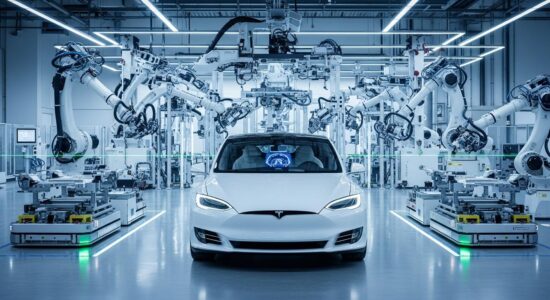
When Jim Cramer, one of Wall Street’s most listened-to voices, radically changes his tune on a company, the market holds its breath. In early 2025, after the release of the Q4 2025 results, the star CNBC analyst dropped a phrase that sounds like a confession: “It’s actually a robotics company and Cybercab.” Tesla‘s stock price? $423.69, down slightly by 0.5%. Even more surprising: the announcement of the end of production for the Tesla Model S and Model X after the second quarter of 2026.
This reversal marks a historic turning point in how Tesla is perceived. No more sterile debate over “premium car manufacturer vs. luxury brand.” Make way for a new reality: Tesla is undergoing a profound mutation toward robotics and artificial intelligence. Let’s decode this strategic shift that some investors have been anticipating for years.
Jim Cramer’s spectacular reversal on Tesla’s future
Jim Cramer isn’t like other Wall Street analysts. A former hedge fund manager and star host of “Mad Money,” his opinions influence millions of individual investors. When he speaks, the market listens. And when he changes his mind, it’s often a sign that a consensus is cracking.
His statement after the Q4 results stands out: “It’s actually a robotics company and Cybercab.” To understand the scale of this reversal, remember that Cramer long analyzed Tesla through a traditional automotive lens, comparing its margins to those of Ford or GM.
Besoin d'accessoires pour ta Tesla ?
Looking for accessories for your Tesla?
The immediate reaction? A 3% drop in the stock the day after the quarterly results were announced. The automotive numbers were disappointing, it’s true. But something deeper is at play here: Wall Street is FINALLY starting to understand what “permabulls” have been saying for years. Tesla has never been just a car manufacturer.
My personal take? This gap between long-term vision and the market’s short-term reaction perfectly illustrates why Tesla remains so misunderstood. Traditional investors look for reassuring quarterly results. Elon Musk, on the other hand, is building a robotics infrastructure for the next 20 years.
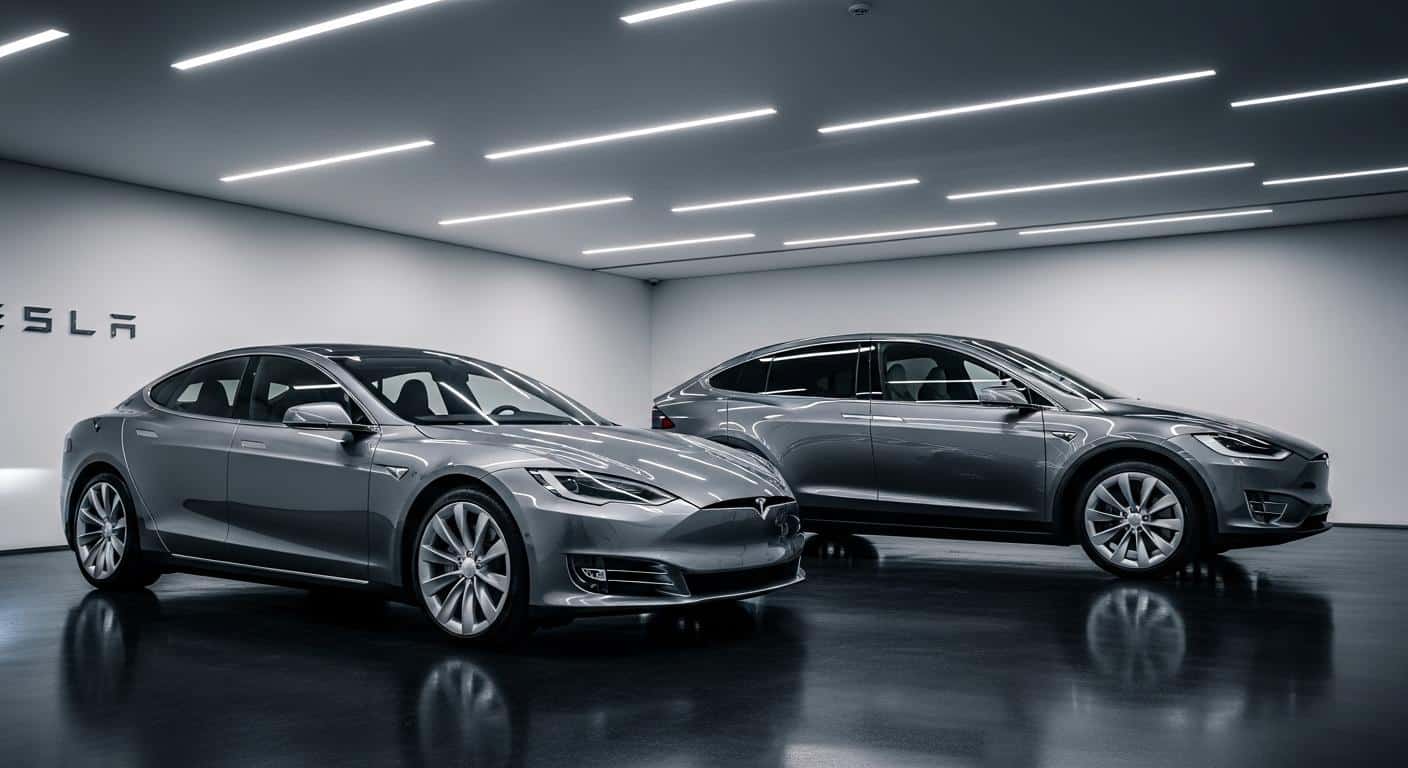
Tesla Model S and Model X: The end of an era scheduled for 2026
Production halt announced after Q2 2026
The announcement came down like a guillotine: the Tesla Model S and Model X will cease production after the second quarter of 2026. For long-time fans of the brand, it’s an emotional moment.
Remember that the Tesla Model S, launched in 2012, revolutionized the electric luxury sedan segment. The Tesla Model S Plaid and its spectacular performance proved that electric vehicles could compete with internal combustion supercars. The Model X, with its iconic Falcon Wing doors, did the same for premium SUVs.
Their disappearance is not insignificant. It signals a radical refocusing: the lineup will now center on the Model 3, Model Y, and future models. My feeling? It’s emotional, sure, but the industrial logic is relentless. These two models represent a marginal share of sales and tie up valuable resources.
A clear signal of the strategic pivot
This production halt sends a crystal-clear message to investors: Tesla is fully embracing its transformation. Simplifying the lineup allows for maximizing production line efficiency and freeing up capital.
Where are these resources going? Toward robotics and artificial intelligence. CapEx and R&D budgets previously allocated to the Tesla Model S/X will be redirected to Cybercab and Optimus. It’s a bold strategic choice, sacrificing a glorious past on the altar of the future.
Impact on Giga Berlin? Limited. The German factory is already heavily focused on the Model Y, the world’s best-selling vehicle in 2024. Tesla’s European strategy remains intact, centered on mass production and efficiency.
Cybercab and Optimus: The new pillars of a robotics-focused Tesla
Cybercab, the game-changing autonomous robotaxi
The Cybercab embodies Tesla’s boldest vision: an autonomous vehicle without a steering wheel or pedals, designed exclusively for on-demand transport. Imagine an Uber without a driver, available 24/7, at a negligible cost per kilometer.
The business model is mouth-watering: each Cybercab could generate recurring revenue via an Uber-like platform, but with much higher margins (no driver salary). Tesla would then become a mobility operator, not just a car seller.
FSD (Full Self-Driving) technology forms the foundation. But moving from the current Level 2+ (driver assistance) to Level 4/5 (full autonomy) represents a titanic challenge, both technological and regulatory. Administrative approvals will take years.
At the same time, the future $25,000 compact Tesla planned for the global market shows that the company isn’t completely abandoning its accessible automotive side, adding nuance to the “100% robotics” narrative.
Optimus, the humanoid robot that intrigues as much as it raises questions
The Optimus robot is perhaps Elon Musk’s wildest bet. A humanoid robot capable of performing repetitive, dangerous, or tedious tasks, both in factories and at home.
Besoin d'accessoires pour ta Tesla ?
Looking for accessories for your Tesla?
The massive investments announced in the financial results testify to the company’s seriousness. The prototypes presented are impressive: object manipulation, fluid movement, voice recognition. But between a spectacular prototype and a product that can be marketed at scale, there is a massive gulf.
My personal review? The potential is colossal. An affordable home robot (Elon mentions $20,000-$30,000) would turn our lives upside down. But I remain cautious about timelines. Tesla has a habit of announcing revolutions that arrive… a few years late. Remember the Roadster 2, the Semi, or the “next year” FSD promise repeated since 2016.
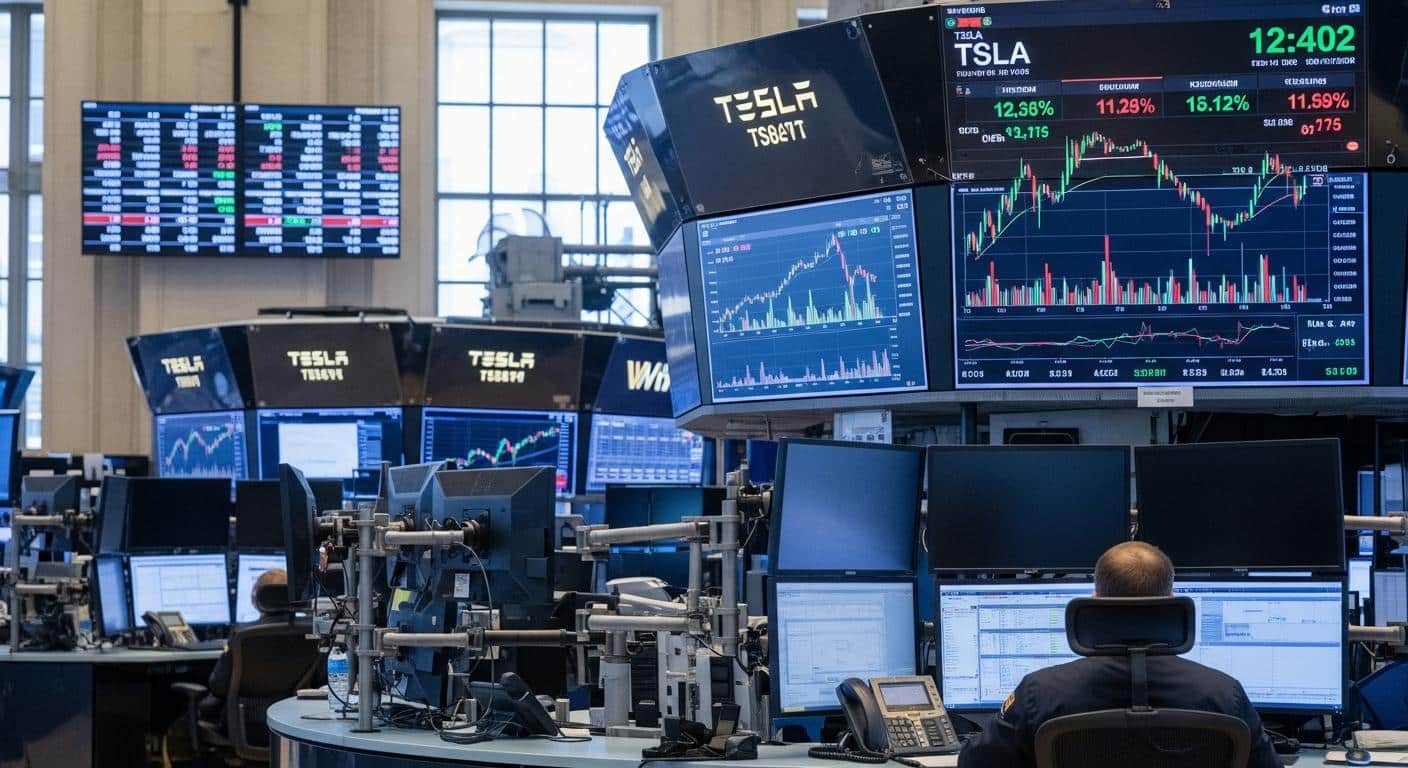
Why Wall Street still struggles to value Tesla correctly
Here is the heart of the problem: how do you value an AI and robotics company that still generates 95% of its revenue from automotive? Traditional valuation multiples (Price/Earnings, Price/Sales) don’t work.
Comparing Tesla to Ford or GM makes no sense. Traditional manufacturers show P/E multiples of 5-8x. Tesla? Over 70x despite the recent correction. Why? Because a growing number of investors are valuing the future, not the present.
The perception gap remains wide. On one side, traditional analysts scrutinize quarterly delivery volumes. On the other, “permabulls” calculate the potential value of a fleet of millions of robotaxis and humanoid robots.
Relevant comparisons? Nvidia, tech companies with a strong software component. Look at how the market values AI and cloud infrastructure. Tesla should be analyzed in this category, with a premium for its physical assets (factories, Supercharger network).
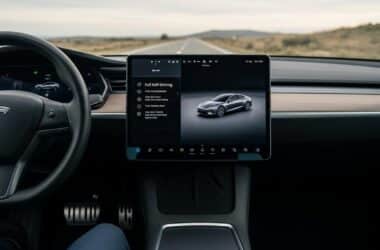
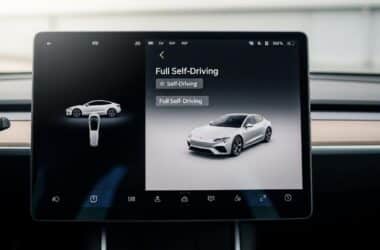
Interesting context: the SpaceX IPO planned for 2026 at a $1.25 trillion valuation. The Musk ecosystem as a whole represents a constellation of disruptive tech companies. Investors who understand this systemic logic are one step ahead. If you own a Tesla, you can even track the Tesla stock price directly from your vehicle’s screen, a feature appreciated by many shareholders.
My analysis? The market consistently takes 2 to 3 years to integrate Tesla’s strategic shifts. It was true for the move to the mass market with the Model 3, and it will be true for the robotics transition.
Were the “permabulls” right all along?
For over five years, die-hard Tesla fans have repeated the same mantra: “Tesla is not a car manufacturer.” They were mocked, called crazy, and accused of being in a cult. Jim Cramer’s reversal now gives them a resounding market validation.
The permabulls identified Tesla’s true strengths early on: software mastery, vertical integration, massive driving data collection, and the capacity for continuous innovation. Not sales volumes or quarterly operating margins.
Why did this misunderstanding last so long? Because for a long time, Tesla looked like a car manufacturer, selling cars with four wheels. The robotics mutation was invisible to anyone not looking under the hood. Today, with Cybercab and Optimus, it’s impossible to ignore the obvious.
Is a stock market re-evaluation expected? If the market truly integrates this transformation, yes. But—and this is crucial—vision does not mean automatic execution. Tesla has a history of massive delays: the Roadster 2 promised for 2020, the Semi launched 3 years late, and “next year” FSD becoming a recurring joke.
My advice to French readers? Watch this shift with passion, understand the technological stakes, but keep your critical thinking. Elon Musk’s strategic vision is often right. The execution timeline, however, sometimes borders on science fiction. Furthermore, industry analysts regularly highlight the regulatory complexity that will accompany the deployment of these technologies.
Tesla is undergoing a profound mutation before our eyes, moving from a premium car manufacturer to a robotics and artificial intelligence company. Jim Cramer, a symbol of mainstream Wall Street, finally recognizes this reality. Will Cybercab and Optimus deliver on their promises? The coming years will tell.
I personally remain fascinated by this transformation, while keeping my feet on the ground. The technological and regulatory challenges are colossal. But if Tesla succeeds in even a part of its vision, we will witness one of the greatest industrial disruptions of the 21st century. And you, what do you think of this robotics shift?
Profitez d'avantages exclusifs en achetant votre Tesla
Vous envisagez d'acquérir une Tesla ? En utilisant mon code de parrainage lors de votre achat, vous pouvez bénéficier d'avantages exceptionnels !
Des kilomètres gratuits de recharge ou d'autres récompenses exclusives, mon code de parrainage est votre passeport pour des avantages supplémentaires : https://ts.la/antoine49352 🤩
Pas de pression, juste une opportunité à saisir pour enrichir votre expérience Tesla.
Découvrez ici le système du parrainage et comment utiliser le code.
Get exclusive perks when buying your Tesla
Thinking about getting a Tesla? If you use my referral code when you purchase, you may be eligible for extra perks.
Free Supercharging miles or other exclusive rewards - my referral code can unlock additional benefits: https://ts.la/antoine49352 🤩
No pressure - just a simple option if you want to enhance your Tesla experience.
Learn how the Tesla referral program works and how to use the code.