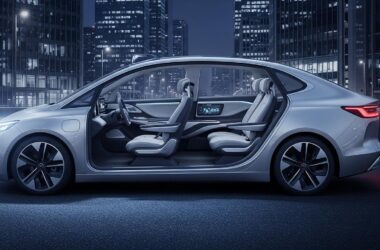


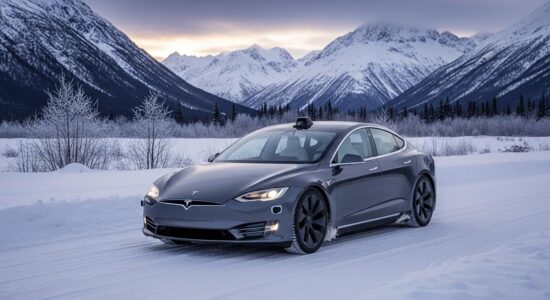
Elon Musk just reaffirmed on X that Tesla Cybercab production will begin in April 2026. This announcement comes as the first prototypes face extreme winter conditions in Alaska, revealing hardware innovations absent from current Teslas.
As a Tesla owner closely following the evolution of autonomous driving, this news particularly excites me. Between concrete technical progress and the necessary realism regarding production challenges, here’s what to remember from this latest information.
Elon Musk Reaffirms Timeline: April 2026 for Start of Production
On his X account, Elon Musk confirmed that the production timeline remains unchanged. This statement follows the initial announcement at the October 2024 Robotaxi event, where the Cybercab was officially unveiled.
What strengthens the credibility of this commitment? The current launch of the Robotaxi service in Austin, where Tesla vehicles are already operating without human supervision. This operational implementation demonstrates that the technology is truly progressing.
Besoin d'accessoires pour ta Tesla ?
Looking for accessories for your Tesla?
My analysis: this public reaffirmation shows confidence in the project’s progress. Unlike previous Tesla delays, we now have tests already underway and a partially deployed service. The April 2026 timing seems more rooted in a tangible industrial reality this time.
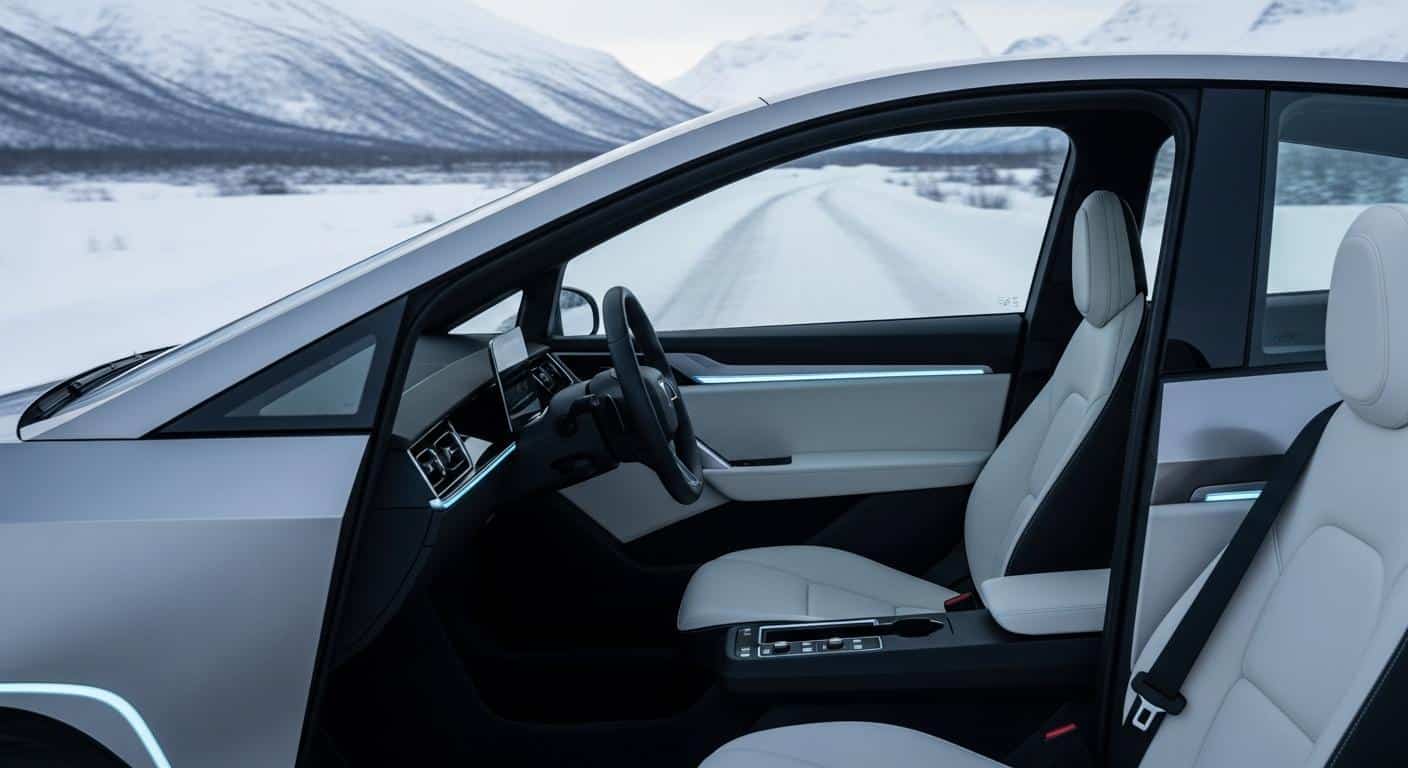
Tests in Extreme Conditions to Validate Full Autonomy
Why Test in Alaska?
The winter tests in Alaska are not just a communication exercise. They address crucial technical imperatives for a 100% autonomous vehicle.
- Extreme Temperatures: Major challenge for sensor performance and battery range
- Snow and Ice: Disrupt camera visibility, crucial for a vision-only system
- Multi-Climate Validation: Essential before any large-scale commercial deployment
I’m well aware of this issue: the importance of battery preconditioning in winter conditions is a topic I’ve personally experienced with my Tesla. For a Robotaxi without human intervention, this thermal management becomes even more critical.
Specific Winter Equipment
Prototypes tested in Alaska are equipped with adapted snow tires, allowing validation of FSD (Full Self-Driving) reactions on slippery surfaces.
These tests specifically verify:
- The responsiveness of traction and braking algorithms on ice
- Obstacle detection with reduced visibility
- Vehicle stability during evasive maneuvers
My opinion: this rigorous approach significantly reassures me about the future safety of the service. Tesla isn’t content with just validating the technology in sunny California.
The Hidden Innovation: Camera Washers Absent from Classic Model Ys
Here’s a major technical difference that distinguishes the Cybercab from current Teslas: the integration of camera washers on the side repeaters and the rear camera.
On a standard Model Y, only the front camera has this cleaning system. For a Robotaxi that must operate without human intervention, this limitation is unacceptable.
Why is this innovation crucial?
- Dirt, snow, or insects on a camera = partial blindness of the vision system
- Autonomy without intervention = impossibility for a human to clean manually
- 24/7 Reliability Required for Commercial Service
My observation: this detail reveals the entire difference between assisted driving (where the driver remains vigilant) and a true Robotaxi. It’s specific hardware that implies additional costs, but which becomes absolutely essential to guarantee a reliable service.
Gradual Production Ramp-Up: Musk Warns of a Slow Start
The Famous “S-Curve” of Production
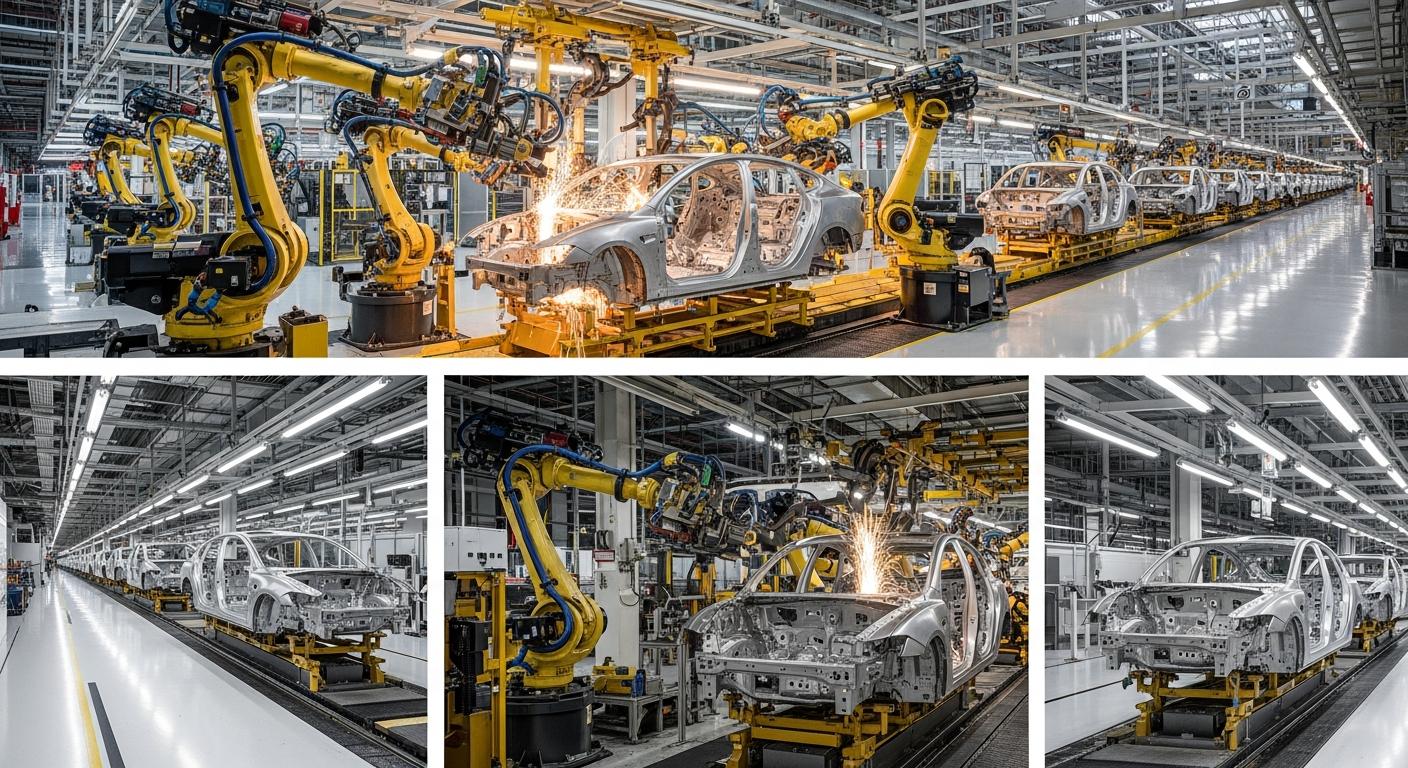
Elon Musk warned: the production ramp-up will follow a trajectory that is “agonizingly slow at first, incredibly fast afterward.” This famous S-curve corresponds to a well-documented industrial reality.
The initial phase, that of the slow start, is explained by several factors:
- Learning manufacturing processes
- Resolution of unforeseen assembly problems
- Training of production teams
- Supply chain optimization
Musk specifies that “almost everything is new” on the Cybercab and the Optimus robot, justifying this unusual manufacturing complexity. As illustrated by Tesla’s historical production ramp-up challenges, these industrial ramps have always represented a major challenge for the manufacturer.
Besoin d'accessoires pour ta Tesla ?
Looking for accessories for your Tesla?
My interpretation: I appreciate this transparency, which avoids false hopes. Don’t expect to see thousands of Cybercabs circulating as early as April 2026. The first few months will be an industrial learning phase.
Pricing Strategy Change: FSD Switches to Mandatory Subscription
A date to remember: February 14, 2026. From this date, Tesla will permanently remove the direct purchase option for FSD (Full Self-Driving), in favor of an exclusive monthly subscription.
Specifically, here’s what’s changing:
- Current subscription price: $99/month
- Former direct purchase price: $8,000 (still available for a few weeks on used vehicles)
- Pricing evolution: the subscription price will gradually increase according to the FSD’s actual capabilities
This evolution is part of a broader logic. For the Cybercab, the Tesla business model relies entirely on a subscription service: no steering wheel, no individual owners, only an autonomous fleet generating recurring revenue.
My analysis: this strategy aligns perfectly with Tesla’s vision of an autonomous fleet. Tesla’s strategy to democratize its autonomous vehicles now involves predictable and scalable revenue models.
Community reactions are mixed: some accept this transition, others regret the loss of software “ownership.” My personal advice: if you currently own purchased FSD, it represents real added value for resale.
April 2026 is gradually becoming clearer with concrete tests in extreme conditions and dedicated hardware specifically designed for Robotaxi operation. According to specialized sources in autonomous mobility, these multi-environment validations are an indispensable step before any commercial deployment.
Let’s be realistic: production will be gradual, not an immediate revolution. As a Teslien, my excitement remains measured but real. The coming months will show whether Tesla can keep its commitments, both on the timeline and on the promised performance of this Level 4 autonomous driving.
Profitez d'avantages exclusifs en achetant votre Tesla
Vous envisagez d'acquérir une Tesla ? En utilisant mon code de parrainage lors de votre achat, vous pouvez bénéficier d'avantages exceptionnels !
Des kilomètres gratuits de recharge ou d'autres récompenses exclusives, mon code de parrainage est votre passeport pour des avantages supplémentaires : https://ts.la/antoine49352 🤩
Pas de pression, juste une opportunité à saisir pour enrichir votre expérience Tesla.
Découvrez ici le système du parrainage et comment utiliser le code.
Get exclusive perks when buying your Tesla
Thinking about getting a Tesla? If you use my referral code when you purchase, you may be eligible for extra perks.
Free Supercharging miles or other exclusive rewards - my referral code can unlock additional benefits: https://ts.la/antoine49352 🤩
No pressure - just a simple option if you want to enhance your Tesla experience.
Learn how the Tesla referral program works and how to use the code.