




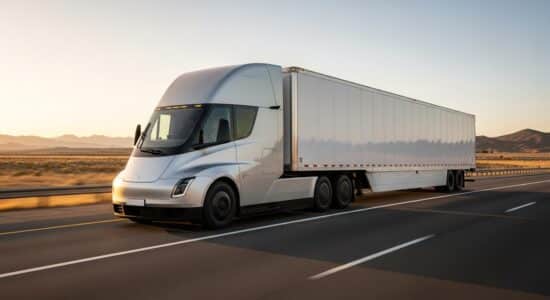
On Sunday, February 8, 2026, Elon Musk posted a message that thrilled the entire Tesla community. On X (formerly Twitter), the head of Tesla confirmed what many had been waiting for years: “Tesla Semi starts high volume production this year”. This announcement marks a decisive turning point for the electric truck, which was first unveiled in 2017.
Simultaneously, Tesla completely revamped the Semi’s official page on its website, featuring detailed specifications and a professional configurator. After years of pilot production with a few dozen units delivered to PepsiCo, the Tesla Semi is finally moving to large-scale commercialization.
The stakes? Nothing less than the revolution of electric road transport. Tesla now offers two distinct versions: Standard and Long Range, each designed for specific uses. Let’s explore what this announcement truly means, with supporting figures.
The Announcement That Marks a Turning Point for Tesla
Elon Musk’s post on February 8, 2026, is significant. Since the Semi’s initial presentation in November 2017, the project has experienced numerous delays. Tesla had initially promised production for 2019, then 2020, before finally delivering the first units to PepsiCo in December 2022.
Besoin d'accessoires pour ta Tesla ?
Looking for accessories for your Tesla?
But be aware, we’re talking about a real change in scale here. The mention “high volume production” signifies the transition from pilot production of a few dozen units to several thousand per year. This is exactly what investors and transport professionals have been waiting for.
The update to the official Tesla website is equally significant. There is now a complete, professional product page with all detailed technical specifications. It’s no longer a concept or an experimental project: it’s a commercial product ready to be ordered.
With this announcement, Tesla becomes the first traditional automaker to launch a heavy-duty electric truck in large series. Having followed this project for years, I believe Tesla has finally resolved the battery production and industrialization challenges that were hindering massive deployment.

Two Versions for Two Distinct Uses
Tesla has made the intelligent choice to offer two distinct configurations, each optimized for a specific mission type.
Standard Version: The Short-Distance Option
The Standard Version boasts a driving range of 325 miles, or 523 kilometers. This is more than enough for regional trips, urban, and suburban deliveries.
The key figure here is energy consumption: 1.7 kWh per mile. This is a remarkable efficiency indicator for a vehicle of this size. The GCWR (Gross Combined Weight Rating) is 82,000 pounds, or 37,195 kg, which represents a very respectable load capacity.
The advantage of this version? A likely lower unladen weight thanks to a smaller battery, and thus a reduced acquisition cost.
Long Range Version: The King of Long Distance
The Long Range Version extends to 500 miles of driving range, or 805 kilometers. With this capacity, you can cross France from north to south on a single charge. This is exactly what long-haul transporters are looking for.
This version has an unladen weight of 23,000 pounds (10,433 kg), significantly higher than a conventional diesel tractor. The reason? A much larger battery to achieve this exceptional driving range.
Here is a comparison table of the two versions:
| Criterion | Standard | Long Range |
| Driving Range | 523 km | 805 km |
| Energy Consumption | 1.7 kWh/mile | Not communicated |
| Unladen Weight | Not communicated | 10,433 kg |
| GCWR | 37,195 kg | Not communicated |
A common point for both versions: fast charging. Tesla announces 60% charge recovered in just 30 minutes thanks to high-power charging infrastructure similar to Superchargers, called Megachargers for the Semi. This is a major asset for operational viability.
Initial Field Feedback Is Reassuring
Numbers are good, but what about real-world performance? Fortunately, we now have concrete feedback that allows us to evaluate actual performance.
PepsiCo remains the historical pilot customer. Since 2022, the company has been operating a fleet of Tesla Semis in intensive use, primarily for beverage and snack deliveries in California. The initial assessments are positive in terms of reliability and operating costs.
Besoin d'accessoires pour ta Tesla ?
Looking for accessories for your Tesla?
But the most interesting case comes from DHL. The logistics company has shared precise data: its Tesla Semis travel an average of 100 miles per day (160 km) and only require a weekly recharge. This is a striking demonstration that the driving range is largely sufficient for daily regional use.
This DHL data is particularly reassuring: one recharge per week for daily use is exactly what fleet managers are looking for. This greatly simplifies operational logistics and reduces downtime.
Uber Freight has also announced a partnership to integrate the Tesla Semi into its logistics platform. And Tesla shows its confidence with a 4-year or 80,000 km warranty, a strong signal regarding the expected reliability of the vehicle.
The Challenges of Scaling Up
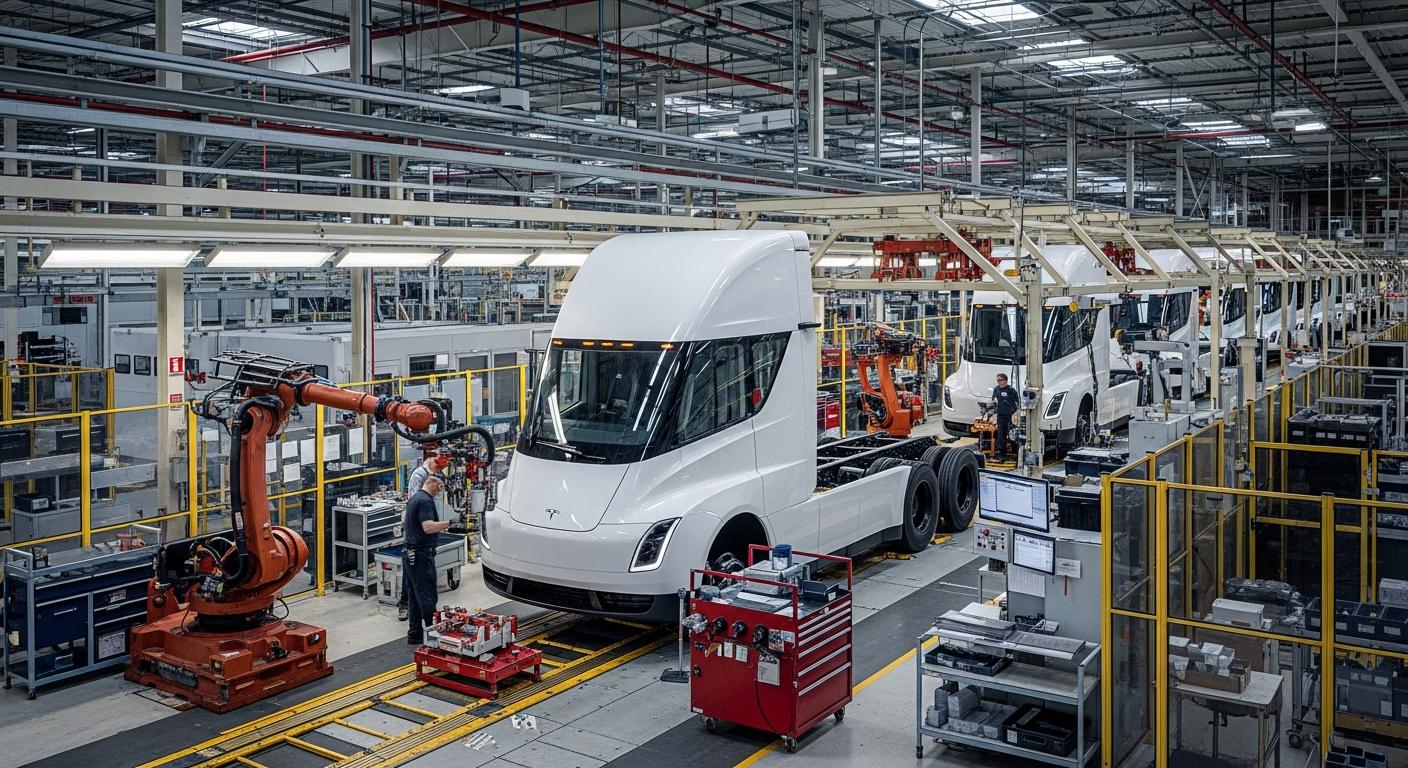
Let’s be honest, Tesla is used to being optimistic about its production schedules. The ramp-up of the Semi will represent a major industrial challenge.
First, production capacity. The Semi will likely be assembled at Gigafactory Nevada, but Tesla has not communicated precise annual volumes. A few thousand units? Tens of thousands? Hard to say for now.
Then there’s the question of 4680 batteries. The Semi requires enormous battery packs, and large-scale battery production remains a major challenge for Tesla. The ability to produce these cells in sufficient volume will directly determine the Semi’s production rate.
The supply chain for specific components (high-power electric motors, power electronics) will also need to keep pace.
And then, there’s the emerging competition:
- Nikola, despite its financial difficulties, is delivering some electric trucks
- Volvo offers the VNR Electric, available in small series
- Daimler is commercializing the eCascadia
- Mercedes is developing the eActros
Tesla’s advantage? Vertical integration: batteries, software, charging infrastructure. Unlike competitors, Tesla controls the entire value chain. It remains to be seen if the company can truly produce several thousand units as early as 2026.
And in Europe, what’s the situation?
The question of the European market remains open. Tesla has not yet officially announced the Semi’s availability in Europe, and for good reason: the vehicle will need to be adapted.
European regulations impose different weight limits than those in the United States, and homologation standards are stricter. The Semi will likely need to be slightly modified to meet these requirements.
Charging infrastructure is another challenge. The Megachargers required for the Semi are still not widely deployed in Europe. However, with the Supercharger network already well established on the continent, Tesla has a solid base to expand this infrastructure.
For French and European transporters, the opportunities are real. The expansion of the Tesla range beyond passenger vehicles addresses a growing need for decarbonization of road transport.
Potential benefits include:
- Drastic reduction in fuel costs (electricity vs. diesel)
- Anticipated compliance with increasingly strict environmental standards
- Easier access to low-emission zones in major cities
According to official industry sources, European CO2 standards for heavy-duty vehicles will significantly tighten in the coming years, making electrification essential.
I’m curious to see when Tesla will officially announce the Semi’s availability in Europe. The demand is clearly there, and the infrastructure is starting to be ready. 2027? 2028? Time will tell, but one thing is certain: electric road transport is no longer a utopia; it’s a reality in motion.
Profitez d'avantages exclusifs en achetant votre Tesla
Vous envisagez d'acquérir une Tesla ? En utilisant mon code de parrainage lors de votre achat, vous pouvez bénéficier d'avantages exceptionnels !
Des kilomètres gratuits de recharge ou d'autres récompenses exclusives, mon code de parrainage est votre passeport pour des avantages supplémentaires : https://ts.la/antoine49352 🤩
Pas de pression, juste une opportunité à saisir pour enrichir votre expérience Tesla.
Découvrez ici le système du parrainage et comment utiliser le code.
Get exclusive perks when buying your Tesla
Thinking about getting a Tesla? If you use my referral code when you purchase, you may be eligible for extra perks.
Free Supercharging miles or other exclusive rewards - my referral code can unlock additional benefits: https://ts.la/antoine49352 🤩
No pressure - just a simple option if you want to enhance your Tesla experience.
Learn how the Tesla referral program works and how to use the code.