

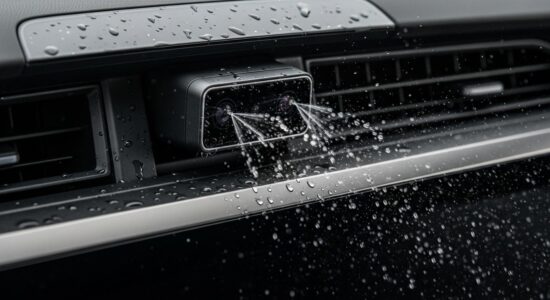
A prototype of the Tesla Cybercab was recently spotted driving through the streets of Chicago, and attentive observers noticed a fascinating detail: clear signs of a camera washing system in action. While the vehicle was generally covered in dirt, the area around the rear camera was surprisingly clean, with visible water marks.
This feature, demanded for years by the Tesla community, makes perfect sense on a vehicle designed to be 100% autonomous. I think this observation confirms that Tesla has listened to its users and integrated a solution to one of the most frustrating problems of autonomous driving: dirty cameras that compromise the system’s vision.
Let’s explore what this discovery reveals about the future of the Cybercab and potentially the entire Tesla lineup.
A camera washing system spotted in the field
The observation was shared by Sawyer Merritt, a renowned industry analyst, who immediately highlighted the importance of this detail. The Cybercab prototype was driving in typical Chicago winter conditions, with dirt, road salt, and snow accumulated on the bodywork.
Besoin d'accessoires pour ta Tesla ?
Looking for accessories for your Tesla?
But here’s the revealing detail: while the entire vehicle was covered in grime, the rear camera showed a perfectly clean area around its lens. Water marks were even visible, proving that a washing system had just activated.
This striking contrast did not go unnoticed by the Tesla community, always on the lookout for the slightest clue about future features. This is the first time this functional technology has been observed on a prototype in real-world conditions, and not in a controlled environment or in official visuals.
A Response to a Recurring Request from Tesla Owners
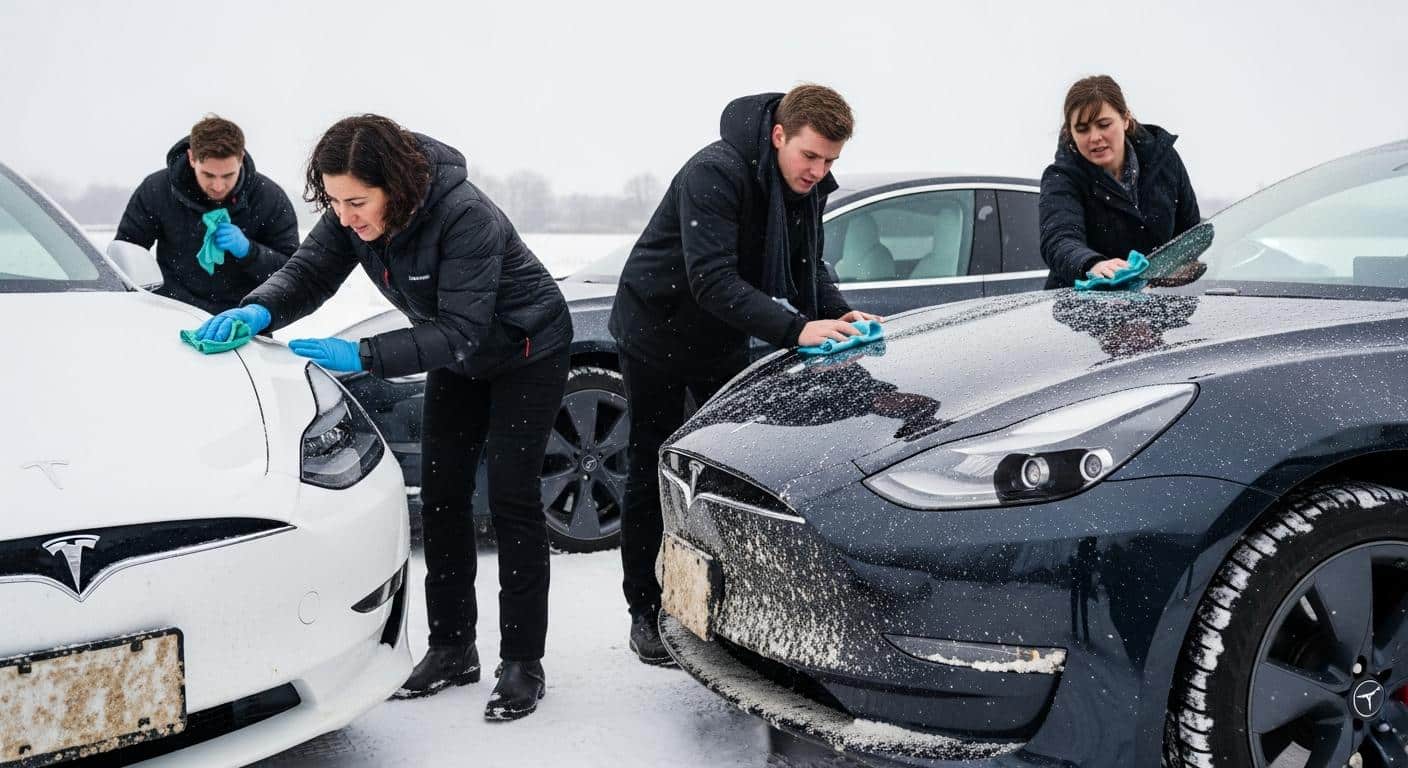
If you own a Tesla equipped with Full Self-Driving or simply Autopilot, you have probably already experienced this frustration: cameras obstructed by snow, mud, road salt, or even heavy rain.
The consequences are immediate and problematic:
- Loss of visibility in blind spots
- Significant degradation of FSD performance
- Recurring system alerts
- Need for frequent stops to manually clean the lenses
This issue is particularly acute in Nordic markets, Quebec, and all regions where winter is harsh. Since the introduction of Autopilot and FSD, the Tesla community has regularly demanded a technical solution to this problem.
As Sawyer Merritt highlighted in his tweet, this request has been made “for years.” Finally seeing a concrete response on the Cybercab validates this legitimate frustration and shows that Tesla has indeed integrated this user feedback into its design.
An Absolute Imperative for a 100% Autonomous Vehicle
Tesla’s Pure Vision Architecture
Tesla has made the strategic choice of pure vision for its autonomous driving systems. Unlike other manufacturers, the brand does not use LiDAR and has even gradually abandoned radars on its recent models.
This approach means a total reliance on external cameras. Artificial intelligence can only make decisions based on what it literally “sees” through these lenses. A dirty camera therefore equates to a blind spot for the system, which is simply unacceptable for a Level 4 or 5 autonomous vehicle.
Probable Extension to All Vehicle Cameras
If the system was spotted on the rear camera, I am convinced that it will be deployed on all external cameras of the Cybercab. The logic of redundancy and system reliability absolutely demands it.
A robotaxi cannot afford any blind spots, regardless of the weather or road conditions. The most probable technical hypothesis is therefore an integrated washing system on the 8 or more cameras the vehicle has, ensuring a permanent 360° view.
This operational reliability is essential for a vehicle designed to operate 24/7, without any human intervention.
The Cybercab, Spearhead of the Robotaxi Strategy
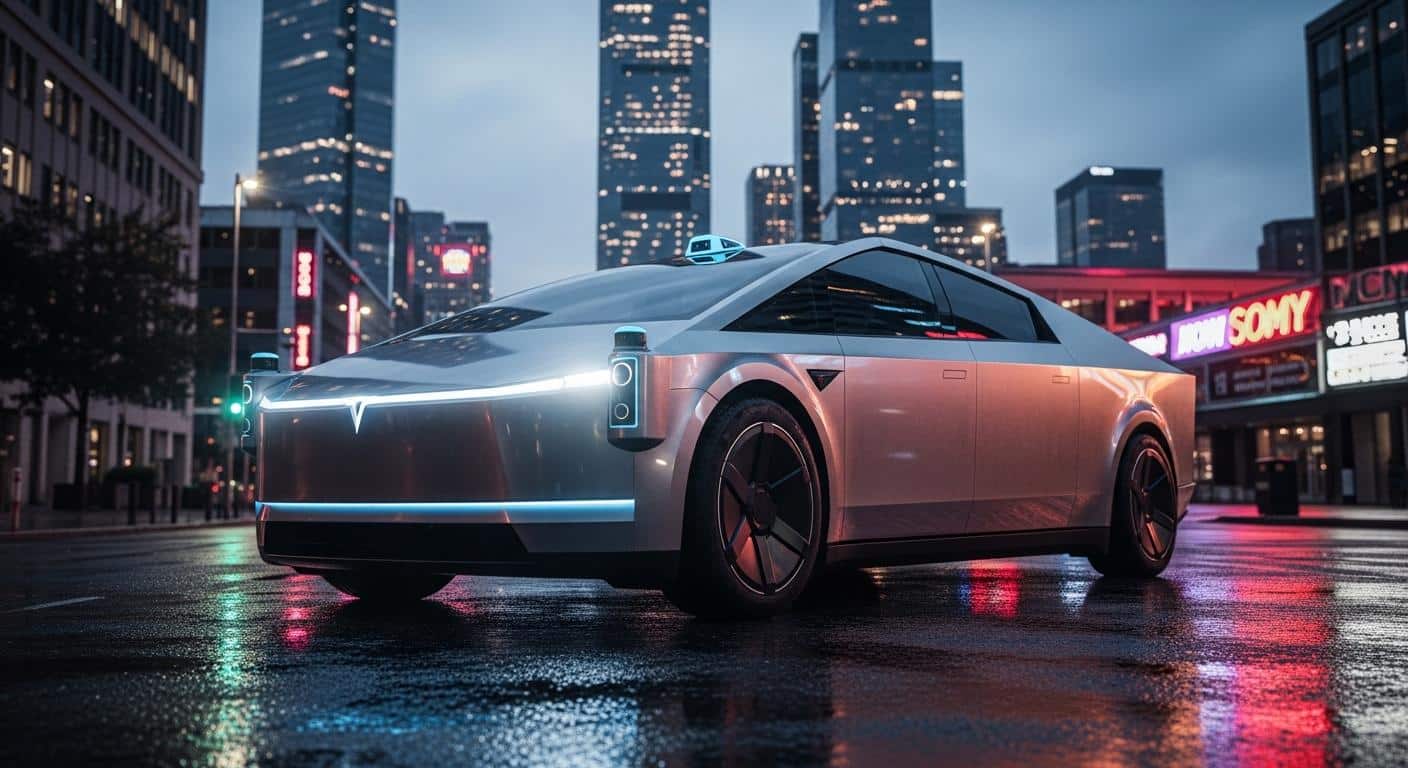
The Tesla Cybercab was first unveiled at the “We, Robot” event held in October 2024 in Los Angeles. This vehicle features a unique configuration: without a steering wheel or pedals, designed to transport 1 to 2 passengers in the context of a fully autonomous robotaxi.
The production is scheduled for late 2026, an ambitious timeline that recalls the production schedule of new Tesla models and the associated challenges. Elon Musk himself stated: “there is so much to this car that is not obvious on the surface.”
Besoin d'accessoires pour ta Tesla ?
Looking for accessories for your Tesla?
The camera washing system is precisely the first concrete confirmation of these hidden innovations. It’s a strong signal: Tesla is not content with just removing the steering wheel; the brand is truly rethinking the entire experience of an autonomous vehicle, down to the technical details that guarantee its operational reliability.
The Cybercab is part of Tesla’s strategy for accessible and innovative vehicles, positioning the brand as a leader in urban autonomous mobility.
And for the Model 3, Y, S, X, and Cybertruck?
This is obviously the question every Tesla owner asks: if the Cybercab has this technology, why not the other models in the lineup?
I think the hope is legitimate. Several arguments advocate for a wider deployment:
- Significant improvement of Full Self-Driving across the entire lineup
- Competitive advantage against European premium brands that already offer similar systems
- Probably low marginal cost once the technology is developed and industrialized
- Consistency with technical innovations progressively deployed across the entire lineup
Nevertheless, let’s remain cautious. Tesla has made no official announcement regarding the integration of this feature on the Model 3, Y, S, X, or Cybertruck. It is possible that this technology remains temporarily exclusive to the Cybercab, or that it is reserved for future refreshes of existing models.
The complexity of retrofitting on already produced vehicles should also not be underestimated. For comparison, manufacturers like Mercedes and BMW already offer camera washing systems on certain high-end trims, which proves the technical feasibility. According to industry experts, this feature will gradually become a standard on premium vehicles equipped with advanced driver-assistance systems.
This observation of a Cybercab prototype in the streets of Chicago confirms one essential thing: Tesla pays meticulous attention to practical details that will make the difference between a theoretical concept and a truly operational robotaxi. The camera washing system is just one example of these discreet but crucial innovations.
By 2026 production, I am convinced that we will discover other hidden surprises in this vehicle. The Cybercab is clearly designed as an innovation laboratory that could then benefit the entire Tesla lineup. Let’s stay attentive to future prototype observations; they will teach us a lot about the future of autonomous mobility.
Profitez d'avantages exclusifs en achetant votre Tesla
Vous envisagez d'acquérir une Tesla ? En utilisant mon code de parrainage lors de votre achat, vous pouvez bénéficier d'avantages exceptionnels !
Des kilomètres gratuits de recharge ou d'autres récompenses exclusives, mon code de parrainage est votre passeport pour des avantages supplémentaires : https://ts.la/antoine49352 🤩
Pas de pression, juste une opportunité à saisir pour enrichir votre expérience Tesla.
Découvrez ici le système du parrainage et comment utiliser le code.
Get exclusive perks when buying your Tesla
Thinking about getting a Tesla? If you use my referral code when you purchase, you may be eligible for extra perks.
Free Supercharging miles or other exclusive rewards - my referral code can unlock additional benefits: https://ts.la/antoine49352 🤩
No pressure - just a simple option if you want to enhance your Tesla experience.
Learn how the Tesla referral program works and how to use the code.