

In early February 2026, Elon Musk made a statement that seems straight out of a science fiction novel. On X, the Tesla CEO claimed that Optimus, his humanoid robot, will become the first “Von Neumann machine” capable of reproducing itself and building entire civilizations on other planets.
I’ll explain what that concretely means and how far this vision could take us. Between spatial ambition and technical reality, where does the Tesla humanoid robot truly stand? Let’s dive into this futuristic vision that blends advanced robotics, artificial intelligence, and Martian colonization.
What exactly is a Von Neumann machine?
A Von Neumann machine is a theoretical system capable of reproducing itself completely autonomously. This fascinating concept was developed by mathematician John von Neumann in the 1940s-1950s, at a time when computing was still in its infancy.
The fundamental principle is relatively simple to understand: the machine collects local materials from its environment, transforms them according to a precise program, and then creates a perfectly functional copy of itself. This copy possesses the same capabilities as the original, including the ability to reproduce itself in turn.
Besoin d'accessoires pour ta Tesla ?
Looking for accessories for your Tesla?
For decades, this concept remained purely theoretical. No self-replicating machine has ever been realized in the real world, primarily due to the monumental technical complexity it represents.
The three essential capabilities of a true Von Neumann machine
For a robot to truly be called a Von Neumann machine, it must possess three fundamental capabilities:
- Complete autonomy: Operating without any external human intervention, making complex decisions, and adapting to its environment
- Resource transformation: Exploiting available materials in its immediate environment, refining them, and transforming them into usable components
- Faithful reproduction: Creating functional copies with exactly the same capabilities, including all electronic, mechanical, and software systems
Elon Musk’s vision for transforming Optimus
On February 3 and 4, 2026, Elon Musk published several posts on X that caused a stir in the tech community. His exact quote: “Optimus will be the first Von Neumann machine, capable of building a civilization by itself on any viable planet.”
This isn’t the first time Musk has claimed that Optimus will be “Tesla’s greatest product,” surpassing even the electric vehicles that made the company famous. But this time, he goes much further in his vision.
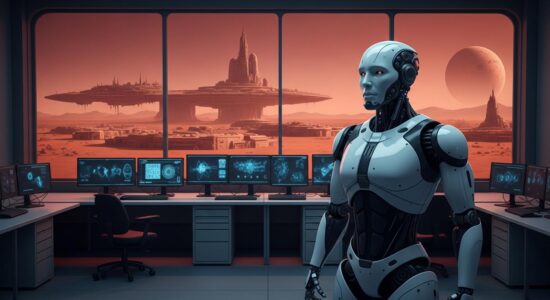
The extraterrestrial ambition is clear: Optimus wouldn’t just be a domestic robot to fold your laundry or carry your groceries. It would become a tool for space colonization, capable of building complete infrastructures on Mars without initial human presence.
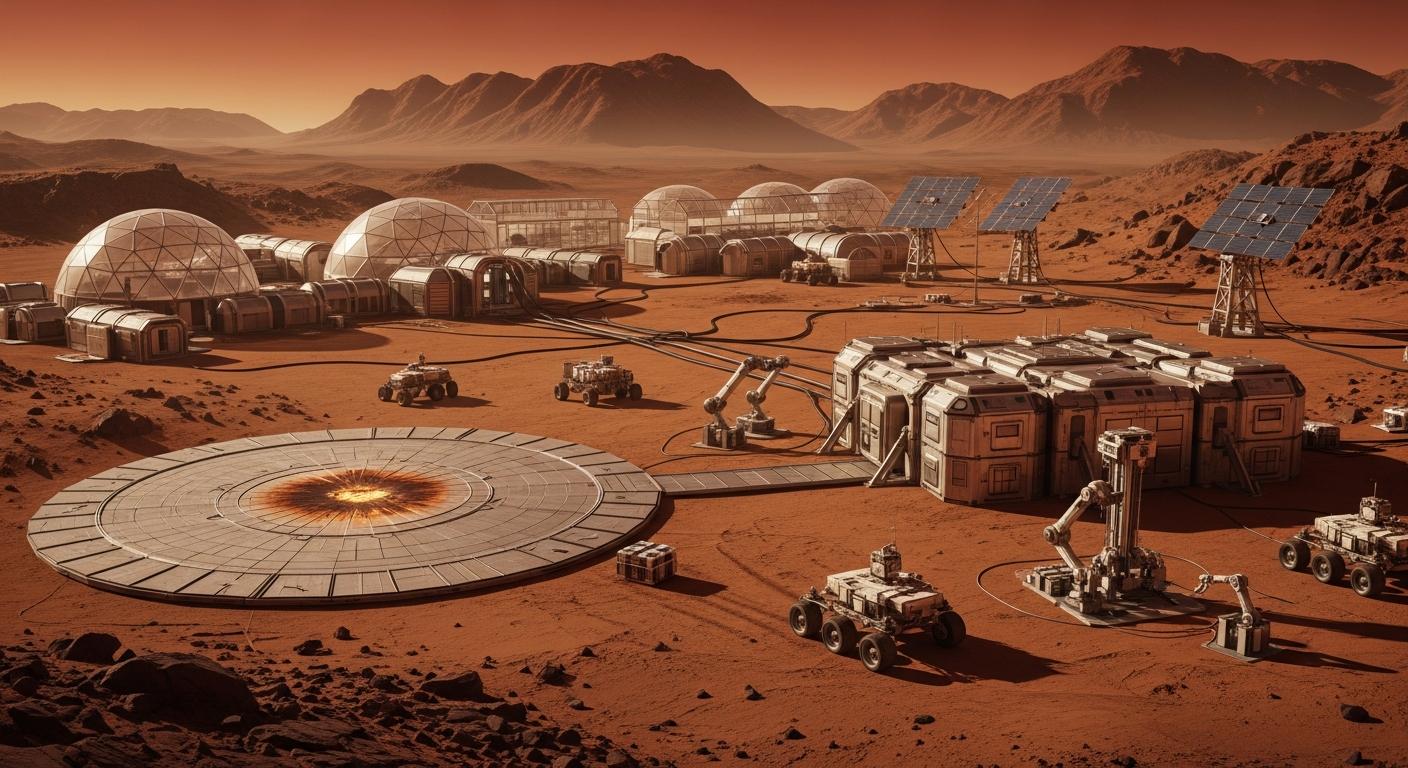
Imagine: dozens of Optimus robots land on Mars, begin to exploit local resources, build habitats, factories, and then reproduce to accelerate the process. An autonomous civilization developing on another planet even before the first humans set foot there.
The colossal technical challenges of self-replication
Let’s be honest: between vision and reality, there’s an absolutely monumental technological gap. Today, Optimus can perform relatively simple tasks like walking, manipulating objects, or basic movements. But reproducing itself? That’s a whole different story.
The challenges of autonomous manufacturing are staggering. How can a robot create sophisticated electronic chips, assemble microscopic components, program complex embedded AI systems, all without human intervention?
On Mars, Optimus would need to be able to exploit Martian regolith, extract specific metals, refine them, produce its own energy, manufacture batteries, motors, sensors… The list is endless.
The technological gap is immense. We are probably talking about several decades of research and development before achieving even a primitive version of this capability. The use of extraterrestrial resources in-situ remains a largely experimental field.
The necessary robotic ecosystem on another planet
A crucial point I want to emphasize: it wouldn’t be a single robot doing everything. You would need a true specialized fleet:
- Extraction robots to collect raw materials
- Refining units to purify resources
- Assembly robots to build new components
- Quality control systems to verify each production
A prior infrastructure would also be needed: a reliable energy source (solar panels?), protected manufacturing workshops, storage systems. The initial bootstrap problem is fascinating: how does the first Optimus create the tools necessary to create other Optimus robots?
SpaceX’s role in this interplanetary vision
Musk’s vision doesn’t just concern Tesla. There’s an obvious synergy with SpaceX. The Starship, the giant vessel currently under development, would be responsible for transporting the first Optimus robots to Mars.
Besoin d'accessoires pour ta Tesla ?
Looking for accessories for your Tesla?
Musk also mentioned the computing power required in a space environment. Robots would need extremely sophisticated artificial intelligence to make real-time decisions, without the possibility of instantaneous communication with Earth (the Earth-Mars communication delay can reach 20 minutes).
Musk’s interplanetary ecosystem combines advanced robotics (Tesla), space transport (SpaceX), and energy systems (Tesla batteries). It’s a global vision where each element supports the others.
Of course, the realistic timeline depends entirely on the success of crewed Starship missions. Before sending self-replicating robots, we’ll first need to successfully land humans on Mars safely.
Where does Optimus really stand today?
Let’s get back to Earth (literally). Today, Optimus Gen 2 prototypes are capable of basic manipulations, relatively fluid walking, and performing simple tasks in a controlled environment. Public demonstrations show real progress, but also very limited performance compared to the grandiose vision.
The gap between vision and reality is characteristic of Elon Musk’s style. If you know the history of his announcements, you know he tends to be very optimistic about deadlines. This is visible in other Tesla projects, such as the Tesla Roadster, whose production has been repeatedly postponed, or the compact Tesla at $25,000 that is supposed to democratize the electric vehicle.
This culture of innovation is found in all the company’s projects. Just like the Tesla Model S Plaid, which pushes the limits of automotive performance, Optimus represents this philosophy of aiming for the impossible to achieve the extraordinary.
My realistic perspective? We’re talking about a vision at least 20-30 years out, certainly not short-term. What I truly believe is that ambition drives innovation. Even if Optimus never achieves full Von Neumann machine status, the technological advancements needed to get close will revolutionize robotics, AI, and potentially space exploration projects.
For now, let’s keep our feet on the ground while looking up at the stars. History has shown us that Elon Musk’s most audacious visions often come to fruition, even if it’s with a few years’ delay. To be continued!
Profitez d'avantages exclusifs en achetant votre Tesla
Vous envisagez d'acquérir une Tesla ? En utilisant mon code de parrainage lors de votre achat, vous pouvez bénéficier d'avantages exceptionnels !
Des kilomètres gratuits de recharge ou d'autres récompenses exclusives, mon code de parrainage est votre passeport pour des avantages supplémentaires : https://ts.la/antoine49352 🤩
Pas de pression, juste une opportunité à saisir pour enrichir votre expérience Tesla.
Découvrez ici le système du parrainage et comment utiliser le code.
Get exclusive perks when buying your Tesla
Thinking about getting a Tesla? If you use my referral code when you purchase, you may be eligible for extra perks.
Free Supercharging miles or other exclusive rewards - my referral code can unlock additional benefits: https://ts.la/antoine49352 🤩
No pressure - just a simple option if you want to enhance your Tesla experience.
Learn how the Tesla referral program works and how to use the code.