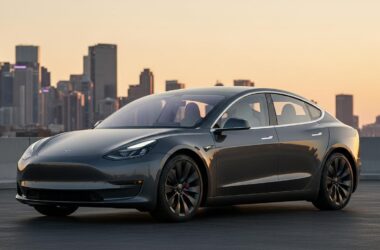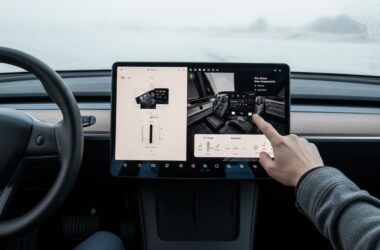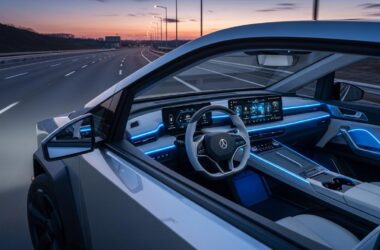



I still remember that period when rumors circulated within the Tesla community: Apple was making extravagant offers to poach our best engineers. The Cupertino giant wanted to revolutionize the automotive industry with its Project Titan, a colossal project intended to directly compete with Tesla. Their strategy? Aggressive and uncompromising: doubling the salaries of Palo Alto’s talent.
The result? A bitter failure that ended with the outright abandonment of the project in early 2024. This talent war tells more than just a recruitment battle: it reveals the limits of money when faced with a strong vision and company culture.
Project Titan, Apple’s Secret Automotive Ambition
A Colossal Project Launched in Secret
The Project Titan was not just a corridor rumor. Apple had mobilized over 2,000 employees at its peak, all dedicated to an ambitious goal: creating a 100% autonomous vehicle by 2028, without a steering wheel or pedals. A concept that leaned more towards science fiction than pragmatic automotive engineering.
Apple thought it could apply its iPhone recipe to the automotive industry: sleek design, impeccable user experience, a closed ecosystem. With a nearly unlimited budget typical of Cupertino, everything seemed possible on paper.
Besoin d'accessoires pour ta Tesla ?
Looking for accessories for your Tesla?
Except that an electric vehicle is not a smartphone on wheels.
From Excessive Ambition to Abrupt Abandonment
The successive revisions of the project speak volumes about the difficulties encountered. The initial goal of total autonomy was gradually scaled back to “partial” autonomy, then “limited.”
Dan Ives, an analyst at Wedbush, summarized it perfectly: Apple had completely underestimated the complexity of the automotive sector. In early 2024, the axe fell: Project Titan was abandoned, and teams were reallocated to artificial intelligence.
The observation is stark but instructive: having money is not enough in the electric vehicle industry. It requires field experience, real-world data, and an industrial culture that cannot be bought overnight.
The “Carpet Bombing” Strategy: Apple Bombards Tesla with Job Offers
Rapid-Fire Phone Calls
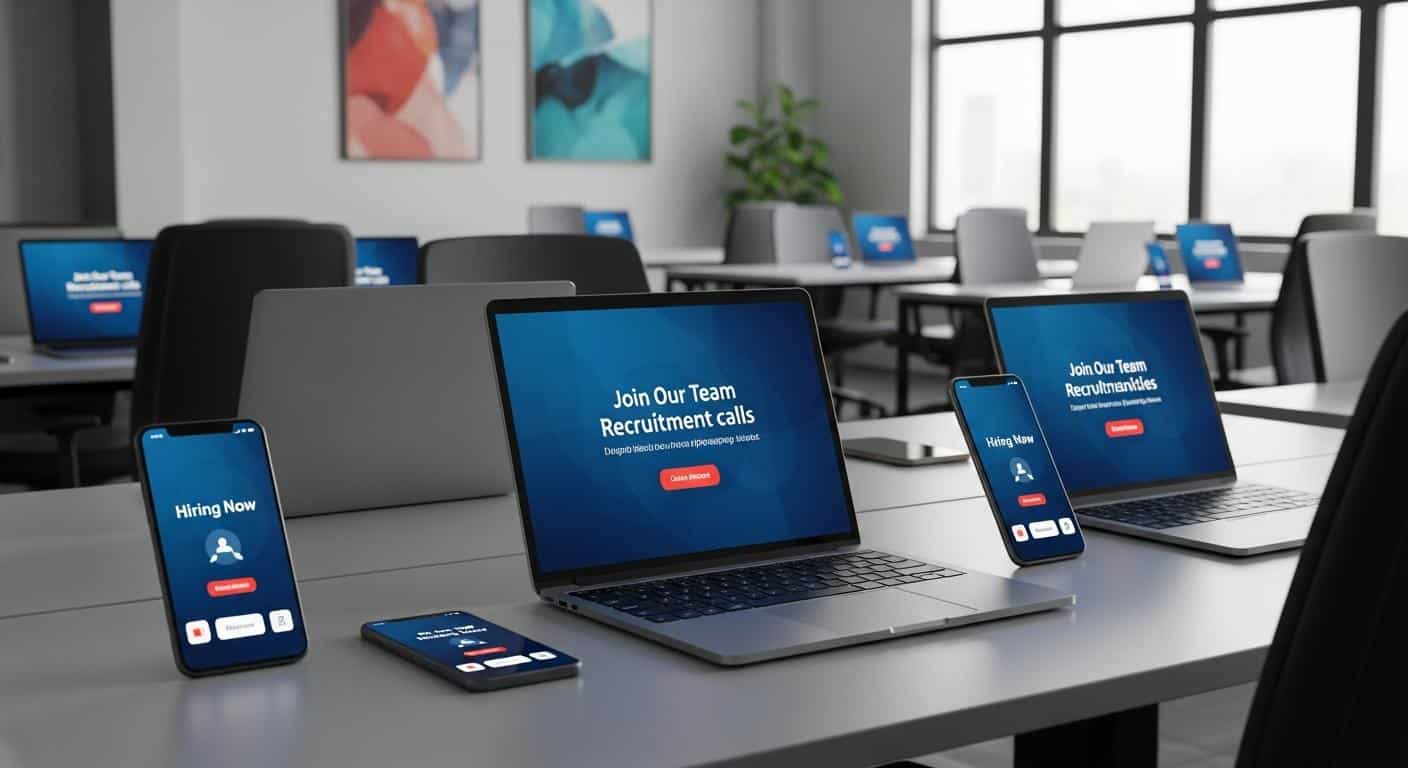
Elon Musk himself described Apple’s strategy as “carpet bombing.” Between 2022 and 2023, as Project Titan was desperately accelerating, Tesla engineers received direct calls from Apple recruiters.
Imagine receiving a call that doubles your salary overnight, without even a prior technical interview. This was Apple’s standardized offer: immediate doubling of salary, full stop.
No presentation of the project’s vision, no motivating technical pitch, just a raw financial proposal. An approach that speaks volumes about the state of urgency Cupertino was in.
A Brutal but Ineffective Approach
This strategy of volume over qualitative selection revealed a fundamental problem: Apple wasn’t selling a dream, but a paycheck. However, at Tesla, many engineers don’t work solely for money.
They are there to revolutionize mobility, to perfect autonomous driving, to be pioneers in an industry undergoing profound transformation. This exclusive focus on money contrasted sharply with the mission-driven culture that characterizes Tesla.
And the results would prove it spectacularly.
The Unexpected Response: Engineers Unplug Their Phones
The anecdote reported by Musk is telling: some Tesla engineers went so far as to unplug their phones entirely to avoid being bothered by Apple’s solicitations. A reaction that demonstrates strong cultural loyalty, far beyond what is usually observed in Silicon Valley.
Why such loyalty? Probably the excitement of working on Full Self-Driving, the feeling of being at the technological forefront, and the conviction of participating in something greater than a mere commercial product.
Interestingly: Tesla did not take any legal action against Apple, unlike the Rivian case in 2020 where Tesla sued the competitor for an “alarming pattern” of poaching. The difference? Rivian was a direct competitor startup in electric vehicles, while Apple at the time remained a non-competing tech giant in the automotive industry.
Besoin d'accessoires pour ta Tesla ?
Looking for accessories for your Tesla?
This loyalty is priceless, and Apple learned it the hard way. A strong company culture cannot be built with blank checks.

The Rare Defectors and Their Post-Apple Fate
Despite Apple’s offensive, very few actual departures were recorded. The recruitment raid’s success was frankly limited. Among the notable cases, we can mention Dr. Michael Schwekutsch, Senior Director of Engineering at Tesla, who joined Project Titan.
The irony of the story? Even the defectors didn’t believe in the Apple project long-term. Schwekutsch now works at Archer Aviation, a company specializing in eVTOLs (electric flying taxis). His journey from Tesla → Apple → Archer alone tells the story of Project Titan’s failure.
The impact of these departures on Tesla? Negligible. Tesla even launched the Tesla Model S Plaid during this period of recruitment raids, a vehicle exceeding 1,000 horsepower that symbolizes the company’s continuous innovation capability, raids or no raids.
Business as usual in Palo Alto, while Cupertino struggled to give substance to its phantom car project.
What This Failure Reveals About the Electric Vehicle Industry
This failed talent war teaches us three fundamental lessons about the electric vehicle industry:
- Tech culture ≠ automotive culture: Apple discovered that the industrial complexity of the automotive industry is not limited to beautiful software and minimalist design.
- Real-world driving data is an insurmountable advantage: Tesla has millions of kilometers driven in real-world conditions, a database that money cannot buy instantly.
- Field experience matters more than patents: one does not become a car manufacturer by recruiting engineers; it takes years of production, errors, and iterations.
Tesla’s competitive advantage also relies on its mastery of large-scale production, a dimension that Cupertino never truly understood. Manufacturing millions of reliable vehicles requires manufacturing expertise that Apple simply did not possess.
Result: Apple repositioned its strategy, abandoning automotive to focus massively on artificial intelligence. Project Titan thus joins the graveyard of abandoned projects, alongside Dyson’s failed attempt and other giants who underestimated the difficulty of the endeavor.
Meanwhile, while Apple was giving up, Tesla was already preparing its next revolution with an accessible compact vehicle, proof that long-term vision and methodical execution always prevail over opportunistic attempts.
This talent war reminds us of a simple truth: in the electric vehicle industry, money isn’t everything. Vision, field experience, and a strong company culture remain the true keys to success. Tesla proved this by resisting Apple’s bombardment, and especially by continuing to innovate while Cupertino gave up.
Profitez d'avantages exclusifs en achetant votre Tesla
Vous envisagez d'acquérir une Tesla ? En utilisant mon code de parrainage lors de votre achat, vous pouvez bénéficier d'avantages exceptionnels !
Des kilomètres gratuits de recharge ou d'autres récompenses exclusives, mon code de parrainage est votre passeport pour des avantages supplémentaires : https://ts.la/antoine49352 🤩
Pas de pression, juste une opportunité à saisir pour enrichir votre expérience Tesla.
Découvrez ici le système du parrainage et comment utiliser le code.
Get exclusive perks when buying your Tesla
Thinking about getting a Tesla? If you use my referral code when you purchase, you may be eligible for extra perks.
Free Supercharging miles or other exclusive rewards - my referral code can unlock additional benefits: https://ts.la/antoine49352 🤩
No pressure - just a simple option if you want to enhance your Tesla experience.
Learn how the Tesla referral program works and how to use the code.