




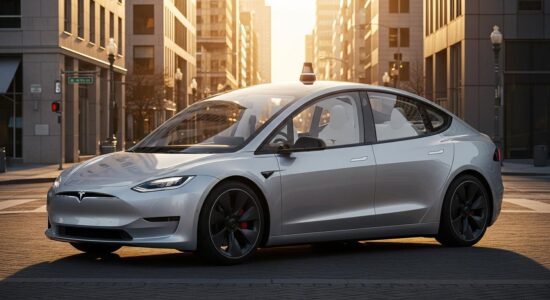
When Elon Musk took the stage at the “We, Robot” event in October 2024 in Los Angeles, one announcement particularly caught my attention: the Tesla Cybercab would boast an operating cost of only $0.20/mile. To put this figure into perspective, that’s 50% cheaper than projections for the Waymo Gen 6, and between 4 and 20 times cheaper than an Uber or Lyft ride depending on the distance.
When I heard Musk announce this figure, I immediately wondered if it was realistic or just another one of his ambitious promises. So I delved into the technical data and third-party analyses to understand how Tesla actually plans to achieve it. And frankly, the technical foundations are more solid than I thought.
The Cybercab aims for 50% lower cost than autonomous competitors
To evaluate the credibility of this announcement, I looked at independent analyses. ARK Invest projects that the Waymo Gen 6 will reach an operating cost of approximately $0.40/mile by 2030. Tesla announces exactly half: $0.20/mile.
This overall cost includes several components: energy consumption, vehicle maintenance, regular cleaning, depreciation of invested capital, and insurance. To contextualize, Waymo Gen 5 (the currently deployed version) shows costs between $0.60 and $1/mile according to estimates. Musk states that there is a “clear path” to this $0.20/mile goal, which is not just an empty promise.
Besoin d'accessoires pour ta Tesla ?
Looking for accessories for your Tesla?
What it changes for the end-user
Now, let’s compare with our daily reality. According to the AAA, owning and operating a personal vehicle in the United States costs approximately $0.77/mile on average. Uber or Lyft rides range between $1 and $4/mile depending on the city and distance traveled.
If Tesla achieves its goal, we’re talking about an autonomous robotaxi potentially cheaper than owning your own car. This aggressive pricing strategy is reminiscent of the one envisioned for the future compact Tesla at $25,000, proving that Tesla seeks to democratize electric mobility at all levels. This is exactly the kind of disruption that could transform our relationship with individual car ownership.
Technical levers to achieve this record efficiency
But concretely, how does Tesla technically plan to achieve this? I’ve identified several particularly interesting engineering levers.
Unprecedented energy efficiency
The stated goal is 5.5 to 6 miles/kWh (or 8.8 to 9.6 km/kWh). To give you an idea, a Model 3 Long Range achieves approximately 4 miles/kWh, and a Model Y is closer to 3.5 miles/kWh. Achieving 5.5-6 miles/kWh requires Tesla’s expertise in batteries and energy efficiency, a field where the manufacturer has demonstrated its technological leadership.
The levers to achieve this? Optimized aerodynamics, maximum weight reduction, and advanced electric motor optimization. Every improvement in energy efficiency directly translates to a reduction in cost per mile.
“Unboxed Manufacturing” for Cost Efficiency
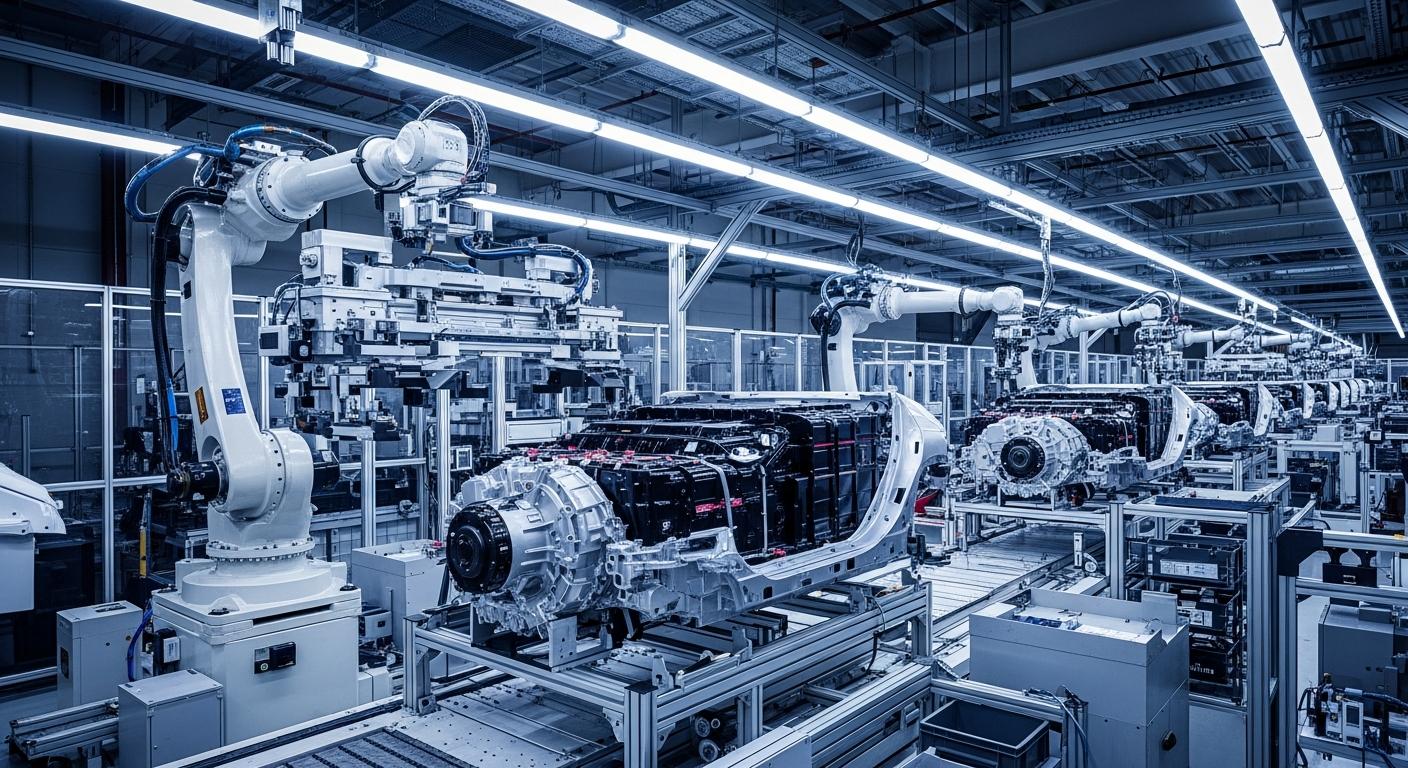
Tesla is also relying on its new manufacturing process called “unboxed manufacturing”. This approach aims to drastically reduce the number of parts and simplify assembly, which directly impacts production costs. The absence of a steering wheel and pedals in an autonomous vehicle like the Cybercab eliminates hundreds of components.
Add to that the zero driver labor cost – the fundamental difference from Uber or Lyft – and a simplified electrical architecture. Optimizing battery life completes this rather convincing technical picture.
A business model that disrupts urban transportation economics
Let’s do a concrete calculation that speaks volumes. Imagine a 20-mile daily commute (approximately 32 km), which corresponds to many daily trips in American suburban areas.
- With a personal vehicle at $0.77/mile: approximately $15.40/day = $5,621/year
- With the Cybercab at $0.20/mile: approximately $4/day = $1,460/year
- Potential savings: $4,161/year
The difference with Uber or Lyft is even more spectacular, with a multiplier factor between 5 and 20 depending on the situation. At this price point, the question becomes legitimate: will owning a vehicle remain relevant in the city? For many two-car households, giving up the second car could become an economic no-brainer.
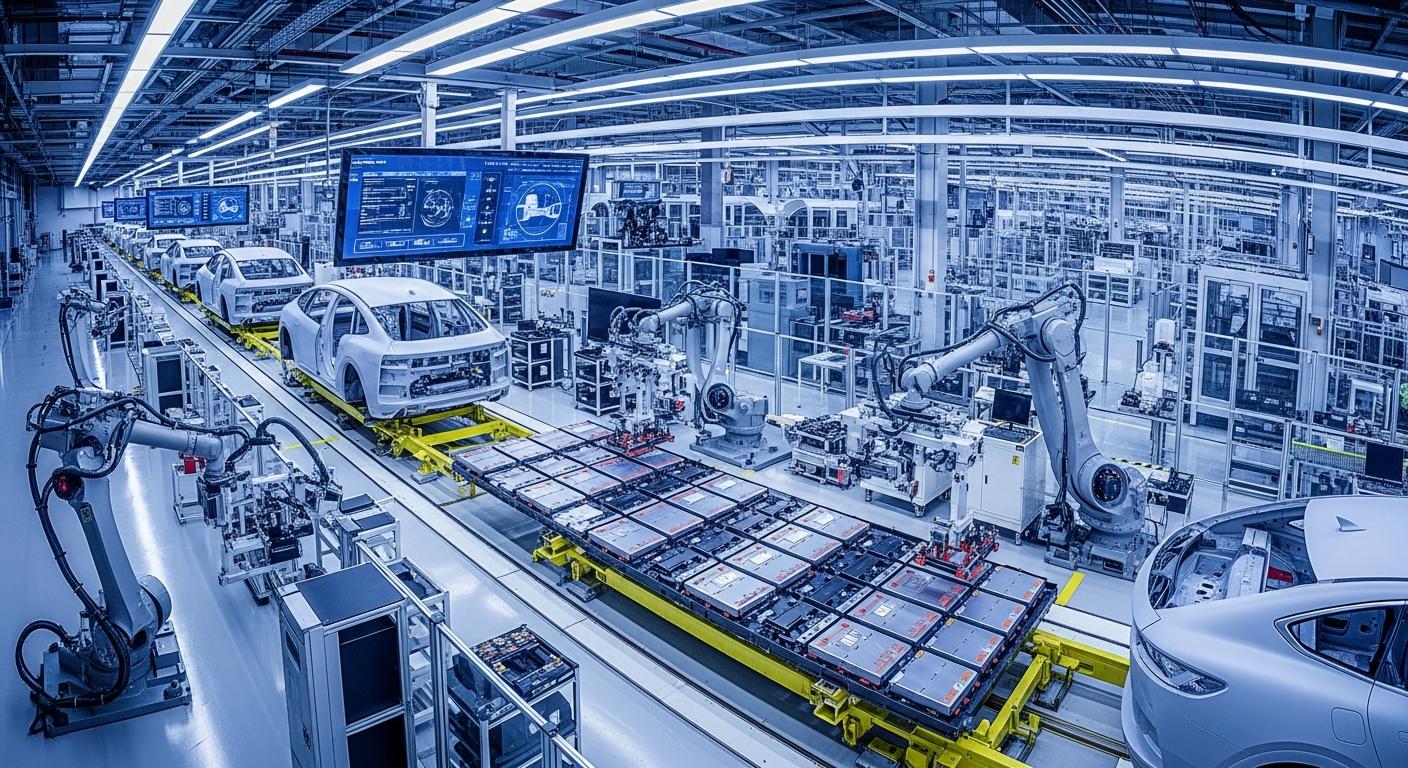
Production ramp-up: a challenge embraced by Musk
Musk has never hidden the upcoming difficulties. He stated that production would be “agonizingly slow” at first, then “insanely fast” once processes are mastered. This classic S-curve – a difficult start followed by exponential acceleration – is well-known in the industry.
What makes the Cybercab particularly complex is that “almost everything is new” in Musk’s own words, referring jointly to the Cybercab and the Optimus robot. Unlike the established production of Model 3 and Model Y, we are facing entirely new technologies: Level 5 autonomy, unprecedented manufacturing processes. Musk evokes a classic S-curve for the production ramp-up, recalling Tesla’s sometimes difficult-to-predict production timelines, as seen with other ambitious projects.
Revealing fact: no precise timeline has been communicated. Deliberately vague or simply realistic about the uncertainty? I lean towards the latter option.
Between ambition and realism: how credible are these promises?
After analyzing all these elements, here is my nuanced verdict. Several ingredients make this promise credible:
Besoin d'accessoires pour ta Tesla ?
Looking for accessories for your Tesla?
- Energy efficiency: Tesla has already largely proven its mastery in this area
- Innovative manufacturing: expertise demonstrated with Giga Press and 4680 batteries
- ARK Invest data: an independent third-party analysis that validates the trajectory
- Real economies of scale from autonomy (no driver to pay)
But several areas of uncertainty remain. Autonomy regulations remain the big question mark with completely unpredictable timing. Insurance costs for robotaxi fleets are still unknown at this stage. The actual maintenance of autonomous vehicles in real-world conditions lacks historical perspective. And then, we are talking about a 2030 horizon, a 6-year projection, which leaves plenty of time for adjustments.
Personally, I remain optimistic about the technical feasibility – the technological building blocks are there – but more cautious about the exact timing. Tesla is accustomed to keeping its technical promises, even if timelines often slip.
Ultimately, this $0.20/mile goal for the Tesla Cybercab is based on solid technical foundations and a coherent economic vision. If Tesla achieves it, we’re talking about a true disruption of urban transportation. What makes the projection credible is that it relies on industry data and third-party analyses, not just Musk’s usual enthusiasm.
I advise you to closely follow the evolution of autonomy regulations and the first concrete deployments. Personally, I’m eager to see the first Cybercabs operating in real-world conditions – that’s where we’ll see if these promises transform into a mobility revolution. And you, at that price, would you choose a Cybercab or your personal Tesla?
Profitez d'avantages exclusifs en achetant votre Tesla
Vous envisagez d'acquérir une Tesla ? En utilisant mon code de parrainage lors de votre achat, vous pouvez bénéficier d'avantages exceptionnels !
Des kilomètres gratuits de recharge ou d'autres récompenses exclusives, mon code de parrainage est votre passeport pour des avantages supplémentaires : https://ts.la/antoine49352 🤩
Pas de pression, juste une opportunité à saisir pour enrichir votre expérience Tesla.
Découvrez ici le système du parrainage et comment utiliser le code.
Get exclusive perks when buying your Tesla
Thinking about getting a Tesla? If you use my referral code when you purchase, you may be eligible for extra perks.
Free Supercharging miles or other exclusive rewards - my referral code can unlock additional benefits: https://ts.la/antoine49352 🤩
No pressure - just a simple option if you want to enhance your Tesla experience.
Learn how the Tesla referral program works and how to use the code.