




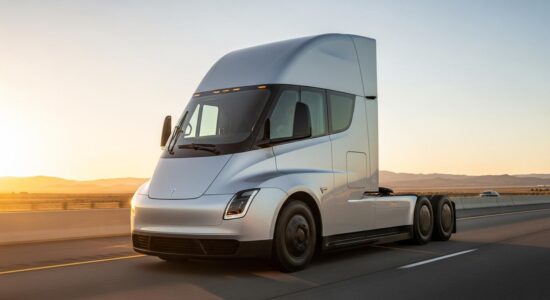
After almost a decade of waiting since its initial presentation in 2017, the Tesla Semi is finally emerging from its pricing shadow. Direct communications from Tesla to interested companies reveal two official prices: $250,000 for the Standard Range version and $290,000 for the Long Range. These amounts, significantly higher than initial estimates, reflect nine years of technological and economic evolution. But beyond the raw figures, this reveals Tesla’s entire strategy for the electric heavy-duty truck segment. A complete breakdown of a pricing strategy that will redefine the codes of electrified road transport.
Two versions in the catalog, two distinct pricing strategies
Tesla therefore offers two distinct configurations of its electric truck. The Standard Range version is priced at $250,000 excluding taxes and delivery fees, while the Long Range version climbs to $290,000 under the same conditions.
The $40,000 difference between the two versions primarily reflects the difference in battery capacity and thus driving range. In euros, according to current exchange rates, this represents approximately €230,000 for the standard version and €267,000 for the long driving range.
To gauge the extent of the price evolution, let’s remember that in 2017, Tesla announced $150,000 for the 300-mile version, $180,000 for the 500-mile version, and $200,000 for the Founders Series. The calculation is clear: we are seeing a 66% increase for the standard version and 61% for the long driving range.
Besoin d'accessoires pour ta Tesla ?
Looking for accessories for your Tesla?
It should be noted, however, that these prices have not been the subject of an official public announcement from Tesla. They come from direct communications to companies engaged in purchase discussions, relayed notably by Electrek. An approach that perfectly matches the Semi’s B2B logic.
But how can such an increase be justified in less than a decade?
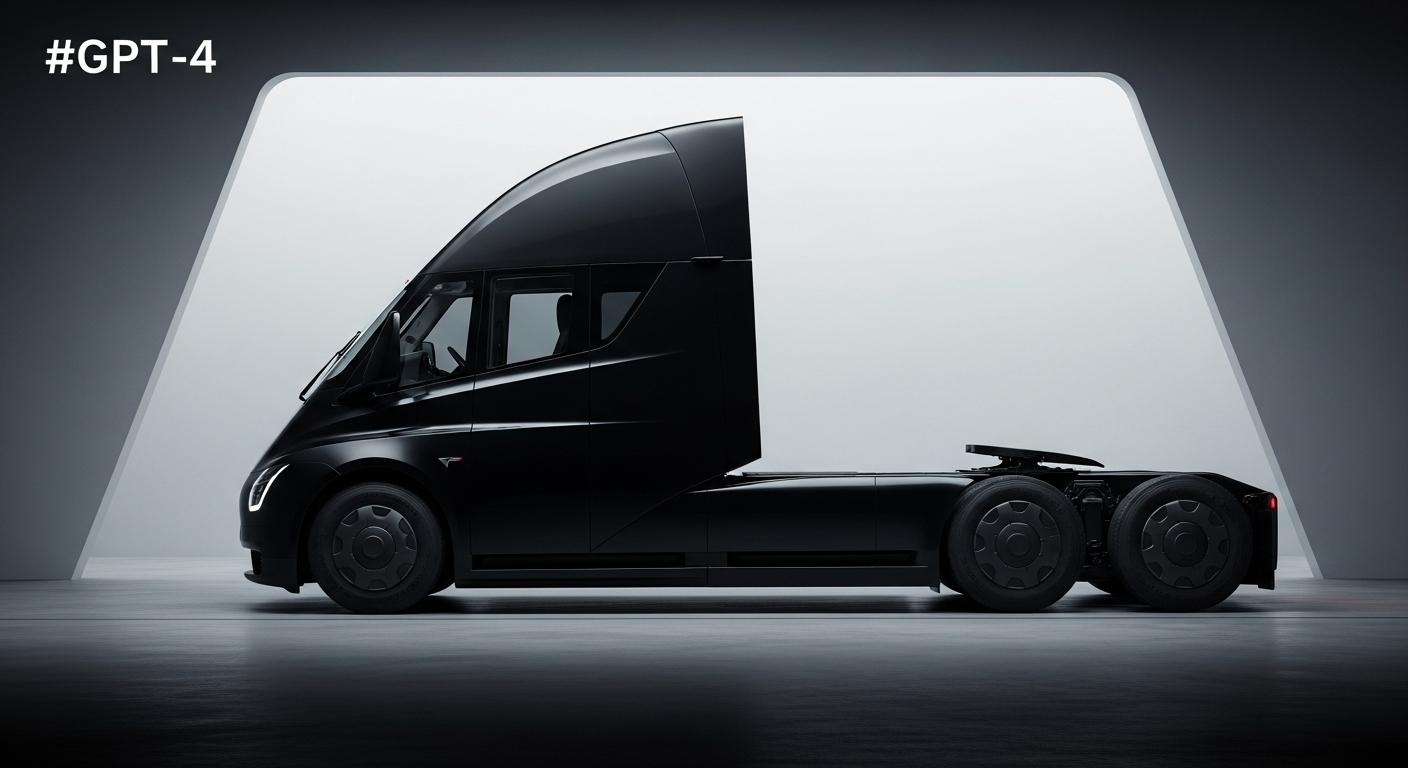
A price increase justified by nine years of evolution
Between 2017 and 2025, the economic and technological context has radically changed. Inflation from 2017-2025 has significantly impacted all production costs, particularly in the automotive and battery sectors.
But beyond inflation, it is above all the major technological evolution that explains this difference. The current Semi has little in common with the 2017 prototype. The driving range has been optimized, charging power refined, safety systems considerably reinforced, and the Autopilot has been specifically adapted to the constraints of heavy-duty vehicles.
The product’s maturity also plays a crucial role. Tesla has moved from a captivating concept on stage to functional units delivered to Pepsi and Frito-Lay, with concrete real-world conditions feedback.
Massive investments in production infrastructure also weigh in the balance. The construction of a dedicated factory in Sparks, Nevada, represents hundreds of millions of dollars that naturally need to be amortized.
Compared to established competitors like the Volvo VNR Electric or the Freightliner eCascadia, the Semi is now positioned as an assumed premium offering, just like the Roadster, whose production is also delayed, but with a technological promise that justifies the price difference.
Imminent mass production from the Sparks, Nevada factory
The year 2025 marks a decisive turning point for the Tesla Semi. The dedicated factory in Sparks, Nevada, whose construction began in 2024, is approaching operational readiness.
This facility aims for an annual capacity of 50,000 units at full load, a volume that will finally allow Tesla to move beyond the artisanal stage that characterized the first deliveries from Fremont.
The timeline communicated by Elon Musk is now clear:
- End of 2025: first Semis rolling off the new production line
- 2026: launch of mass production itself
This industrial scaling represents a strong signal. Tesla is moving away from experimentation to embrace a volume-driven approach necessary to amortize colossal R&D investments.
To contextualize, the evolution of Tesla’s international production shows that 50,000 annual units represent a significant share of the American electric heavy-duty truck market, which is still embryonic but growing rapidly.

A B2B business model with radically different codes
Unlike the Model 3, Y, S, or X, the Semi will never appear on a public configurator with a prominently displayed price. The B2B business model operates under completely different rules.
Besoin d'accessoires pour ta Tesla ?
Looking for accessories for your Tesla?
Interested companies go through a reservation system followed by direct negotiation with Tesla sales teams. Order volumes, delivery times, charging infrastructure needs: everything is discussed on a case-by-case basis.
But the element that radically changes the pricing landscape is government incentives. In California alone, $165 million is available to subsidize the purchase of electric heavy-duty trucks. These aids can drastically reduce the final price paid by fleets.
Concretely, a Californian company could obtain several tens of thousands of dollars in reductions per Semi purchased, depending on the applicable incentive programs. The announced price of $250,000 or $290,000 is therefore only a starting point in the final negotiation.
This confidential approach explains why pricing information comes from indirect sources rather than official Tesla communication. In the B2B world, public price transparency is simply not the norm.
The Semi facing the European and French road transport market
While the Semi is preparing to hit the American market, the European situation remains much more uncertain. The Old Continent already has an established offering with the Volvo FH Electric, the Mercedes eActros, and Scania’s electric models.
Regulatory issues constitute a first obstacle. European homologation requires compliance with specific Euro standards, and urban traffic constraints vary considerably from one country to another.
But the major challenge remains the Megacharger infrastructure. The Tesla Semi requires specific ultra-fast charging stations capable of delivering considerable power. This network simply does not exist in Europe today.
For the French market, however, the potential exists. Large logistics fleets (Carrefour, Leclerc, national transporters) are closely scrutinizing like the future $25,000 compact car targeting the global market for road transport decarbonization solutions.
Tesla’s integrated ecosystem and advanced battery technology are undeniable competitive advantages. But the timeline for arrival in Europe, adaptation to local specificities, and especially the final price in euros including tax remain major unknowns.
Sector data shows that road transport accounts for a considerable share of emissions, as illustrated by automotive industry data, which reinforces the urgency of a transition to electrified solutions in this segment.
Prices confirmed at $250,000 and $290,000, mass production planned for 2026, and a clearly high-end strategic positioning: all the elements are now on the table. The Tesla Semi represents a major test for Elon Musk’s company in the B2B segment, a territory where the codes differ radically from the general public. The real question remains: will these prices convince large transport fleets to massively switch to electric? Feedback from Pepsi in 2026 and the effective deployment of production will provide concrete answers in the coming months.
Profitez d'avantages exclusifs en achetant votre Tesla
Vous envisagez d'acquérir une Tesla ? En utilisant mon code de parrainage lors de votre achat, vous pouvez bénéficier d'avantages exceptionnels !
Des kilomètres gratuits de recharge ou d'autres récompenses exclusives, mon code de parrainage est votre passeport pour des avantages supplémentaires : https://ts.la/antoine49352 🤩
Pas de pression, juste une opportunité à saisir pour enrichir votre expérience Tesla.
Découvrez ici le système du parrainage et comment utiliser le code.
Get exclusive perks when buying your Tesla
Thinking about getting a Tesla? If you use my referral code when you purchase, you may be eligible for extra perks.
Free Supercharging miles or other exclusive rewards - my referral code can unlock additional benefits: https://ts.la/antoine49352 🤩
No pressure - just a simple option if you want to enhance your Tesla experience.
Learn how the Tesla referral program works and how to use the code.