


I still remember my first drive with my Tesla: that strange sensation of slowing down without touching the brake. A bit unsettling at first, I admit. Yet, a few days later, I couldn’t do without it. The Tesla regenerative braking is much more than just a technical feature: it’s a real revolution in daily driving.
This intelligent system transforms your vehicle’s kinetic energy into electricity, which it reinjects directly into the Tesla battery. The result? More driving range, less brake wear, and incomparable driving comfort.
In this article, I’m going to share my experience and explain why the maximum mode is the best choice for the vast majority of drivers. Spoiler: you’ll never want to go back.
What exactly is regenerative braking?
In simple terms, regenerative braking allows your Tesla to recover energy normally lost during deceleration. Unlike a combustion car where braking dissipates this energy as heat, your Tesla transforms it into electricity.
Besoin d'accessoires pour ta Tesla ?
Looking for accessories for your Tesla?
The principle is ingenious: when you lift your foot off the accelerator, the electric motor reverses its operation and becomes a generator. This energy recovery recharges the battery in real-time, while slowing the vehicle progressively and controllably.
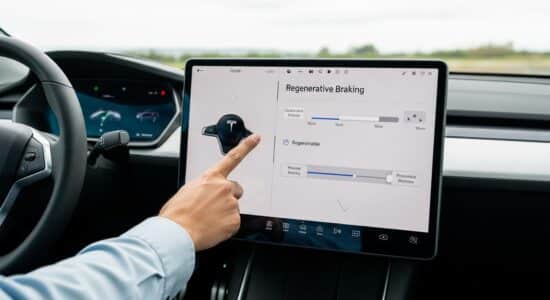
Depending on the Tesla models, you have access to different modes: Standard (moderate regenerative braking) or Low (minimal regenerative braking). My advice? Opt for the maximum mode available on your vehicle.
How it works technically (without jargon)
Imagine a dynamo bicycle: when you pedal, the dynamo produces electricity to power your light. Regenerative braking works on the same principle, but in reverse.
When your Tesla slows down, the electric motor transforms into a generator. Kinetic energy (the energy of movement) is converted into electrical energy that returns directly to the Tesla battery. This process generates very little heat, unlike traditional mechanical brakes which heat up enormously.
It’s this efficiency that makes all the difference: you recover part of the energy you spent to accelerate, which significantly improves your overall driving range.
The 4 advantages of maximum regenerative braking
Optimized daily driving range
This is the most visible daily advantage. Thanks to energy recovery, you gain between 5% and 15% driving range depending on your driving style and route. In the city, where stops and decelerations are frequent, this gain is even more pronounced.
Personally, on my daily urban commutes, I observe a difference of about 10% compared to driving without maximum regenerative braking. On winding roads, this figure can climb up to 15%. To optimize your battery management, regenerative braking is truly your best ally.
It’s not just a matter of numbers on the screen: it’s real extra mileage, less frequent recharges, and increased peace of mind on long journeys.
Brakes that last (really) long
Here’s an impressive fact: after 80,000 kilometers with my Tesla, my brake pads are still original. And they still have many good years ahead of them!
With regenerative braking maximized, you only use mechanical brakes for complete stops or emergency situations. Wear becomes almost non-existent. Compare that to a combustion car where pads need to be changed every 30,000 to 50,000 kilometers.
The savings on maintenance are substantial. And if you want to customize your Tesla’s brake calipers, you might as well do it on brakes that will stay new for a long time!
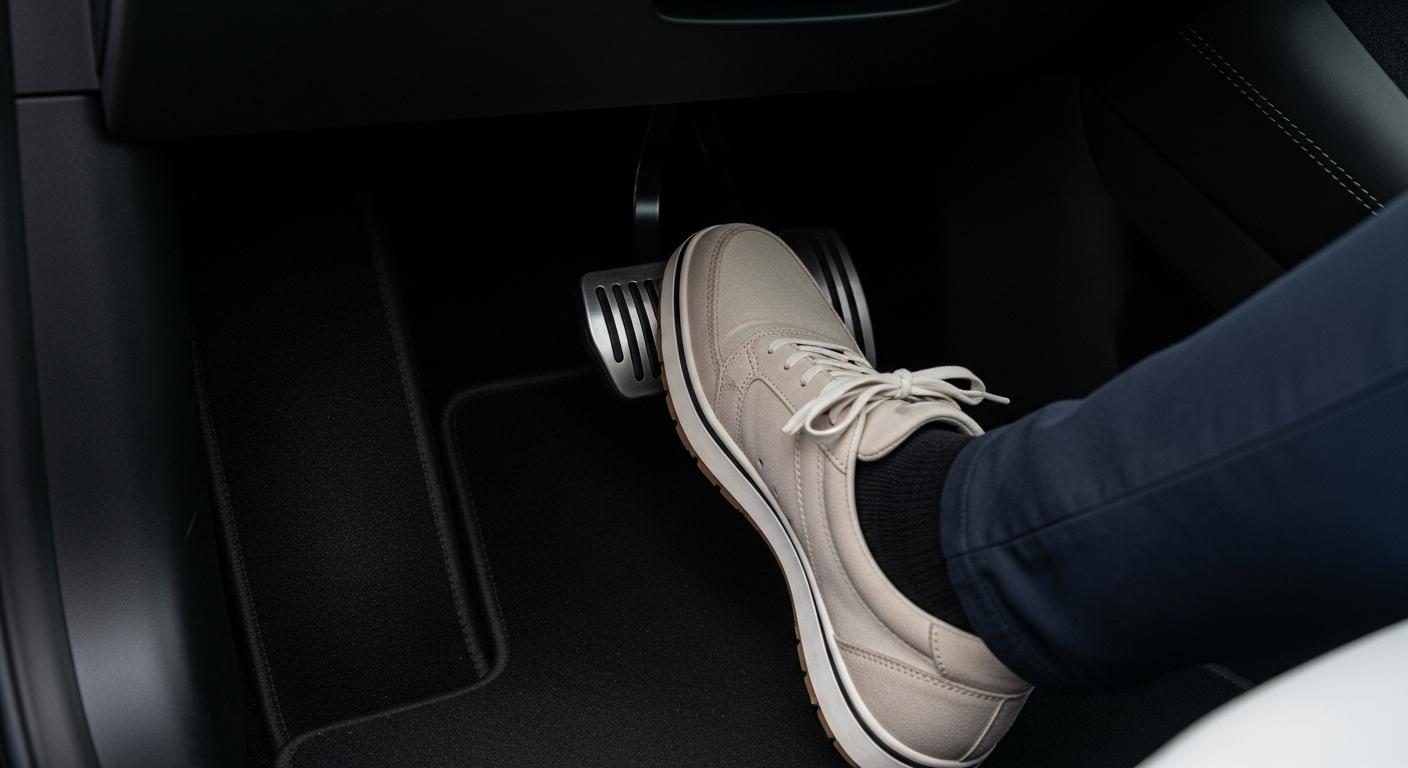
One Pedal Driving quickly becomes second nature. You accelerate and slow down with the same foot, without ever touching the brake. It’s smooth, comfortable, and surprisingly relaxing on long journeys.
In terms of
Besoin d'accessoires pour ta Tesla ?
Looking for accessories for your Tesla?
How to get used to regenerative braking (beginner’s guide)
Let’s be honest: the first three days might feel strange. This aggressive “engine braking” sensation is surprising at first. Your passengers might complain about a few jerks. It’s normal, and it passes quickly.
Full adaptation usually takes 2 to 3 days maximum. My advice? Go directly to maximum mode to get used to it faster. It’s like learning to swim: better to dive right in than stay on the edge.
To get to grips with your Tesla upon delivery, regenerative braking is one of the first settings to master.
Here are some practical tips that helped me:
- Anticipate red lights and stop signs more: lift your foot earlier
- Modulate the accelerator more finely: small adjustments are enough
- Adjust your safety distance: it can be slightly reduced thanks to instant deceleration
- Practice in an empty parking lot to feel the power of regenerative braking
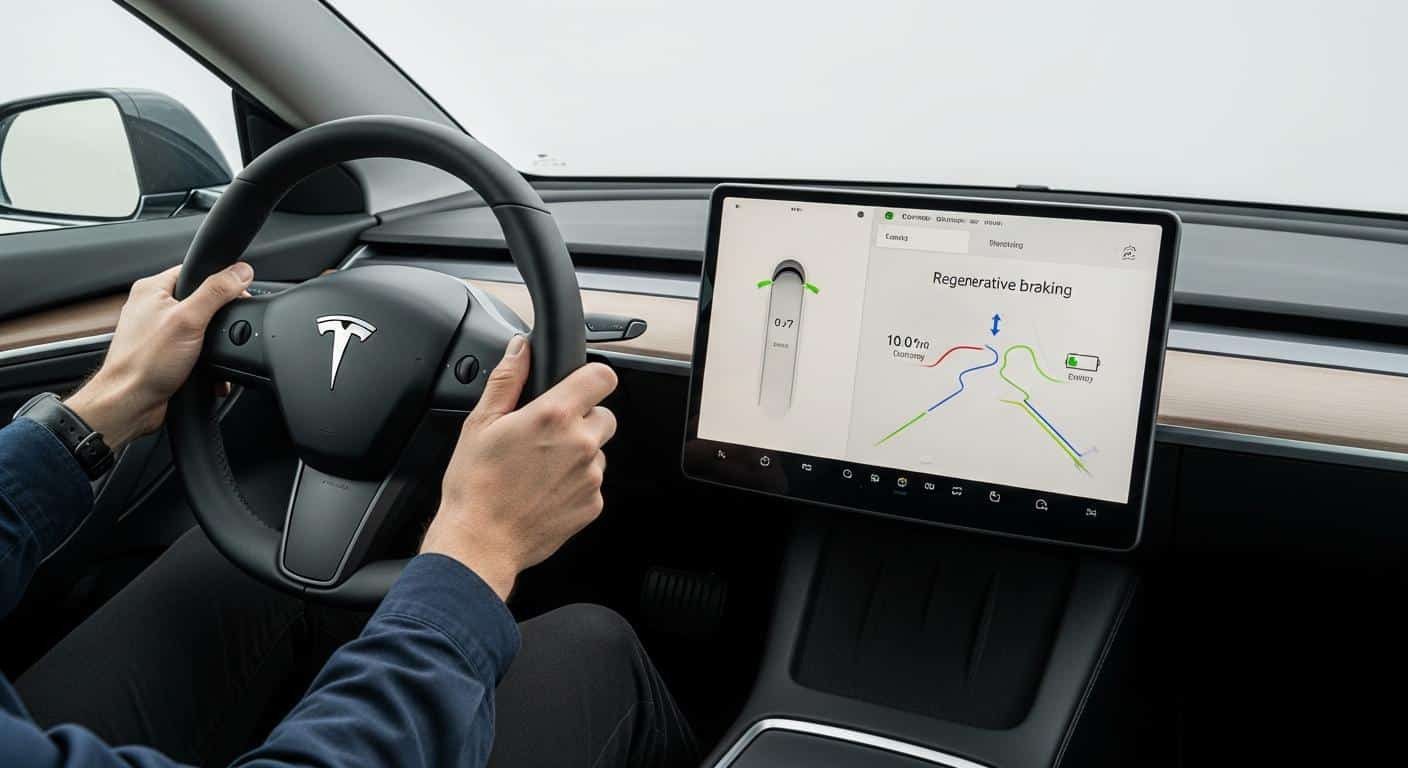
- Observe the energy indicator on the screen: you’ll see energy recovery in real-time
For your passengers’ comfort, try to be particularly gentle for the first few days. With a little practice, your driving will become even smoother than with a conventional car.
When should you really use conventional brakes?
Regenerative braking doesn’t completely replace mechanical brakes. Here are the situations where you’ll need them:
- Emergency situations: sudden braking requires the combined power of the regenerative system and mechanical brakes
- Complete stops: the very last meters before a full stop require pressure on the brake pedal
- In rain or snow: behavior may vary slightly, with recovery sometimes reduced to prevent skidding
Rest assured: the Tesla manages everything intelligently. The system automatically combines regenerative and mechanical braking as needed. Safety is always ensured, regardless of the conditions.
A bonus tip: regularly test your mechanical brakes, every 500 to 1,000 kilometers or so. A good firm brake application is enough to prevent oxidation of the discs and brake pads. Some Tesla models even display an alert if the brakes are not used enough.
My verdict after years of maximum regenerative braking
After several years of driving exclusively in maximum mode, I can tell you without hesitation: I will never go back. The benefits on driving range are very real, the almost zero wear on my brakes saves me on maintenance, and one pedal driving has become second nature.
Every time I drive a combustion car, I instinctively look for that regenerative braking that isn’t there. That’s how much you get used to it!
For whom might it not be suitable? Frankly, the cases are rare. Perhaps for someone who shares their car with a driver resistant to change, or for very specific medical reasons. But in 95% of cases, it’s the best choice.
If you are a new
Regenerative braking represents one of the most beautiful innovations in electric driving. It is at once ecological, economical, and pleasant. According to industry experts, this technology will continue to improve in the coming years, making our electric vehicles even more efficient.
So, ready to activate maximum mode and discover a new way of driving? Test it today and observe the difference. And don’t hesitate to share your experience in the comments: I’d be curious to know how long it took you to get used to it!
Profitez d'avantages exclusifs en achetant votre Tesla
Vous envisagez d'acquérir une Tesla ? En utilisant mon code de parrainage lors de votre achat, vous pouvez bénéficier d'avantages exceptionnels !
Des kilomètres gratuits de recharge ou d'autres récompenses exclusives, mon code de parrainage est votre passeport pour des avantages supplémentaires : https://ts.la/antoine49352 🤩
Pas de pression, juste une opportunité à saisir pour enrichir votre expérience Tesla.
Découvrez ici le système du parrainage et comment utiliser le code.
Get exclusive perks when buying your Tesla
Thinking about getting a Tesla? If you use my referral code when you purchase, you may be eligible for extra perks.
Free Supercharging miles or other exclusive rewards - my referral code can unlock additional benefits: https://ts.la/antoine49352 🤩
No pressure - just a simple option if you want to enhance your Tesla experience.
Learn how the Tesla referral program works and how to use the code.