


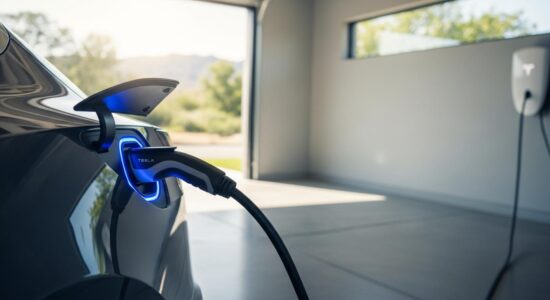
Yes, you can — and should — leave your Tesla plugged in permanently: this is Tesla’s official recommendation for preserving your battery. The battery management system (BMS) takes care of everything and stops charging automatically at the threshold you have set. Set your limit to 80-90% for daily use, and you no longer have to think about it.
It’s probably the question that comes up most often in Tesla groups and forums: “can I leave my Tesla plugged in overnight, every night, without damaging the battery?” The short answer is yes. But there are a few nuances worth understanding — not to worry about, but to optimize your battery’s lifespan over the long term.
First thing to keep in mind: your Tesla is not a smartphone. The chemistry is different, the onboard system is far more sophisticated, and the car manages its own charging. Here is what that actually means in practice.
What Tesla says — and what it actually means
The Tesla owner’s manual is crystal clear on this point: “The best way to preserve the high voltage battery is to leave your vehicle plugged in when not in use.” This is not a trivial suggestion – it is an official instruction, written in black and white in Tesla’s documentation.
Besoin d'accessoires pour ta Tesla ?
Looking for accessories for your Tesla?
Behind this recommendation lies the Battery Management System (BMS) – the brain of your battery. It continuously monitors the state of charge, temperature and cycles, and makes decisions on your behalf.
Concretely, the BMS stops charging as soon as you reach the configured threshold (80%, 90% or 100%), then only resumes if the battery drops slightly below it. Unplugged, your vehicle regularly draws from its battery to test systems and recharge the low-voltage battery. Plugged in, the car manages. Unplugged, it consumes its own reserves.
The analogy I often use: leaving your Tesla plugged in is like keeping your laptop on the charger — it knows when to stop on its own. Plus, staying plugged in allows you to activate battery preconditioning or cooling without affecting your range. A significant advantage depending on the season.
The real impact on the battery: the actual risks (and those that aren’t)
What really degrades a lithium-ion battery
The main enemy of a battery is deep charge/discharge cycles – regularly going from 0% to 100% and back. That’s what wears out the chemistry, not staying plugged in.
Excessive heat is the other major degradation factor – we will come back to this in the section on special cases. And repeated fast charging at Superchargers wears the battery more than slow charging at home, even though Tesla has worked hard to limit this effect.
There is also an important difference depending on the type of battery in your vehicle:
- LFP batteries (lithium iron phosphate): found on the Model 3 and Model Y Rear-Wheel Drive in many markets. LFP can be charged to 100% daily without issue. Tesla even recommends a full weekly charge to properly calibrate the range estimate.
- NMC batteries (nickel manganese cobalt): fitted in the Long Range and Performance versions. NMC can be charged to 100% for long trips only – on a daily basis, keeping the charge between 60 and 80% helps preserve it longer.
What does NOT degrade: misconceptions to debunk
Leaving your Tesla plugged in does not degrade the battery – provided the BMS does its job, which it does very well. This is a misconception inherited from the old NiMh batteries of the 90s, which does not apply to modern lithium-ion chemistry.
Staying at 80% charge daily is an optimization recommendation, not a survival rule. If you forget one evening and charge up to 85%, your battery is not going to melt. What really matters is avoiding the two extremes: staying at 100% for long periods without driving, and repeatedly discharging below 5 to 10%.
The vampire drain (passive standby loss) exists, but remains very limited in an optimal configuration: between 0 and 1% approximately per 24 hours. Tesla continues to improve this point through software updates. Drain increases mainly if third-party applications constantly query the vehicle and prevent it from entering deep sleep.
The special cases where it changes everything
The “stay connected” rule applies in the vast majority of situations, but here are the cases where it is particularly important — or on the contrary, where you need to adapt your strategy.
Long absence (vacation, business trip): leaving the Tesla plugged in is clearly the best option. The car keeps its battery topped up, receives its software updates, and you can monitor it remotely from the app. You can even defrost your Tesla remotely from the app if you return in winter – which is only possible if the battery is sufficiently charged.
Heatwaves and extreme cold: this is where staying plugged in becomes truly useful. Tesla’s thermal management system can activate to keep the battery within its ideal temperature range without drawing from the range. In summer in an outdoor parking lot, in winter in a garage: plugged in, your Tesla is in the best possible conditions.
Closed garage in winter: plugged in = battery that can be pre-conditioned remotely. You leave with a battery already at optimal temperature, without waiting for the car to warm up while driving. A real gain in comfort and range.
Besoin d'accessoires pour ta Tesla ?
Looking for accessories for your Tesla?
Supercharger as the only charging source: if you don’t have a home charger, Tesla recommends charging as often as possible and avoiding letting the battery frequently drain to a low level before recharging. In that case, look into battery preconditioning before arriving at the Supercharger – it makes a real difference in charging speed and battery wear.
And if you’re planning a long trip, also take a look at what’s being said about charging stops on long journeys – road charging strategy is something you need to plan ahead for.
My daily best practices for a long-lasting battery
Here is what I do concretely, and what I recommend to everyone who asks me:
- Set the charge limit to 80–90% for daily use. In the Tesla app or from the touchscreen, go to Charging → slide the charge limit slider. For vehicles with a recommended daily charge limit of 80%, Tesla advises keeping this setting and only increasing to 100% when necessary, for example before a long trip.
- Charging to 100% the night before a long trip is perfectly acceptable – and even recommended. No need to worry if you spend a night at 100% before heading out the next morning.
- Never let the battery drop below 10-15% on a regular basis. This is far more stressful for the battery chemistry than staying plugged in at 80%.
- Enable preconditioning from the app before you leave – especially in winter – rather than relying on the heat generated while driving.
- Park in the shade or indoors in summer when possible. Ambient temperature has more impact on degradation than the charge level itself.
- Track your battery’s evolution with a third-party app. In the French-speaking community, TeslaFi and Tessie are the most widely used for battery health monitoring, charging statistics, and vampire drain detection. They notably allow you to compare your data with other owners and track consumption while parked.
The degradation of a Tesla battery is a slow and inevitable process — but largely manageable with good habits. Feedback from owners shows that charging to 90% daily while rarely dropping below 20% yields results very close to those obtained by limiting to 80%: the difference in degradation is practically identical. What matters is consistency and avoiding extremes.
To go further on temperature and its role in the longevity of lithium-ion batteries, check out this article on thermal management – an often underestimated aspect.
So, do you leave your Tesla plugged in or not? And what daily charge limit have you set? Let us know in the comments — it’s always interesting to see the community’s habits.
Profitez d'avantages exclusifs en achetant votre Tesla
Vous envisagez d'acquérir une Tesla ? En utilisant mon code de parrainage lors de votre achat, vous pouvez bénéficier d'avantages exceptionnels !
Des kilomètres gratuits de recharge ou d'autres récompenses exclusives, mon code de parrainage est votre passeport pour des avantages supplémentaires : https://ts.la/antoine49352 🤩
Pas de pression, juste une opportunité à saisir pour enrichir votre expérience Tesla.
Découvrez ici le système du parrainage et comment utiliser le code.
Get exclusive perks when buying your Tesla
Thinking about getting a Tesla? If you use my referral code when you purchase, you may be eligible for extra perks.
Free Supercharging miles or other exclusive rewards - my referral code can unlock additional benefits: https://ts.la/antoine49352 🤩
No pressure - just a simple option if you want to enhance your Tesla experience.
Learn how the Tesla referral program works and how to use the code.