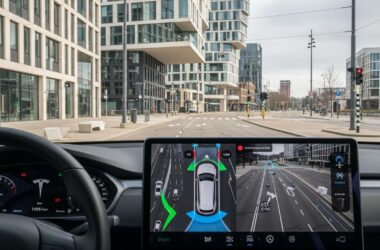


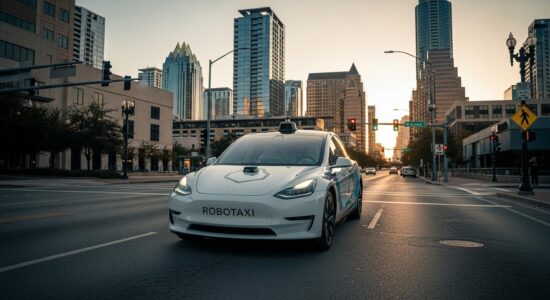
I’ve been following the supervisor-less Tesla Robotaxi revolution for months, and January 2026 marked a historic turning point: in Austin, Texas, the first autonomous vehicles are now operating without a safety driver on board. A world first for Tesla, which officially crosses the threshold of Level 4 autonomy.
But behind this spectacular announcement lies a much more nuanced real-world situation. After analyzing feedback from early users and available data, I invite you to discover the sometimes surprising gap between the promise and the actual experience. Spoiler: getting a true autonomous Robotaxi turns out to be much more complicated than expected.
The Historic Launch of Autonomous Robotaxis in Austin
Tesla has just reached a major symbolic milestone in the development of autonomous driving. Initially planned for late 2025, the removal of safety supervisors materialized in January 2026 – a delay of a few weeks that remains acceptable in the world of disruptive technologies.
What exactly has changed? Some vehicles are now operating in Austin with no human behind the wheel, relying solely on the Full Self-Driving (FSD) system. The autonomous deployment follows a gradual approach: first reserved for employees for internal tests, then gradually opened to the general public via the booking application.
Besoin d'accessoires pour ta Tesla ?
Looking for accessories for your Tesla?
This advancement contrasts sharply with the European situation. In France and the European Union, much stricter regulations make this type of deployment unthinkable in the short term. While Tesla experiments in Austin, we remain spectators of this revolution which, perhaps, will cross the Atlantic in a few years.
Let’s acknowledge the technical feat: operating vehicles without a supervisor in a real urban environment represents Tesla technology constantly pushing boundaries. But as often with cutting-edge innovations, initial enthusiasm needs to be tempered by real-world data.
The Real-World Situation: When Availability Becomes an Issue
David Moss’s Revealing Experience
David Moss is not a detractor; quite the opposite. This recognized influencer in the FSD community has accumulated over 10,000 miles with version 14 of the autonomous driving system. His expertise makes his testimony all the more significant.
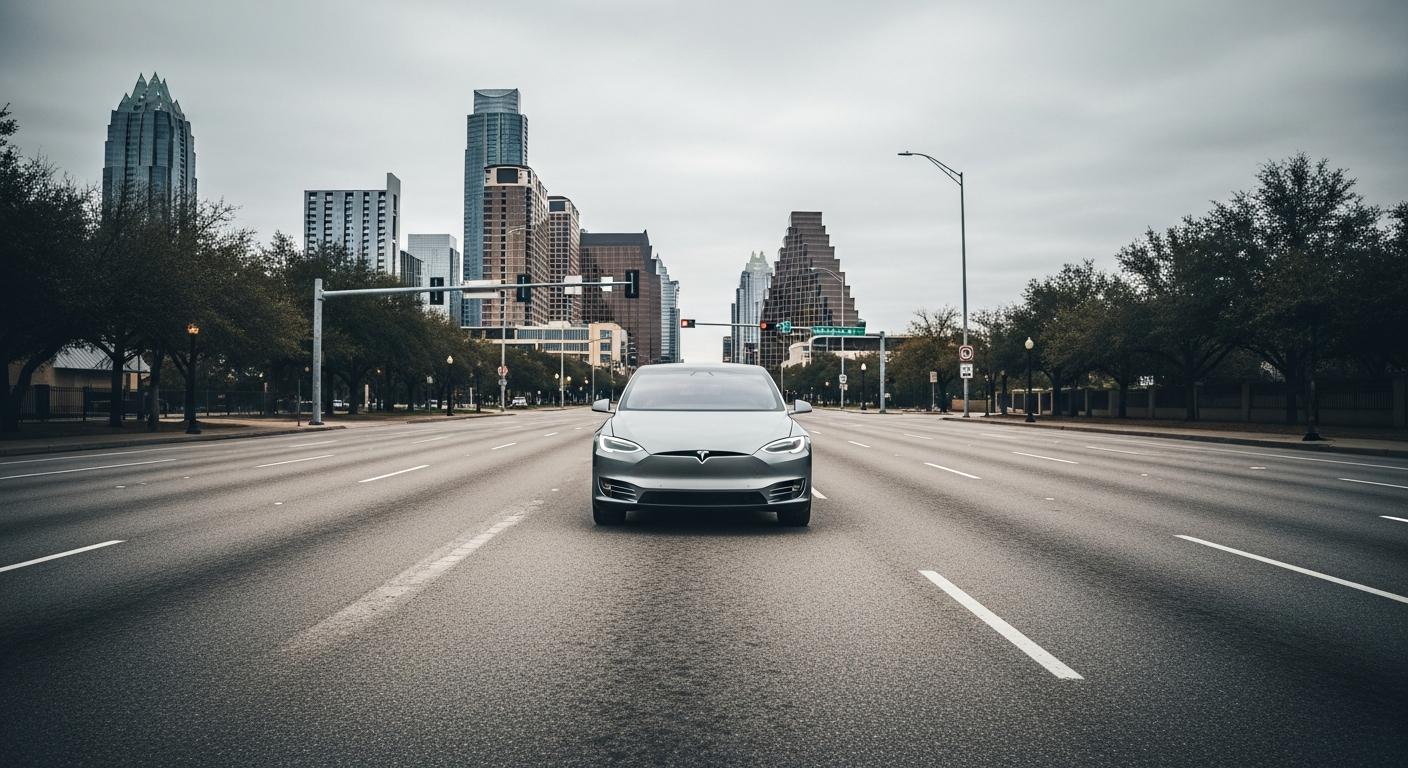
Over four days of intensive use of the Robotaxi app in Austin, David made 38 booking attempts. The result? Zero rides in a supervisor-less vehicle. Each time, a safety driver was present on board. A frustrating experience that perfectly illustrates the gap between the launch announcement and the actual limited availability.
An Imbalanced Supervised/Unsupervised Vehicle Ratio
The truth is that the fleet of truly autonomous Robotaxis can be counted on one hand. Of all the vehicles operating in Austin as part of the service, only “a handful” operate without a supervisor.
This imbalanced proportion mathematically explains why getting an autonomous vehicle is an uphill battle. For an average user opening the app, the probability of encountering one of the rare supervisor-less Robotaxis remains extremely low.
Tesla does not communicate precise figures on the exact number of autonomous vehicles in circulation. This opacity fuels legitimate questions from early adopters who expected a more massive deployment.
A Cautious and Deliberate Deployment Strategy
In response to questions, Ashok Elluswamy, Head of AI at Tesla, confirmed the approach: the deployment strategy deliberately prioritizes gradualness. The ratio of autonomous vehicles will increase gradually over the weeks and months.
This gradual ramp-up follows an undeniable logic: safety over volume. Each supervisor-less trip generates valuable data that helps refine algorithms, detect edge cases, and validate the system’s reliability in infinitely varied real-world conditions.
Personally, this caution seems not only justified but also responsible. A serious accident involving an autonomous Robotaxi could ruin years of development and permanently tarnish the technology’s image. Waymo, a direct competitor of Tesla in this field, has, moreover, followed exactly the same approach during its own deployments.
The stakes go far beyond Tesla: the credibility of an entire emerging industry is at stake in these first months of real-world operation. Even if this approach disappoints impatient users in the short term, it builds the foundations for sustainable deployment.
Impressive Performance in Extreme Conditions
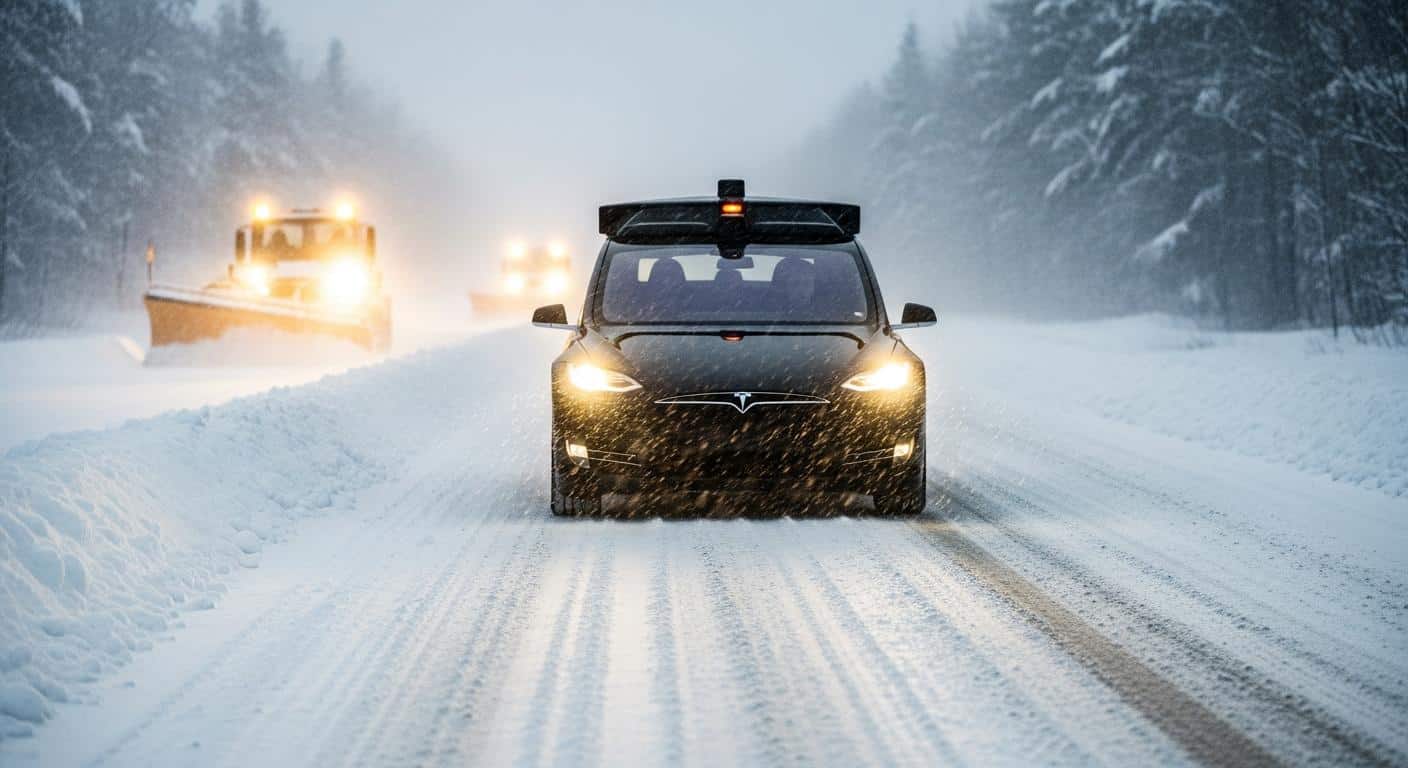
What if Tesla’s true show of strength occurred during an extreme weather event? In January 2026, Austin experienced an ice storm with temperatures dropping to 29°F (approximately -2°C). Extreme conditions that severely tested autonomous driving systems.
Result: Tesla Robotaxis continued to operate and provide service. At the same time, Waymo vehicles – equipped with lidar sensors reputed to be more performant – were withdrawn from circulation for safety reasons.
Besoin d'accessoires pour ta Tesla ?
Looking for accessories for your Tesla?
This performance validates a fundamental technological choice by Tesla: to rely solely on cameras and artificial intelligence rather than expensive lidar sensors. In degraded visibility conditions with black ice, freezing rain, and slippery roads, the FSD system proved its robustness.
This kind of real-world test is worth all the simulators in the world. For us, European readers accustomed to harsh winters, this resilience raises a fascinating question: how would this system perform on French or Swiss mountain roads in a full snow storm?
The Real Challenge: Moving from Technical Feat to Commercial Scale
Proving that a technology works and deploying it massively are two radically different challenges. Tesla has just validated the first; the second promises to be far more complex.
The scaling up raises multiple and interconnected questions:
- Production of dedicated vehicles in sufficient volumes (where the implications of global Tesla production play a crucial role)
- Maintenance and fleet management infrastructure
- Evolving regulatory framework and adoption by authorities
- Public acceptance and user trust management
The commercial viability also remains to be demonstrated. What economic model will make these fleets profitable? At what price will rides be offered to compete with traditional services while generating profits?
Tesla is working on the future of Tesla mobility accessible to all, but the timeline for the Robotaxis’ ramp-up remains unclear. Several years will probably be necessary before a truly significant deployment, even in the United States.
I observe this deployment with fascination and realism. Tesla has reached a major technical milestone in Austin, that’s undeniable. But between a few autonomous vehicles operating in a Texan city and a global network of Robotaxis transforming our daily mobility, the road remains long.
The current limited availability is not a failure: it’s a normal, even necessary, phase of responsible deployment. The coming months will tell if Tesla manages to accelerate this ramp-up while maintaining an impeccable level of safety. Meanwhile, it is crucial to follow recent industry developments to understand how this technology could evolve in different regulatory contexts.
And you, if the opportunity arose tomorrow, would you try the experience of a supervisor-less Robotaxi? While waiting for this technology to cross the Atlantic and adapt to our European roads, we remain privileged witnesses of a revolution unfolding in real-time, with its spectacular advancements and pragmatic limitations.
Profitez d'avantages exclusifs en achetant votre Tesla
Vous envisagez d'acquérir une Tesla ? En utilisant mon code de parrainage lors de votre achat, vous pouvez bénéficier d'avantages exceptionnels !
Des kilomètres gratuits de recharge ou d'autres récompenses exclusives, mon code de parrainage est votre passeport pour des avantages supplémentaires : https://ts.la/antoine49352 🤩
Pas de pression, juste une opportunité à saisir pour enrichir votre expérience Tesla.
Découvrez ici le système du parrainage et comment utiliser le code.
Get exclusive perks when buying your Tesla
Thinking about getting a Tesla? If you use my referral code when you purchase, you may be eligible for extra perks.
Free Supercharging miles or other exclusive rewards - my referral code can unlock additional benefits: https://ts.la/antoine49352 🤩
No pressure - just a simple option if you want to enhance your Tesla experience.
Learn how the Tesla referral program works and how to use the code.