

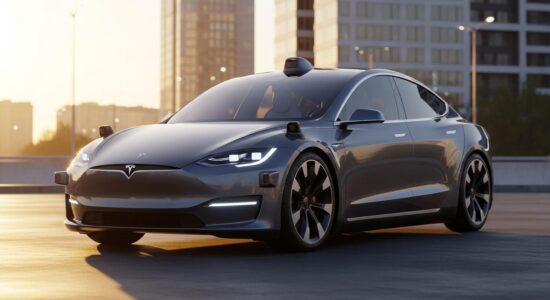
The world of autonomous mobility has just crossed a symbolic milestone: the first Tesla Cybercab has rolled off the lines at Gigafactory Texas. The announcement, shared by Tesla Korea on February 17 and 18, 2026 and then confirmed by Elon Musk on X, marks a concrete step toward bringing this revolutionary autonomous robotaxi to market. No steering wheel, no pedals, 100% driven by artificial intelligence: the Cybercab embodies Tesla’s boldest vision since the company was founded.
Unveiled with great fanfare in 2024, this radical vehicle had so far remained at the concept stage. With this first unit assembled in Austin and mass production announced for April 2026, Tesla is entering a decisive phase. But what does this breakthrough really change for the company, for urban mobility, and for us—Tesla owners or future users?
Austin marks a major milestone in Tesla’s history
It was through a viral post from Tesla Korea, accompanied by exclusive photos, that the world discovered the first Cybercab unit assembled in the Texas workshops. Elon Musk was quick to confirm the news on X, turning what could have been a simple leak into an official celebration.
Gigafactory Texas thus becomes the global birthplace of the autonomous robotaxi, cementing Austin as the epicenter of Tesla’s transformation. Because beyond being an automaker, the company is now positioning itself as a major player in AI and robotics applied to mobility.
Besoin d'accessoires pour ta Tesla ?
Looking for accessories for your Tesla?
Let’s be clear, though: this is a pre-production prototype, not volume manufacturing yet. The real assembly lines will officially start in April 2026, according to the announced schedule. This first unit is above all a technical and symbolic milestone: proof that the concept works and can be industrialized.
The Cybercab, a radical vehicle that breaks the mold
Design and engineering: welcome to the post-steering-wheel era
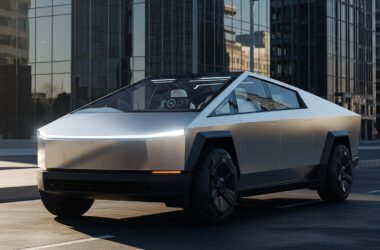
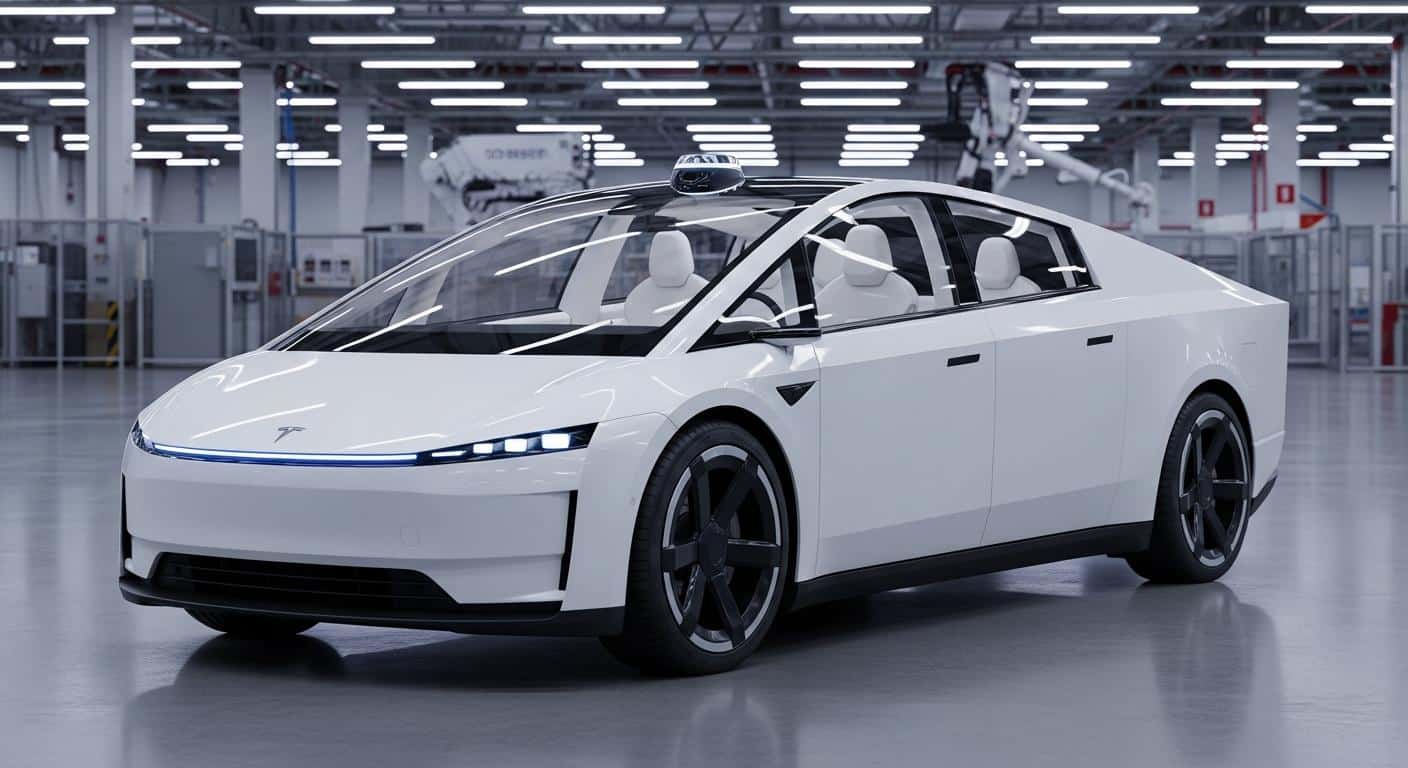
The Cybercab looks like nothing we’re used to. This two-seat cabin has no manual controls: no steering wheel, no pedals, no gear lever. Tesla is going all-in on its FSD (Full Self-Driving) system in a vision-based configuration—meaning it relies solely on cameras and artificial intelligence.
The design, true to the Cybertruck’s angular universe, follows a clear industrial logic: reduce mechanical complexity to lower manufacturing and maintenance costs. Fewer moving parts, less wear, fewer human interventions needed.
Against Waymo, Tesla is betting on pure vision
Unlike Waymo, the current market leader with robotaxis already operating in several US cities, Tesla refuses to equip its vehicles with expensive lidars and multiple sensors. The brand is betting everything on a camera system paired with ultra-high-performance AI.
The upside? Drastically lower costs and unmatched scalability. The risk? Harder regulatory and public acceptance. For now, Tesla is rolling out its autonomous robotaxi tests in a limited way, mainly in Austin and the Bay Area, with Model Y vehicles equipped with vision-based FSD.
April 2026: the production marathon begins
Elon Musk has confirmed April 2026 as the start date for Cybercab mass production. But given Tesla’s track record, I’d urge caution. The ramp-up will be gradual, following what Musk calls the “S-curve”: slow at first, then exponential once processes are dialed in.
Let’s remember that the recurring Roadster delays taught us to temper our expectations. The Cybertruck slipped by several years, and so did the Semi. Producing a robotaxi involves even stricter quality and safety constraints than a consumer vehicle.
My personal estimate? Meaningful volumes likely won’t be reached until 2027. But this first unit at least proves the project is moving forward in a tangible way, which wasn’t a given just a few months ago.
The “Unboxed” method: industrial revolution or promise in the making?
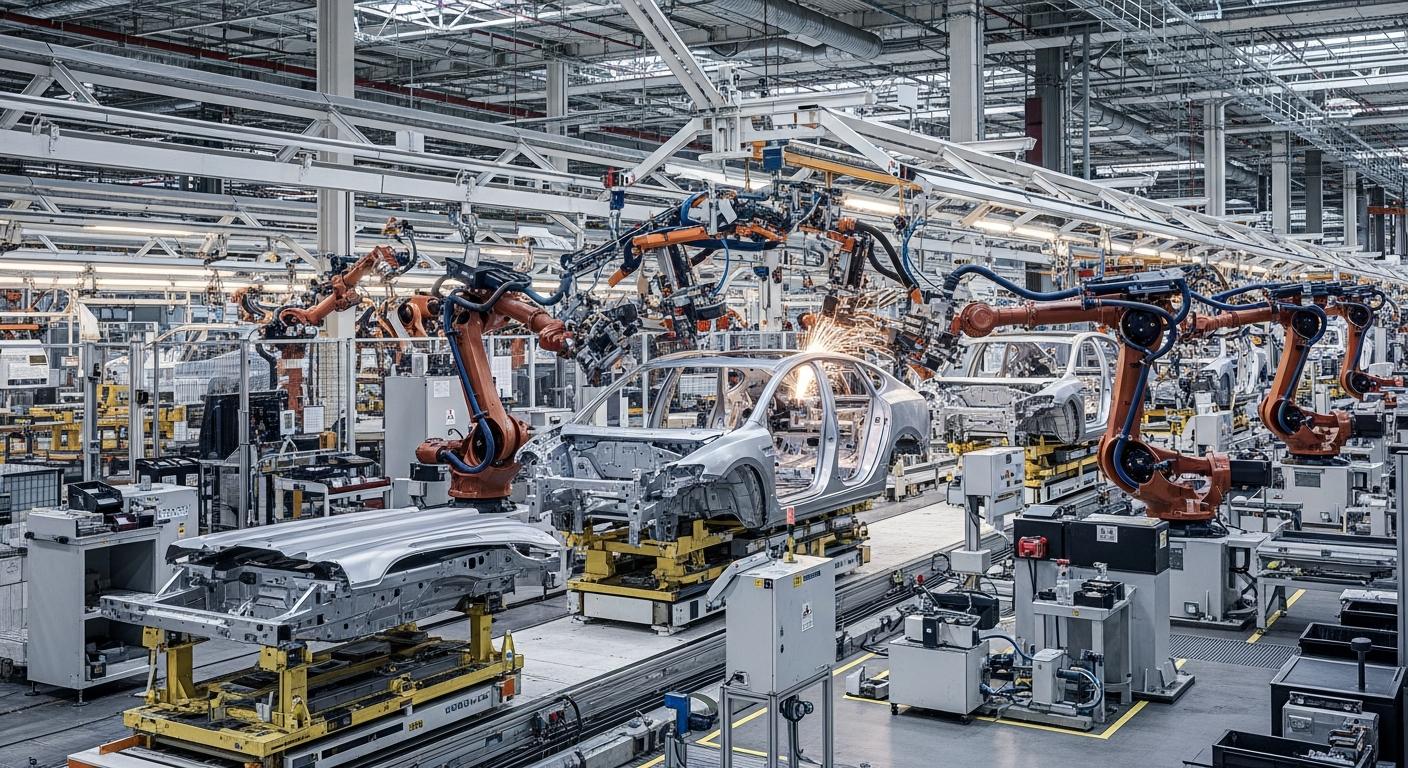
The Cybercab will be the first Tesla vehicle assembled using the Unboxed method, the revolutionary modular assembly process presented at Investor Day 2023. Unlike traditional lines where the vehicle moves sequentially, this approach makes it possible to assemble different modules in parallel before bringing them together.
The theoretical benefits are considerable: a smaller factory footprint, optimized production costs, faster throughput. But as with Teslas produced in China, the question of where production is localized raises major strategic issues in terms of efficiency and scalability.
It remains to be proven that this modular production will deliver on its promises at scale. The Cybercab will serve as a full-scale real-world test. If the method works, it could be rolled out across the entire Tesla lineup, including the $25,000 compact announced for the global market.
And for us in Europe? It will be a long road
Let’s be direct: don’t expect to see Cybercabs showing up on the streets of Paris or Brussels for several years. European regulation on autonomous vehicles is among the strictest in the world, and European type approval for a Level 4 or 5 system is a particularly complex obstacle course.
Beyond the legal framework, the necessary infrastructure still needs to be built: real-time up-to-date HD mapping, widespread 5G coverage, and adapted legislation in the event of an accident. Social acceptance is also a major cultural challenge in our European countries, which are traditionally more cautious about technological disruption.
Besoin d'accessoires pour ta Tesla ?
Looking for accessories for your Tesla?
In France, autonomous vehicle tests are underway, but the legal framework remains unclear. The relevant authorities are working to harmonize regulations, but the process takes time.
My realistic timeline for a rollout in Europe? Not before 2028–2030 at the earliest. The United States and China, with their more flexible regulatory approaches, will serve as testing grounds. We’ll watch, we’ll learn, and then we’ll adopt.
This first Cybercab unit rolling out of Austin is an important symbolic milestone in Tesla’s history. But let’s be clear-eyed: the road is still long before a large-scale rollout, even in the United States. For us, current Tesla owners in Europe, the immediate value lies mainly in watching how FSD evolves. The progress made on the Cybercab will ultimately benefit our Model 3, Model Y, and other vehicles in the lineup.
Elon Musk’s long-term vision is taking shape little by little, with spectacular bursts of speed and inevitable slowdowns. See you in April 2026 to follow the actual start of the production lines, and in the months that follow to gauge the reality of this long-awaited ramp-up.
Profitez d'avantages exclusifs en achetant votre Tesla
Vous envisagez d'acquérir une Tesla ? En utilisant mon code de parrainage lors de votre achat, vous pouvez bénéficier d'avantages exceptionnels !
Des kilomètres gratuits de recharge ou d'autres récompenses exclusives, mon code de parrainage est votre passeport pour des avantages supplémentaires : https://ts.la/antoine49352 🤩
Pas de pression, juste une opportunité à saisir pour enrichir votre expérience Tesla.
Découvrez ici le système du parrainage et comment utiliser le code.
Get exclusive perks when buying your Tesla
Thinking about getting a Tesla? If you use my referral code when you purchase, you may be eligible for extra perks.
Free Supercharging miles or other exclusive rewards - my referral code can unlock additional benefits: https://ts.la/antoine49352 🤩
No pressure - just a simple option if you want to enhance your Tesla experience.
Learn how the Tesla referral program works and how to use the code.