

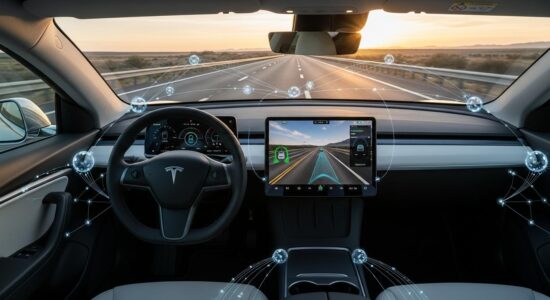
I still remember my surprise when I discovered the announcement on February 18, 2026: Tesla FSD crosses 8 billion miles in Supervised mode. A figure that is literally dizzying when you realize the scale of what it represents.
Between undeniable technical prowess and legitimate methodological questions, these data deserve serious attention. Especially since for us, French drivers, the situation is unique: FSD remains prohibited in Europe, but these billions of miles of experience are shaping the future of global autonomous driving.
So, let’s decipher these impressive figures together, with a critical but benevolent eye.
One billion miles in 7 weeks: the acceleration is spectacular
To fully appreciate the achievement, we need to put things into context. At the end of December 2025, Tesla announced it had surpassed 7 billion miles driven in FSD Supervised. Today, barely 7 weeks later, we’ve reached 8 billion.
Besoin d'accessoires pour ta Tesla ?
Looking for accessories for your Tesla?
An additional billion miles in less than two months. Let me show you how dizzying this exponential growth is:
- 2021: 6 million miles
- 2022: 80 million (×13 in one year)
- 2023: 670 million (×8)
- 2024: 2.25 billion (×3.4)
- 2025: 4.25 billion (×1.9)
- Early 2026: 8 billion
Several factors explain this incredible acceleration. First, the free FSD trials massively offered by Tesla to its customers. Then, the gradual expansion of the Robotaxi program which accumulates miles daily. And obviously, the natural increase in the fleet of equipped vehicles.
My analysis? Tesla is artificially creating urgency to reach 10 billion, that famous symbolic threshold Elon Musk has been talking about for months.
10 billion miles: marketing promise or real finish line?
What Elon Musk Says
In January 2026, Elon Musk clearly laid the groundwork: 10 billion miles would be the threshold for full unsupervised autonomous driving. According to his projections, Tesla should reach approximately 10 billion cumulative miles in 2026.
He often talks about the concept of the “long tail”: those rare, unpredictable scenarios that are precisely the most difficult for AI to master. The idea is that with enough data, even these extreme cases will be covered.
The crucial nuance I observe
Be careful, there’s a fundamental difference between miles driven in FSD and truly useful training data. Not all miles are equal:
- A straight highway in California ≠ a complex urban intersection in Boston
- A sunny day ≠ driving in snow or heavy rain
- Wide American roads ≠ our narrow European streets
My main question: do these 10 billion include enough diversity of situations? Because when it comes to artificial intelligence, what really matters are varied scenarios, not just raw volume.
Moreover, Teslas manufactured in China, which also accumulate FSD data, bring interesting geographical diversity, even if this data remains highly concentrated in North America.
Impressive safety statistics… provided you read them carefully
Tesla has published its official figures for the last 12 months in North America, and they are indeed impressive:
- FSD Supervised: 1 major collision every 5.3 million miles
- Tesla with active safety systems: 1 collision/2.17 million miles
- Tesla without active safety: 1 collision/855,000 miles
- U.S. average: 1 collision/660,000 miles
Concretely, with 8 billion miles in FSD, we’re talking about approximately 830 total collisions, compared to 16,131 in manual driving with assistance. My first thought: it is indeed 2.4 times safer than conventional assisted driving.
But wait, let’s dig a little deeper. My immediate critical reading raises several questions:
- Who uses FSD? Probably more attentive, tech-savvy drivers who actively monitor the system
- On which roads? Mostly highways? Dense urban areas?
- Under what real-world conditions? Is mild weather overrepresented?
- What is the average duration before human intervention?
The comparison with the American average shows a ratio of 8 times safer, but this national average includes distracted, intoxicated drivers on dangerous roads. The context changes everything.
What these figures don’t tell us (and it’s the most important thing)
The methodological biases I note
As a careful observer, several methodological biases jump out at me:
Besoin d'accessoires pour ta Tesla ?
Looking for accessories for your Tesla?
- Selection bias: FSD users are early adopters, statistically more cautious and attentive
- Geographical bias: almost exclusively North American data, on specific infrastructures
- Situational bias: is FSD deactivated in situations deemed too complex?
- Absence of audited data: Tesla remains judge and jury in the evaluation
The European question (which concerns me directly)
This is the point that really affects us: FSD remains prohibited in France and in most European countries. European regulations are much stricter and require full homologation.
Our European infrastructure is fundamentally different:
- Much narrower roads
- Different signage depending on the country
- Roundabouts omnipresent (almost non-existent in the USA)
- Pedestrians and cyclists much more integrated into urban traffic
My strong opinion: these 8 billion guarantee NOTHING for Europe. Let’s wait to see the tests on our roads before celebrating prematurely.
My verdict: an undeniable technical achievement, but let’s remain clear-headed
Let’s be clear: 8 billion miles is absolutely colossal. Tesla is accumulating an incomparable data competitive advantage over the competition. The pure vision approach (without LiDAR) is truly starting to show its results, and it’s impressive.
This advantage will also be found in future models, such as the future $25,000 Tesla compact that will benefit from this mature technology, or the future Tesla Roadster that will natively integrate the most advanced FSD.
BUT: beware of marketing numbers. My concrete expectation is to see:
- Data audited by an independent body
- True transparency on usage contexts
- Tests in European real-world conditions
For us, French Tesla owners, we observe with interest, but we remain spectators for now. The real question becomes: can Tesla convince European regulators with Tesla’s official data?
One thing is certain: I will be following the evolution towards 10 billion very closely. See you in a few months to see if this magic threshold truly delivers on its promises.
Profitez d'avantages exclusifs en achetant votre Tesla
Vous envisagez d'acquérir une Tesla ? En utilisant mon code de parrainage lors de votre achat, vous pouvez bénéficier d'avantages exceptionnels !
Des kilomètres gratuits de recharge ou d'autres récompenses exclusives, mon code de parrainage est votre passeport pour des avantages supplémentaires : https://ts.la/antoine49352 🤩
Pas de pression, juste une opportunité à saisir pour enrichir votre expérience Tesla.
Découvrez ici le système du parrainage et comment utiliser le code.
Get exclusive perks when buying your Tesla
Thinking about getting a Tesla? If you use my referral code when you purchase, you may be eligible for extra perks.
Free Supercharging miles or other exclusive rewards - my referral code can unlock additional benefits: https://ts.la/antoine49352 🤩
No pressure - just a simple option if you want to enhance your Tesla experience.
Learn how the Tesla referral program works and how to use the code.