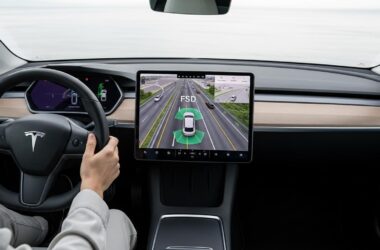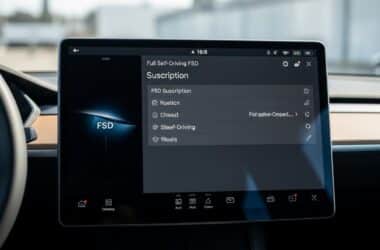


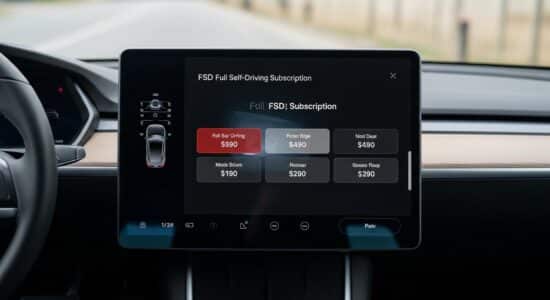
Tesla just crossed a decisive milestone this weekend, February 15–16, 2026. The brand has permanently removed the option to buy Full Self-Driving (FSD) in the United States. From now on, only a $99/month subscription gives access to this autonomous driving technology. This strategic decision comes in a specific context: the current adoption rate is only 12% among owners—far below Elon Musk’s targets, since part of his compensation depends on that rate. In response, the Tesla community isn’t staying quiet and has put forward no fewer than 4 alternative pricing models. I analyzed these proposals to understand what Tesla owners really expect from Tesla when it comes to pricing.
Tesla removes the one-time purchase of FSD in the United States
Official confirmation came this weekend: Tesla is ending the lifetime purchase option for Full Self-Driving. This decision marks a radical shift in the brand’s commercial strategy.
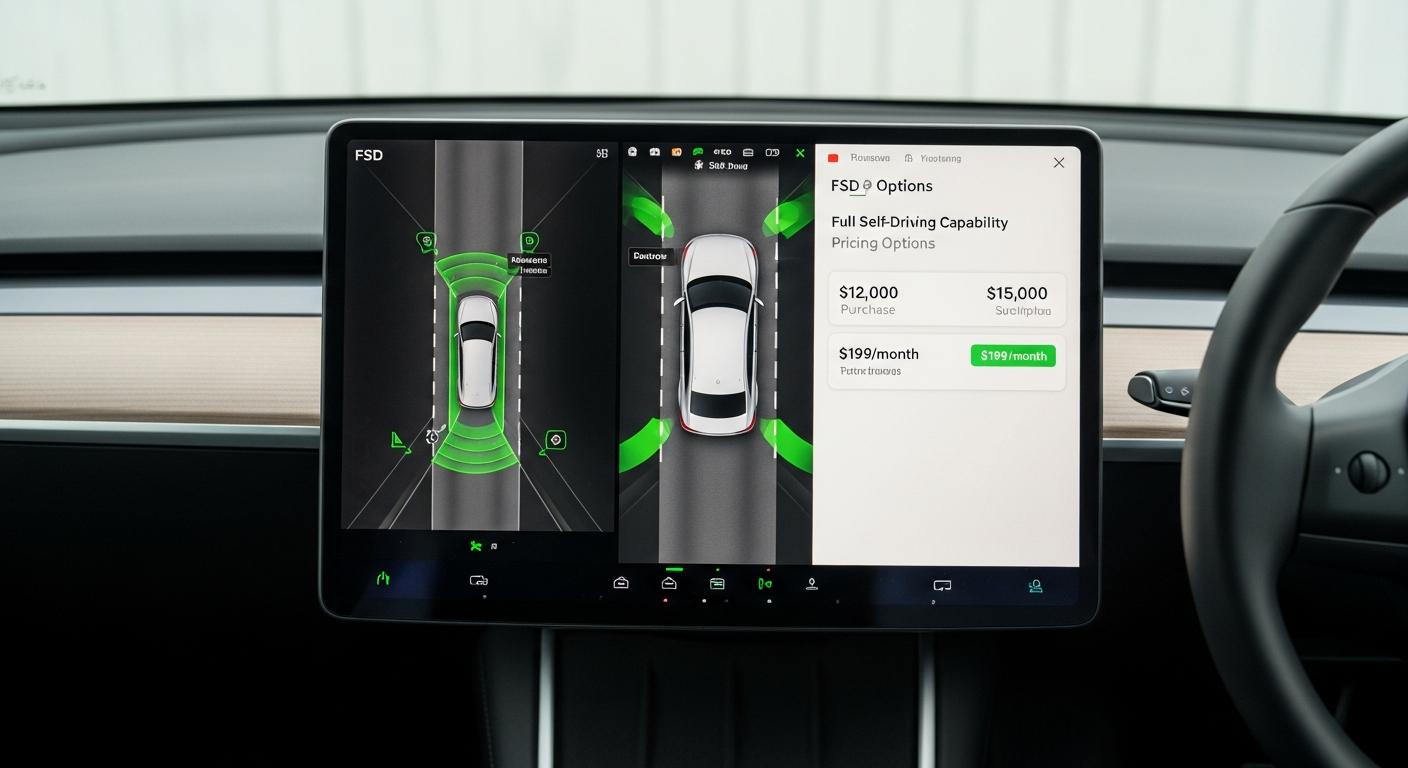
In practical terms, new buyers no longer have a choice: they must sign up for a subscription-only model billed at $99/month (around €92/month at the current exchange rate). Tesla is clearly betting on recurring revenue rather than one-off payments, even if a few exceptions remain for specific cases such as vehicle transfers.
In Europe, the situation is broadly similar, even if subscription terms can vary slightly by market. The immediate impact is clear: it’s now impossible to pay once and own this technology for good. This shift forces owners to rethink their relationship with FSD and its true long-term cost.
Besoin d'accessoires pour ta Tesla ?
Looking for accessories for your Tesla?
Tesla’s pricing dilemma: profitability vs mass adoption
The number speaks for itself: only 12% of owners have subscribed to the $99/month plan. With several million Teslas on the road worldwide, the revenue potential is still colossal.
This low adoption rate isn’t just a minor commercial detail. It directly affects Elon Musk’s compensation targets, with a significant portion of his pay tied to widespread FSD adoption among owners. The paradox is obvious: a high price leads to low adoption, which ultimately limits total revenue.
Let’s ask the strategic question: is it better to have 12% of users at $99 or 40% at $49? With 1 million vehicles, the first scenario brings in $11.88M/month, the second $19.6M/month. The math is clear.
This situation is reminiscent of subscription services like Netflix or Spotify, which found their balance between price and volume. For Tesla, the stakes are even higher with the imminent arrival of the Cybercab in April 2026, a fully autonomous vehicle that will rely 100% on FSD. The pressure is on to quickly find the right pricing balance. And the community has no shortage of ideas.
Four pricing models proposed by Tesla owners
The Tesla community has mobilized massively to imagine alternatives to the current model. Four main categories of proposals clearly emerge from the discussions. I analyzed each one to assess its relevance and feasibility.
A simple price cut
The most straightforward approach is simply to lower the monthly subscription. The main proposal centers around $49/month (around €45/month), i.e., half the current price. Some even suggest $69/month as a nod to Elon Musk’s signature sense of humor.
The benefits are undeniable: maximum simplicity and immediate affordability for a broad user base. The downside? Such a drastic drop could devalue the perceived worth of the technology and make it feel less premium. My review: it’s effective, but perhaps too simplistic to reflect FSD’s real complexity.
Tiered pricing: Supervised/Unsupervised
This two-tier system is based on the vehicle’s real-world autonomy. On one side, FSD Supervised (the current version requiring human supervision) would be billed at $50/month. On the other, FSD Unsupervised (full autonomy to come) would jump to $300/month, insurance included.
The logic is rock-solid: you pay based on how much responsibility is truly transferred to the vehicle. This approach makes perfect sense with the arrival of the Cybercab, which will operate with no pedals or steering wheel. A premium price is justified when the technology genuinely lets you do without a driver entirely. My analysis: it’s coherent, but everything depends on regulatory timing and the actual availability of Unsupervised mode.
Pricing based on commitment length
Inspired by gyms or streaming platforms, this model offers maximum flexibility:
- Day pass: around $10 for road trips or occasional use
- Weekly pass: around $30 for vacations or temporary travel
- Monthly subscription: $99 kept for those who want full flexibility
- Annual subscription: $999 (around $83/month with a one-year commitment)
This approach matches very real use cases: the long weekend, monthly business trips, or simply wanting to try before committing. From my personal driving experience: I’d definitely use the day pass for my occasional long trips where FSD adds real value, without paying all year for a feature I don’t use every day.
The modular feature-based model (the most popular)
This is the proposal generating the most enthusiasm: modular pricing that lets you choose only the functions you actually use.
- Supervised base + Autopark: $50/month
- Add Summon: $75/month total
- Add Navigate on Autopilot: $90/month
- Full pack: $99/month (as it is today)
The logic is simple and powerful: pay only for what you use. In the city, I personally mostly use Autopark and Summon to park in tight spaces, but I use Navigate on Autopilot much less. Why pay full price for features you barely use?
Besoin d'accessoires pour ta Tesla ?
Looking for accessories for your Tesla?
This popularity comes from the sense of control and customization it provides. Owners could even adjust their subscription depending on the season or changing needs. This flexibility to fine-tune the driving experience with tailored shortcuts perfectly matches Tesla’s tech DNA.
The technical challenge for Tesla remains managing software activations and deactivations, but it’s absolutely doable. My clear-cut review: it’s the smartest model, even if it’s more complex to implement than a simple price cut.
Ultimately, each model addresses different needs and user profiles. The real question is: which one will Tesla choose?
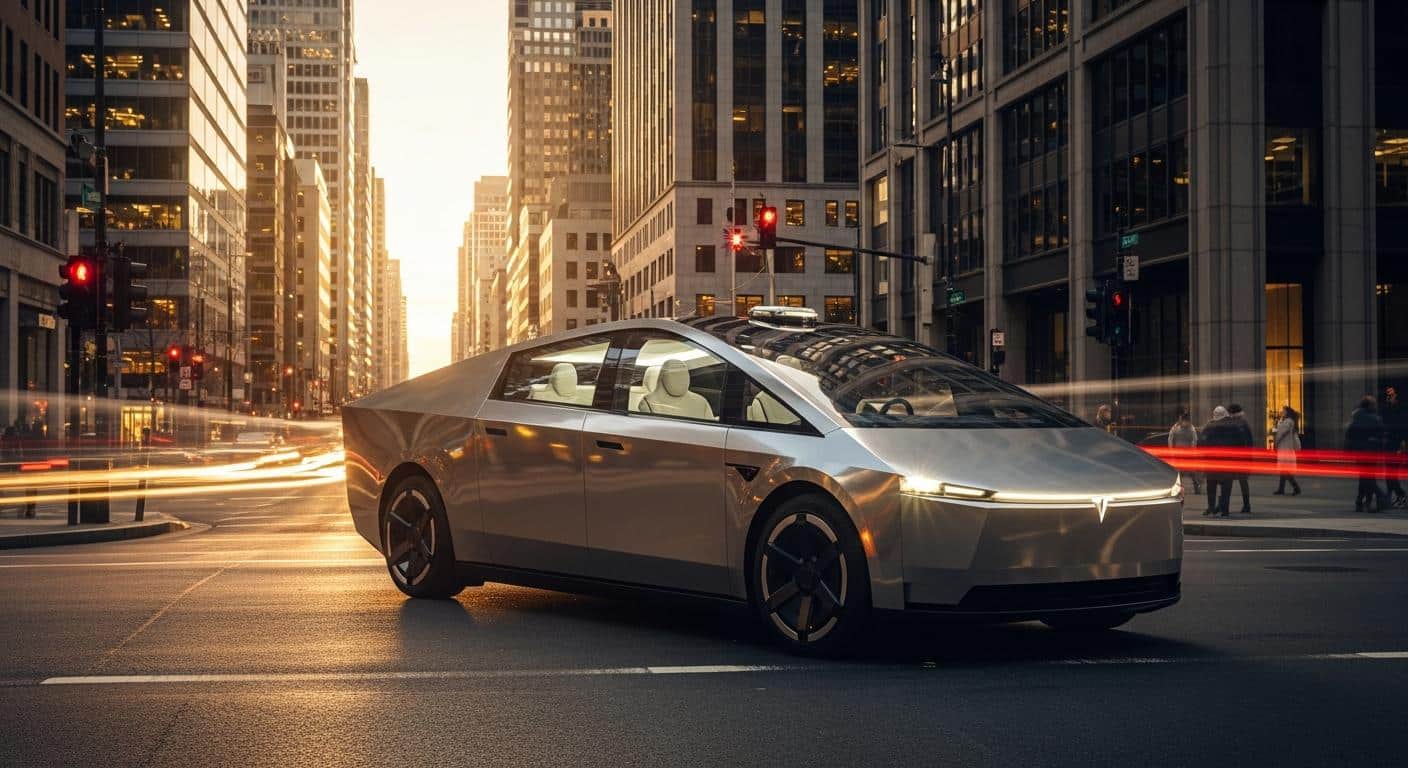
The Cybercab arrives in April 2026: a turning point for the FSD ecosystem
Elon Musk has confirmed it three times in six months: the Cybercab will arrive in April 2026. This vehicle represents a radical break with no pedals or steering wheel, which means it will have to operate in Unsupervised mode from day one.
This deadline transforms FSD: from a premium option, it becomes the very core of the product. The regulatory and technological pressure is immense, and Tesla and its sometimes optimistic production timeline announcements have taught us to be cautious about deadlines.
But if the Cybercab delivers on its promises, it may justify the $300/month premium price in Unsupervised mode. Even more, it opens the door to a full ecosystem where Tesla becomes a true robotaxi company. The burning question for current owners: will we be able to rent out our own vehicle on this network? With the arrival of more affordable new Tesla models, the brand’s broader strategy to democratize its lineup is taking shape.
Discussions around FSD pricing take on a new dimension in light of the expected developments in the autonomous driving sector in Europe.
Tesla has removed the option to buy FSD, and the community is responding with impressive creativity. I honestly find these proposals smarter than the current $99 strategy that convinces only 12% of owners. And you—what pricing model would make you take the plunge? The day pass to try it out? The modular model to pay only for what you use? Or simply a price cut? Feel free to share your review in the comments or on social media. One thing is certain: with the Cybercab arriving in two months, Tesla will have to decide quickly.
Profitez d'avantages exclusifs en achetant votre Tesla
Vous envisagez d'acquérir une Tesla ? En utilisant mon code de parrainage lors de votre achat, vous pouvez bénéficier d'avantages exceptionnels !
Des kilomètres gratuits de recharge ou d'autres récompenses exclusives, mon code de parrainage est votre passeport pour des avantages supplémentaires : https://ts.la/antoine49352 🤩
Pas de pression, juste une opportunité à saisir pour enrichir votre expérience Tesla.
Découvrez ici le système du parrainage et comment utiliser le code.
Get exclusive perks when buying your Tesla
Thinking about getting a Tesla? If you use my referral code when you purchase, you may be eligible for extra perks.
Free Supercharging miles or other exclusive rewards - my referral code can unlock additional benefits: https://ts.la/antoine49352 🤩
No pressure - just a simple option if you want to enhance your Tesla experience.
Learn how the Tesla referral program works and how to use the code.